City story · Amsterdam · 7 min read
Amsterdam Murals: Street Art Beyond the Canals
Most visitors come for the canals and the gabled houses, but Amsterdam also paints. Tall apartment blocks, school walls, utility boxes and old industrial buildings carry some of the best work in the city. A slow tour of the Amsterdam murals worth a detour.
Start in the Bijlmer
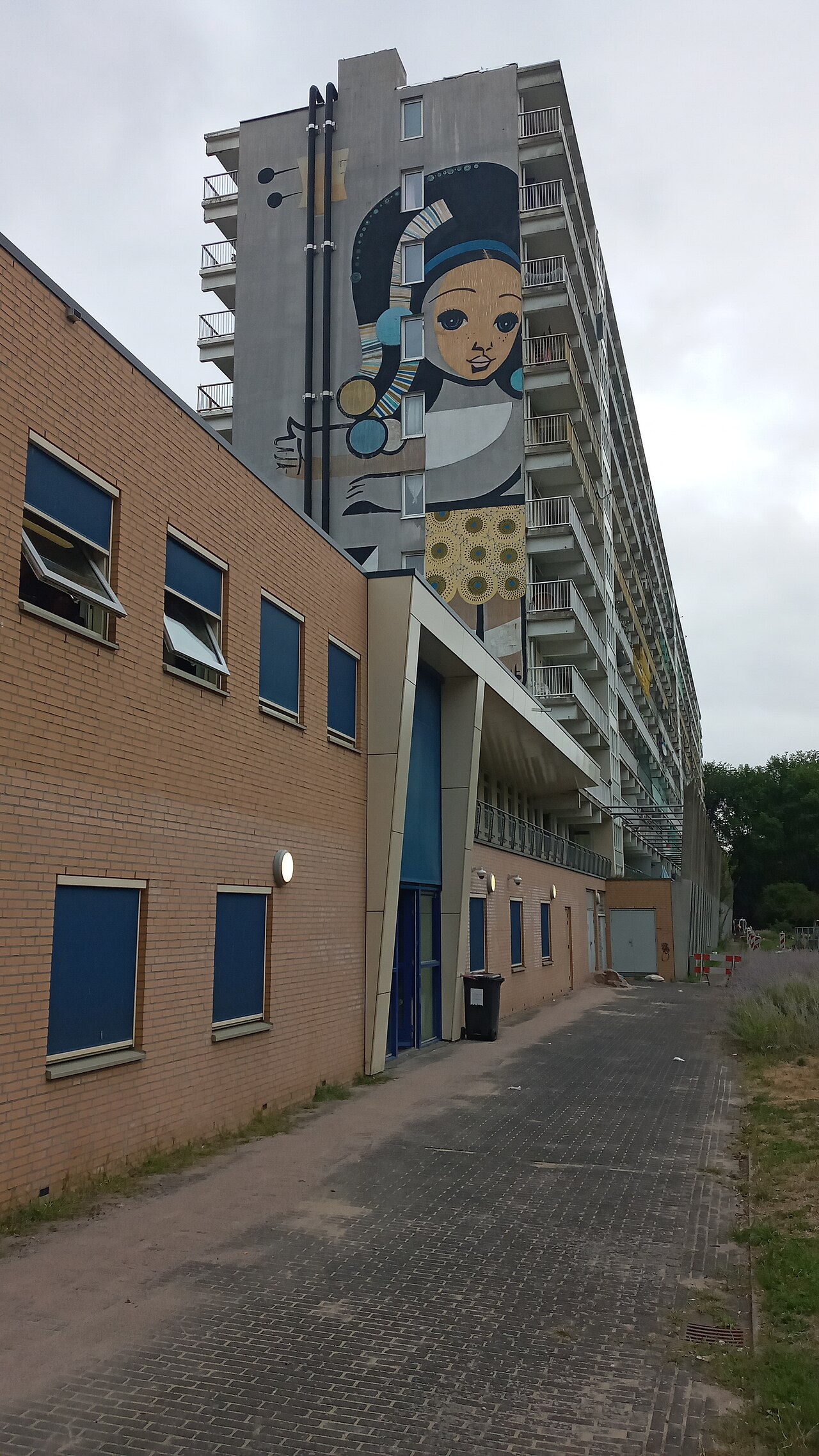
The best first stop for Amsterdam murals is a tall one. In the Bijlmer, in the south-east of the city, a girl with a dark headdress and wide, calm eyes looks out from the end wall of an apartment block. The photographer's description names the artist as Speto, and the scale is the point: the portrait rises up the whole gable, far above the low brick building in front of it.
It is a good example of what a mural does for housing. A plain concrete end wall, the kind nobody looks at twice, becomes the thing people give directions by.

Oost: a family on bicycles
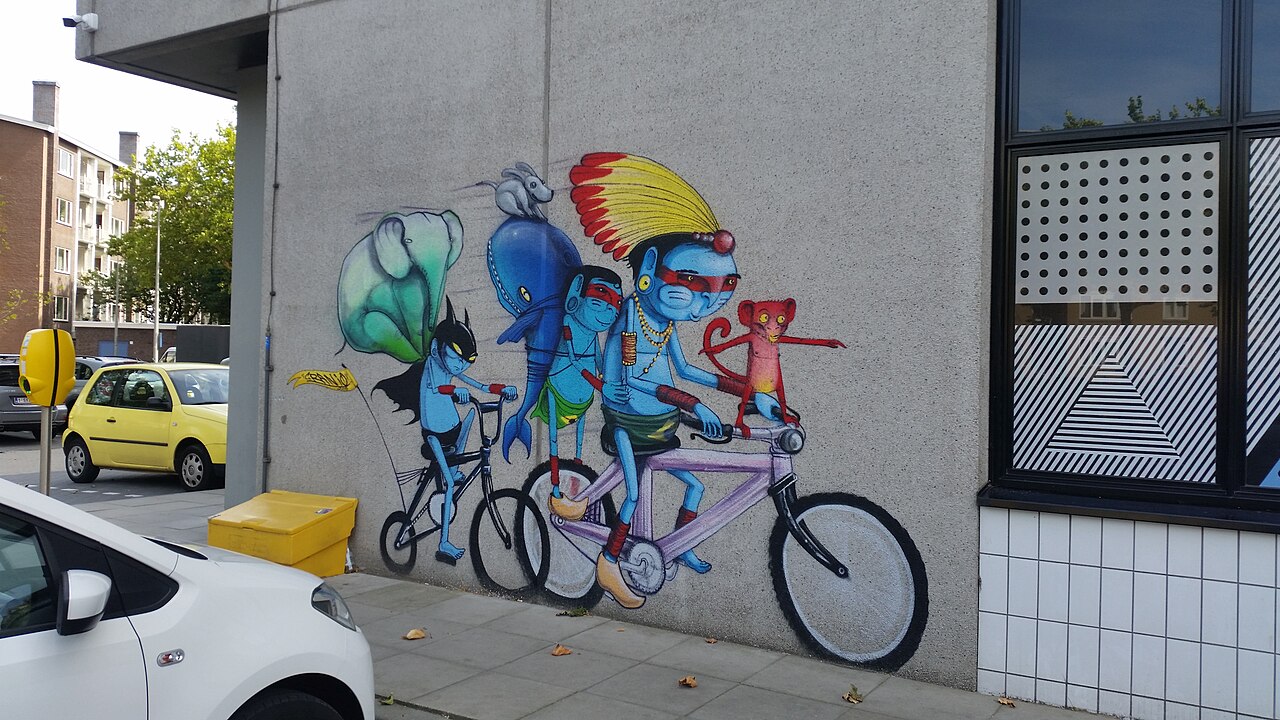
Back toward the center, on Vrolikstraat in the east, a corner of grey concrete has been turned into a story. Blue figures ride bicycles together: one in a tall feathered headdress, one in a bat-eared mask, with a whale, a rabbit and a red monkey along for the ride. The photographer notes that the wall is the work of a Brazilian street artist, and the signature on the wall reads Cranio.
Nothing about the picture is realistic, and that is why it works. It is playful, easy to read from a passing car or bike, and it makes the street feel like somebody's neighborhood.

NDSM and Noord
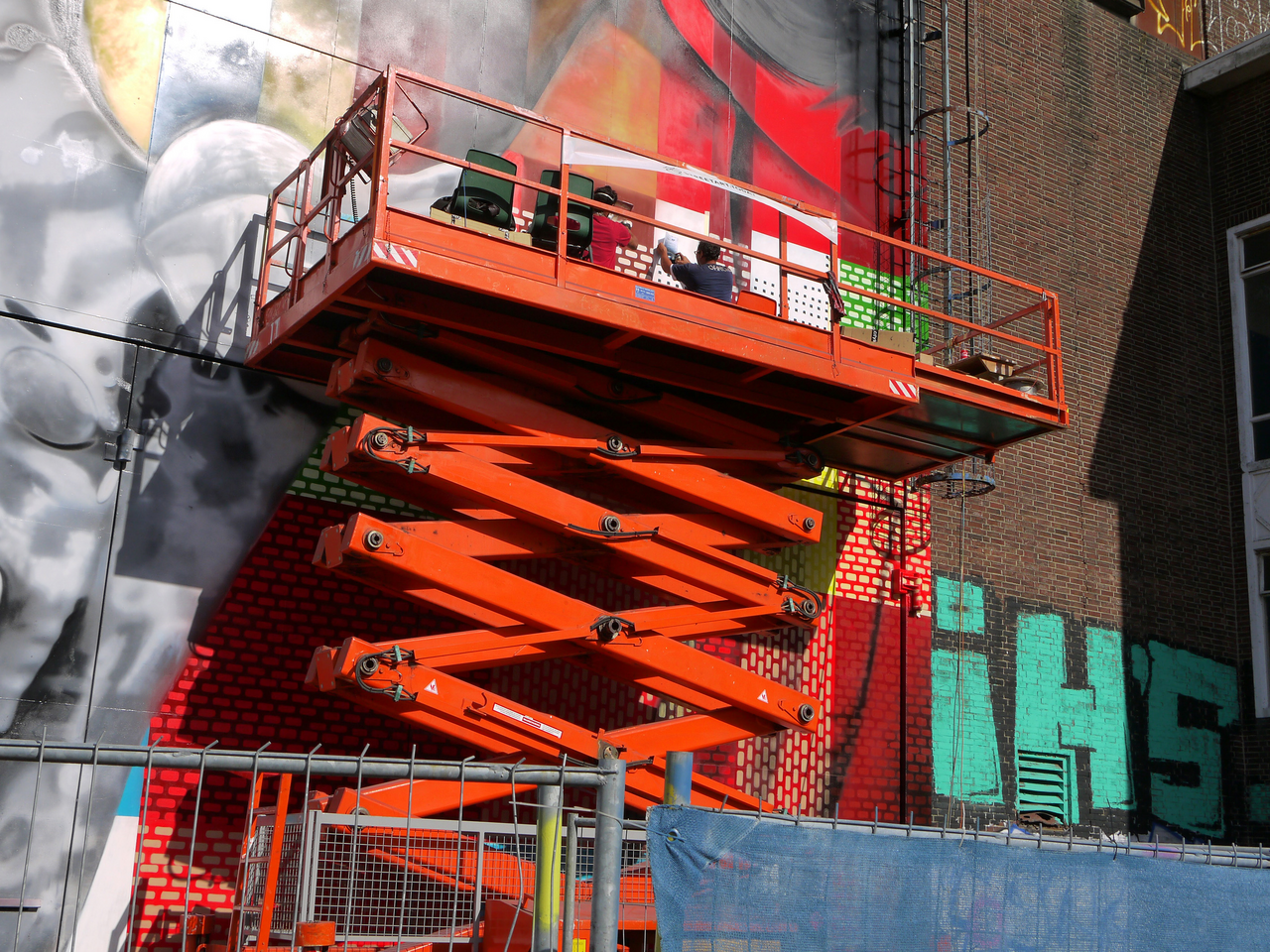
Take the free ferry across the IJ to Amsterdam-Noord and the scale changes again. The NDSM site, a former shipyard, is crowded with large walls, hoardings and containers, and it is one of the best places in the city to see painters at work. In the photograph, two people stand on a scissor lift high against a brick wall, a huge gray face taking shape beside them, while bright blocks of red and turquoise fill in the rest of the surface.
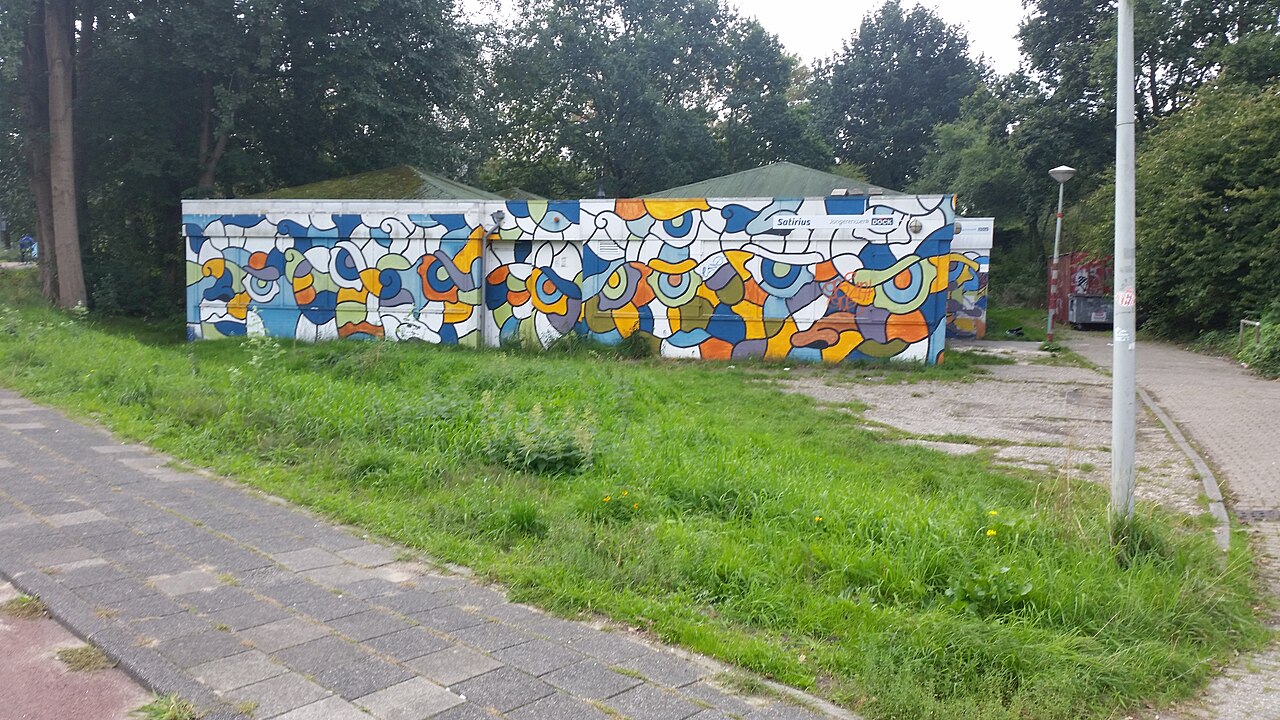
A few streets away, the youth center on Meteorenweg wears a coat of swirling blue, orange and yellow shapes with eye-like forms scattered through them. It sits in a green park, and the paint makes a plain low building into something you notice from the path.


A Keith Haring wall by the Markthallen
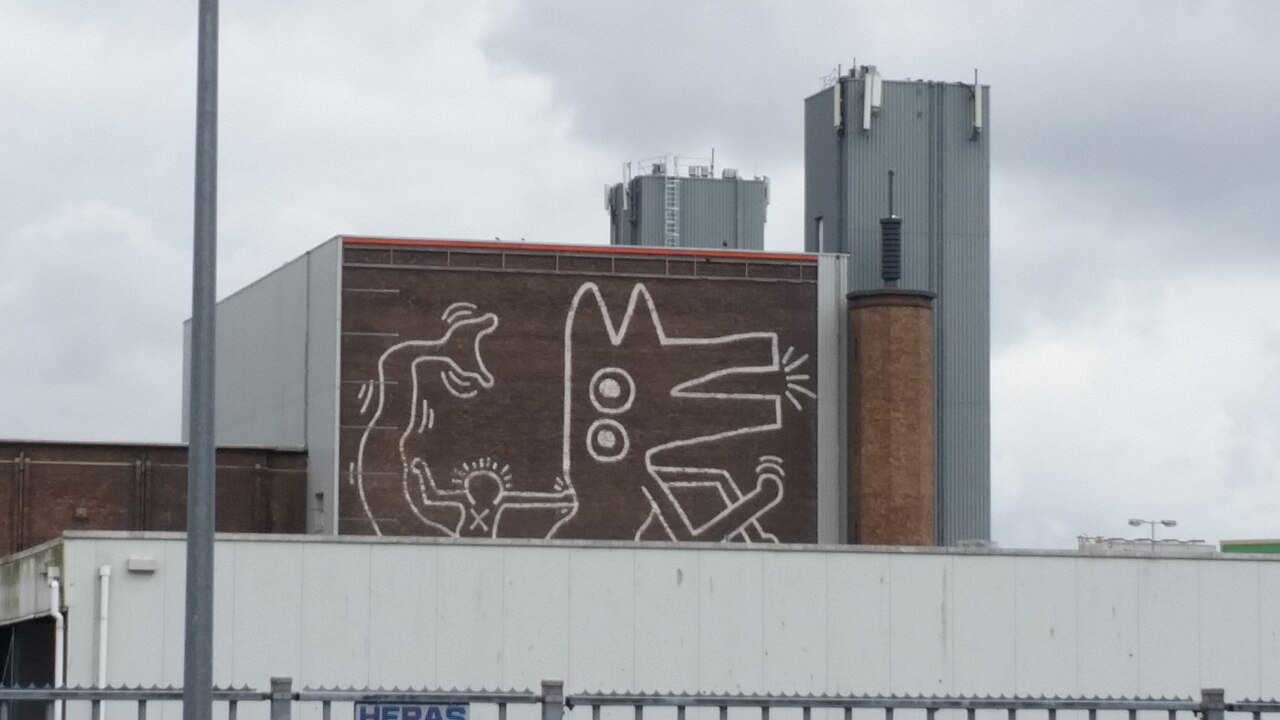
In the west, on a brick industrial building at the Markthallen, simple white lines make a large drawing: a barking dog-like creature on the right and a small figure on the left. The photographer's description credits the wall to Keith Haring. Seen across the water, it is a reminder that a mural does not need color to carry. A few confident lines, painted big on a dark wall, are enough to be seen from far away.
The wall is on an industrial edge of the city rather than a main street, so it rewards the walk. Give yourself time to look at it from a distance as well as up close.

The Spuistraat and the old center
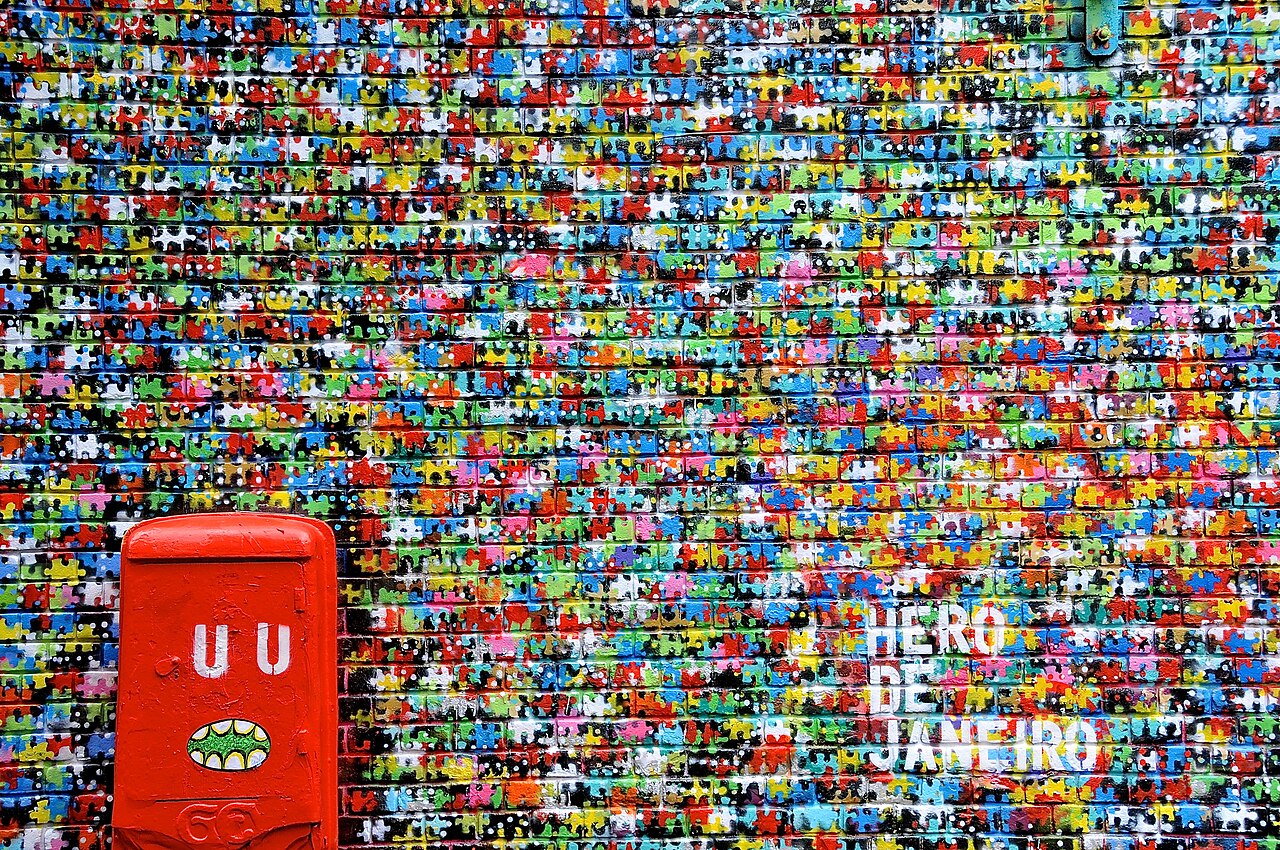
Even in the historic center, walls get painted. On the Spuistraat, a whole brick wall is covered in tiny puzzle-piece shapes in red, blue, yellow, green and pink, and the name Hero de Janeiro is painted at the lower right. A red utility box with a small green grin sits at the bottom left of the wall, and it looks as if it was always part of the picture.
Look closely and the wall changes: from across the street it is a field of color, and up close every brick has its own small piece. That kind of patient detail is why people stop in the middle of a busy street to take a photo.

Zuid: lettering as a wall
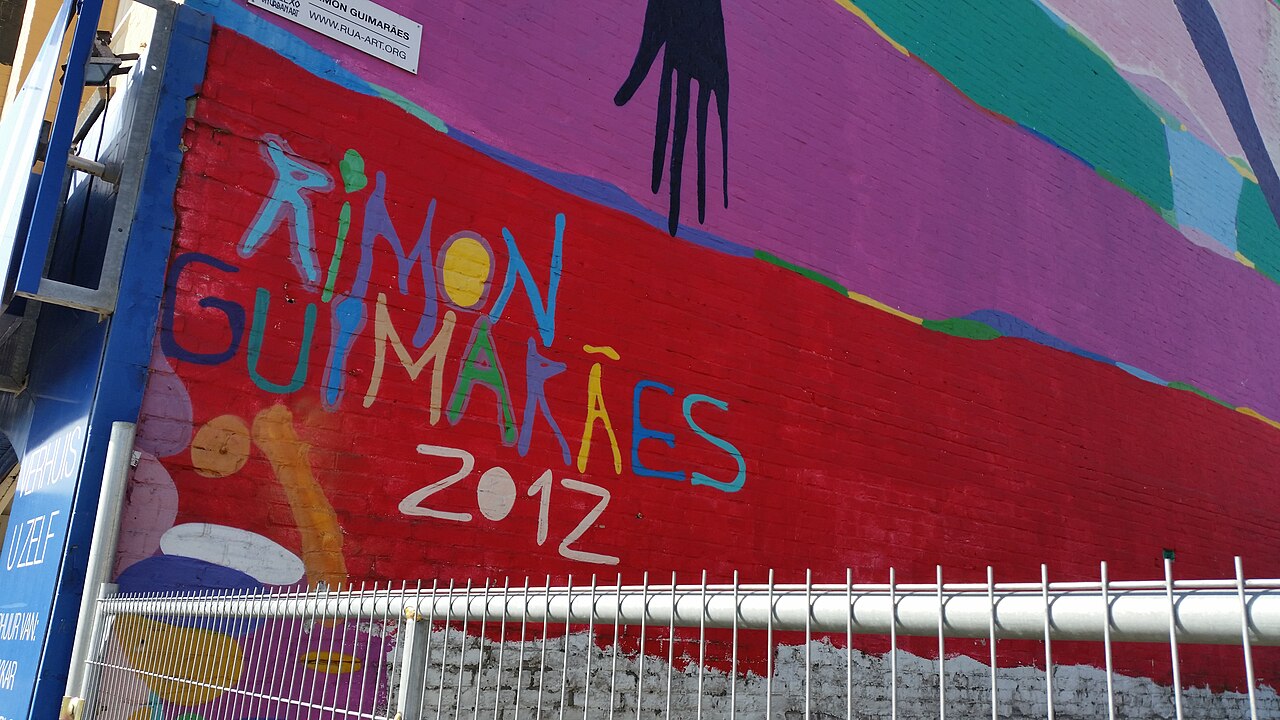
On Havenstraat in the south of the city, a red brick wall carries a name rather than a picture. Hand-painted letters in blue, green, yellow and white spell out Rimon Guimarães and the year 2012, set below a band of purple and green and a dark hand reaching down from above. The artist's name and the date are right there on the wall, as in the old tradition of signing a painting.
It is a good reminder that a mural can be quiet. Not every wall needs a face or a scene; a bold color field and a few loose letters can do the job.

Nieuw-West: portraits for the neighborhood
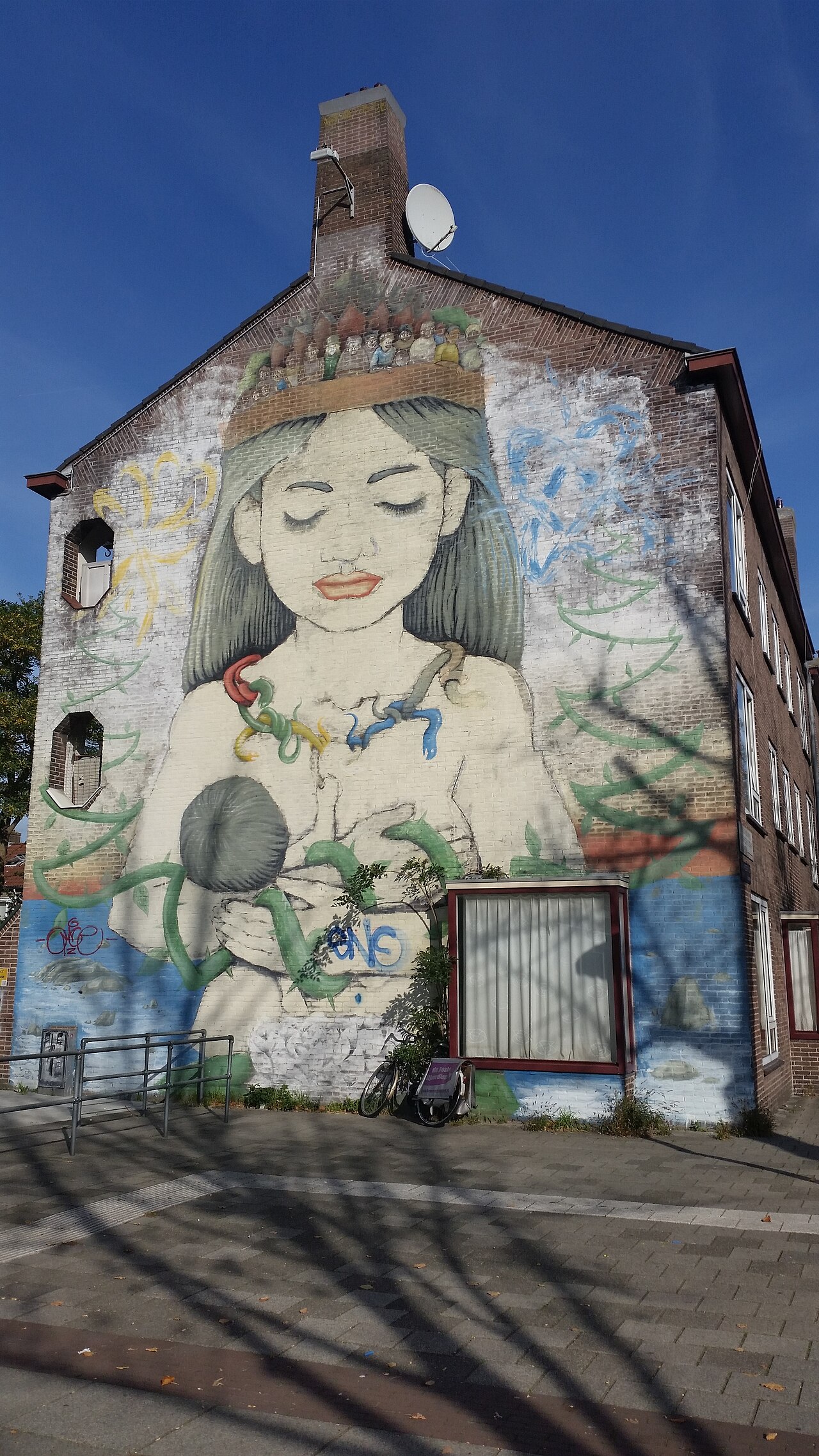
Some of the most moving murals in Amsterdam are far from the tourist routes. In Slotermeer, a gable end holds a girl with closed eyes and a crown of tiny people, holding a ball of yarn while green vines wind around her. According to the photographer, the wall is titled Tolerance, was painted by the Argentine artist Alaniz, and refers to tolerance between the generations who live in the neighborhood.
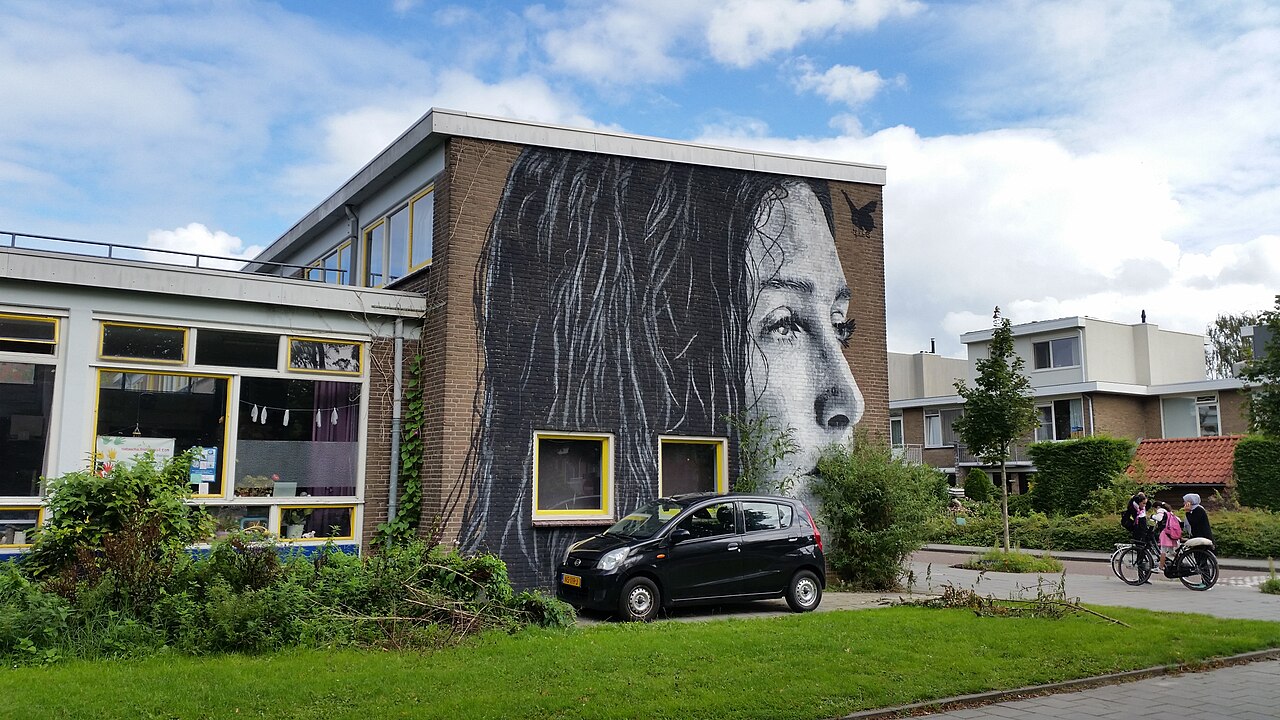
Not far away, a school building has a large black-and-white portrait of a woman in profile, her long hair running down the brick. The photographer names the artist as Nils Westergard. Both walls are painted at the scale of the building they sit on, and both make a calm, residential street feel looked after.


Small walls, big difference
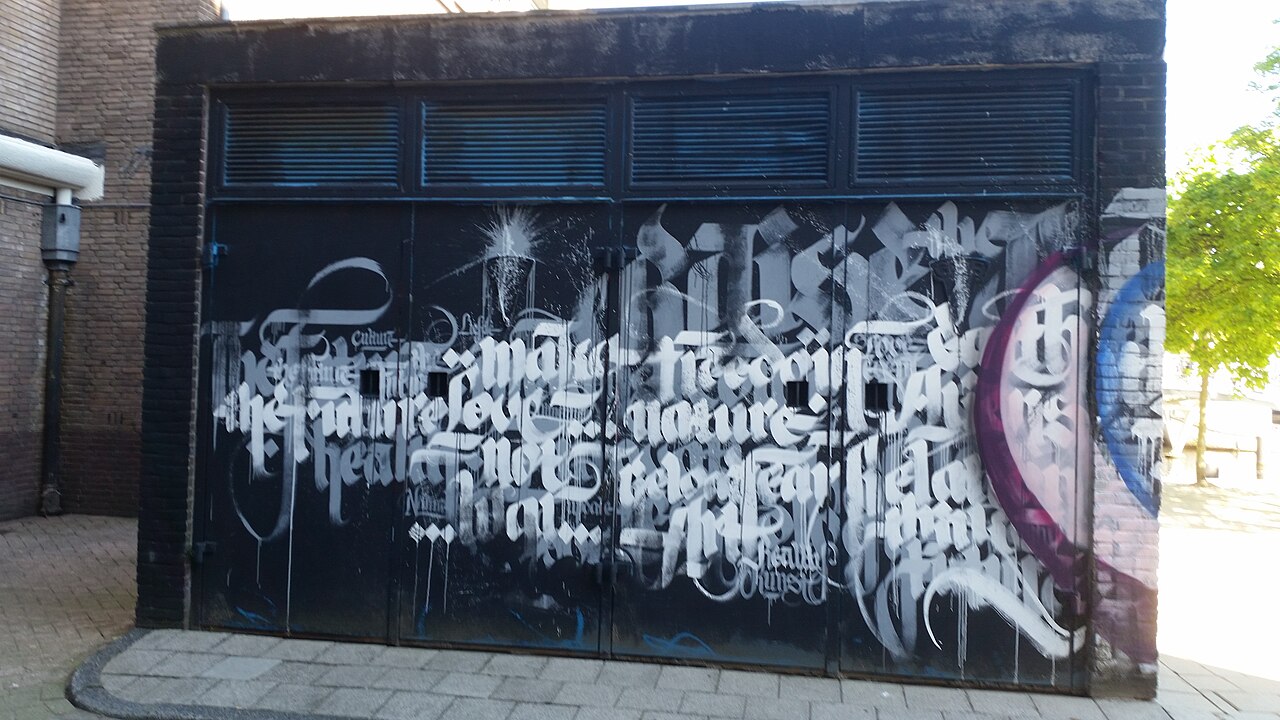
Not every mural is a gable. Near the Constantijn Huygensstraat in Oud-West, the doors of a dark brick utility building are covered in sweeping white calligraphy, layered so densely that the letters become texture. It is one more way a small, forgotten surface can become something people slow down for.
That is a useful lesson for anyone who owns a building. The walls that get the most attention are not always the biggest ones. A well-placed door, side wall or corner can change how a whole street feels.

How to see Amsterdam murals on foot and by bike
Amsterdam is compact, and the best way to see its walls is the way locals do: on a bike or on foot. Spend one day north of the IJ, with NDSM and Meteorenweg, and another in the south and east, with the Bijlmer, Vrolikstraat and Havenstraat. The Spuistraat is an easy stop on any walk through the center, and Slotermeer and the Markthallen suit a quiet morning. Look up, because the best walls are often on gable ends, and expect some of what you see to be painted over by next season.
Our Amsterdam field guide page lists more of the city's walls, with locations and credits, for anyone who wants a longer route.
If you have a wall in mind
Every wall in this story began as a blank surface and someone's decision to leave it less blank. If you manage a building and keep looking at a wall, we would be glad to hear about it. Tell us about your wall and we will take it from there.
Frequently asked questions
- Where can I see murals in Amsterdam?
- Good places to start are the NDSM site and Meteorenweg in Amsterdam-Noord, the Bijlmer in the south-east, Vrolikstraat in the east, the Spuistraat in the center, Slotermeer in Nieuw-West, and the Keith Haring wall at the Markthallen in the west.
- Is there a Keith Haring mural in Amsterdam?
- Yes. A large white line drawing credited to Keith Haring is painted on a brick industrial building at the Markthallen in Amsterdam-West.
- Is NDSM a good place to see street art?
- NDSM, a former shipyard in Amsterdam-Noord, has many painted walls and hoardings, and you may see painters at work there. You reach it by the free ferry across the IJ from behind Central Station.
- Are the murals still there?
- Some walls stay for years and others are painted over or replaced, especially at open sites like NDSM. If there is a wall you want to see, check recent photos before you go.
All photos are free-licensed and credited under each image; license links go to the original file pages.
Stadsverhaal · Amsterdam · 7 min leestijd
Muurschilderingen in Amsterdam: street art voorbij de grachten
De meeste bezoekers komen voor de grachten en de gevels, maar Amsterdam schildert ook. Hoge flats, schoolmuren, stroomkastjes en oude industriële gebouwen dragen een deel van het beste werk van de stad. Een rustige tocht langs de muurschilderingen in Amsterdam die een omweg waard zijn.
Begin in de Bijlmer
De beste eerste stop voor muurschilderingen in Amsterdam is een hoge. In de Bijlmer, in het zuidoosten van de stad, kijkt een meisje met een donkere hoofdtooi en grote, rustige ogen uit over de kopgevel van een flat. In de beschrijving van de fotograaf wordt Speto als kunstenaar genoemd, en de schaal is het punt: het portret rijst op over de hele gevel, ver boven het lage bakstenen gebouw ervoor.
Het laat goed zien wat een muurschildering voor woningbouw kan doen. Een kale betonnen kopgevel, het soort waar niemand twee keer naar kijkt, wordt het ijkpunt waarmee mensen de weg wijzen.
Oost: een gezin op de fiets
Terug richting het centrum, aan de Vrolikstraat in Oost, is een hoek van grijs beton in een verhaal veranderd. Blauwe figuren fietsen samen: een met een hoge veren hoofdtooi, een met een masker met vleermuisoren, en een walvis, een konijn en een rode aap gaan mee. De fotograaf noemt de muur het werk van een Braziliaanse street-artkunstenaar, en op de muur staat de handtekening Cranio.
Niets aan het beeld is realistisch, en juist daarom werkt het. Het is speels, vanuit een passerende auto of fiets makkelijk te lezen, en het maakt van de straat de buurt van iemand.
NDSM en Noord
Neem de gratis pont over het IJ naar Amsterdam-Noord en de schaal verandert opnieuw. Het NDSM-terrein, een voormalige scheepswerf, staat vol grote muren, bouwschermen en containers, en is een van de beste plekken in de stad om schilders aan het werk te zien. Op de foto staan twee mensen op een schaarlift hoog tegen een bakstenen muur, terwijl naast hen een groot grijs gezicht ontstaat en felle vlakken rood en turquoise de rest van het oppervlak vullen.
Een paar straten verderop draagt het jongerencentrum aan de Meteorenweg een jas van kolkende blauwe, oranje en gele vormen met oogachtige figuren ertussen. Het staat in een groen park, en de verf maakt van een laag, gewoon gebouw iets wat je vanaf het pad opmerkt.
Een Keith Haring bij de Markthallen
In het westen, op een bakstenen industrieel gebouw bij de Markthallen, vormen simpele witte lijnen een grote tekening: rechts een blaffend, hondachtig wezen en links een klein figuurtje. In de beschrijving van de fotograaf wordt de muur aan Keith Haring toegeschreven. Vanaf de overkant van het water is het een herinnering dat een muurschildering geen kleur nodig heeft om te dragen. Een paar zelfverzekerde lijnen, groot geschilderd op een donkere muur, zijn genoeg om van veraf gezien te worden.
De muur ligt aan een industriële rand van de stad en niet aan een hoofdstraat, dus de wandeling wordt beloond. Neem de tijd om er zowel van een afstand als van dichtbij naar te kijken.
De Spuistraat en het oude centrum
Zelfs in het historische centrum worden muren beschilderd. In de Spuistraat is een hele bakstenen muur bedekt met kleine puzzelstukjes in rood, blauw, geel, groen en roze, en rechtsonder staat de naam Hero de Janeiro. Linksonder zit een rood stroomkastje met een kleine groene grijns, alsof het altijd al bij het beeld heeft gehoord.
Kijk goed en de muur verandert: van de overkant is het een veld van kleur, van dichtbij heeft elke steen zijn eigen stukje. Zulke geduldige details zijn de reden dat mensen midden in een drukke straat stilstaan om een foto te maken.
Zuid: letters als muur
Aan de Havenstraat in het zuiden van de stad draagt een rode bakstenen muur een naam in plaats van een afbeelding. Met de hand geschilderde letters in blauw, groen, geel en wit spellen Rimon Guimarães en het jaartal 2012, onder een band van paars en groen en een donkere hand die van bovenaf omlaag reikt. De naam van de kunstenaar en de datum staan er gewoon op de muur, zoals vanouds bij het signeren van een schilderij.
Het is een goede herinnering dat een muurschildering ook stil kan zijn. Niet elke muur heeft een gezicht of een scène nodig; een krachtig kleurvlak en een paar losse letters kunnen het werk doen.
Nieuw-West: portretten voor de buurt
Een aantal van de meest ontroerende muurschilderingen in Amsterdam ligt ver van de toeristische routes. In Slotermeer toont een kopgevel een meisje met gesloten ogen en een kroon van piepkleine mensjes, dat een kluwen wol vasthoudt terwijl groene ranken zich om haar heen slingeren. Volgens de fotograaf heet de muur Tolerance, is hij geschilderd door de Argentijnse kunstenaar Alaniz en verwijst hij naar tolerantie tussen de generaties die in de wijk wonen.
Niet ver daar vandaan heeft een schoolgebouw een groot zwart-wit portret van een vrouw in profiel, met lang haar dat langs de bakstenen omlaag loopt. De fotograaf noemt Nils Westergard als kunstenaar. Beide muren zijn geschilderd op de schaal van het gebouw waarop ze staan, en beide laten een rustige woonstraat verzorgd aanvoelen.
Kleine muren, groot verschil
Niet elke muurschildering is een kopgevel. Bij de Constantijn Huygensstraat in Oud-West zijn de deuren van een donker bakstenen transformatorhuisje bedekt met zwierige witte kalligrafie, zo dicht over elkaar gelegd dat de letters textuur worden. Het is weer een manier waarop een klein, vergeten oppervlak iets kan worden waarvoor mensen hun pas vertragen.
Dat is een bruikbare les voor iedereen die een gebouw bezit. De muren die de meeste aandacht krijgen zijn niet altijd de grootste. Een goed geplaatste deur, zijmuur of hoek kan veranderen hoe een hele straat aanvoelt.
Zo bekijkt u de muurschilderingen van Amsterdam te voet en per fiets
Amsterdam is compact, en de beste manier om de muren te zien is de manier van de Amsterdammers zelf: op de fiets of te voet. Besteed een dag aan het noorden van het IJ, met NDSM en de Meteorenweg, en een andere aan het zuiden en oosten, met de Bijlmer, de Vrolikstraat en de Havenstraat. De Spuistraat is een makkelijke stop op elke wandeling door het centrum, en Slotermeer en de Markthallen passen bij een rustige ochtend. Kijk omhoog, want de beste muren zitten vaak op kopgevels, en reken erop dat een deel van wat u ziet volgend seizoen overgeschilderd is.
Op onze Amsterdam-gidspagina staan meer muren van de stad, met locaties en vermeldingen, voor wie een langere route wil lopen.
Als u een muur in gedachten hebt
Elke muur in dit verhaal begon als een lege wand en de beslissing van iemand om hem minder leeg te laten. Beheert u een gebouw en kijkt u steeds naar dezelfde muur, dan horen we er graag over. Vertel ons over uw muur en wij nemen het van daaruit over.
Veelgestelde vragen
- Waar kan ik muurschilderingen in Amsterdam zien?
- Goede plekken om te beginnen zijn het NDSM-terrein en de Meteorenweg in Amsterdam-Noord, de Bijlmer in het zuidoosten, de Vrolikstraat in Oost, de Spuistraat in het centrum, Slotermeer in Nieuw-West en de Keith Haring bij de Markthallen in het westen.
- Is er een Keith Haring-muurschildering in Amsterdam?
- Ja. Een grote witte lijntekening die aan Keith Haring wordt toegeschreven, staat op een bakstenen industrieel gebouw bij de Markthallen in Amsterdam-West.
- Is NDSM een goede plek voor street art?
- NDSM, een voormalige scheepswerf in Amsterdam-Noord, heeft veel beschilderde muren en bouwschermen, en met wat geluk ziet u er schilders aan het werk. U bereikt het met de gratis pont over het IJ, vanaf achter Centraal Station.
- Zijn de muurschilderingen er nog?
- Sommige muren blijven jarenlang staan, andere worden overgeschilderd of vervangen, vooral op open terreinen zoals NDSM. Wilt u een bepaalde muur zien, bekijk dan vooraf recente foto's.
Alle foto's hebben een vrije licentie en worden onder elke afbeelding vermeld; de licentielinks verwijzen naar de pagina's van de originele bestanden.