City story · Cape Town · 7 min read
Cape Town Murals: A Street Art Walk Beyond Bo-Kaap
Cape Town is famous for its mountain and its colorful houses, but the walls tell their own story. Heritage paintings, color-block houses, hand-lettered messages and mosaics are scattered across the city. A walk through the Cape Town murals worth stopping for.
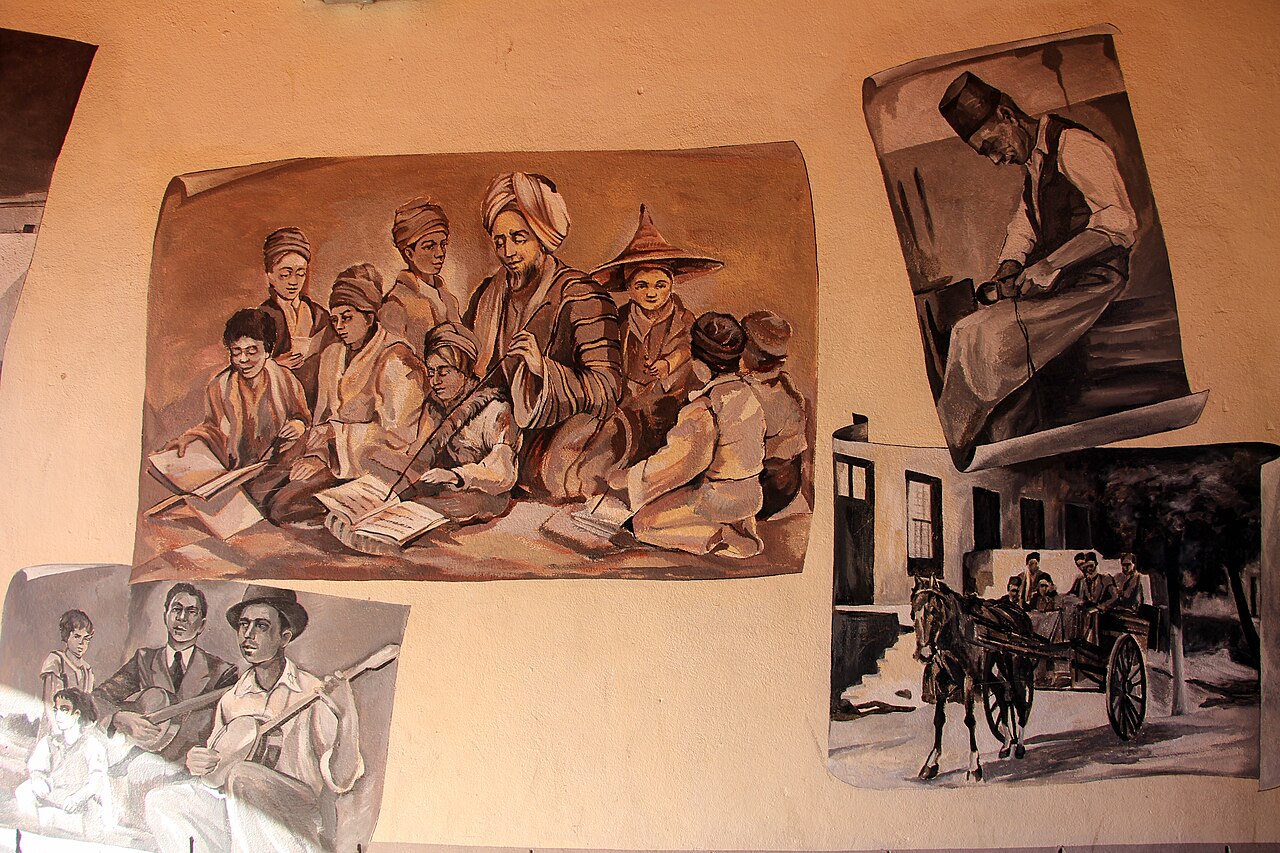
Start with a heritage courtyard in Bo-Kaap
The most famous neighborhood in Cape Town is Bo-Kaap, a historic district on the slopes of Signal Hill above the city center and a historical center of Cape Malay culture. It is a living neighborhood where people make their homes, and it is a protected heritage area, so it rewards a quiet, respectful visit. Walk slowly, keep your voice low, and ask before you photograph anyone.
One of the best Cape Town murals here is the Bo-Kaap Heritage Mural in an arched courtyard at 93 Wale Street. The photographer who took this picture credits the work to Nasser Palangi and describes it as an illustration of the cultural heritage of the early inhabitants of Bo-Kaap. It is painted as a series of scroll-shaped pictures that look like old photographs pinned to the wall. A robed teacher sits among children with open books, a man in a fez works with his hands, a horse-drawn cart rolls along a street, and two musicians play a banjo and a guitar. The tones are mostly browns and grays, which makes the whole wall feel like a family album.

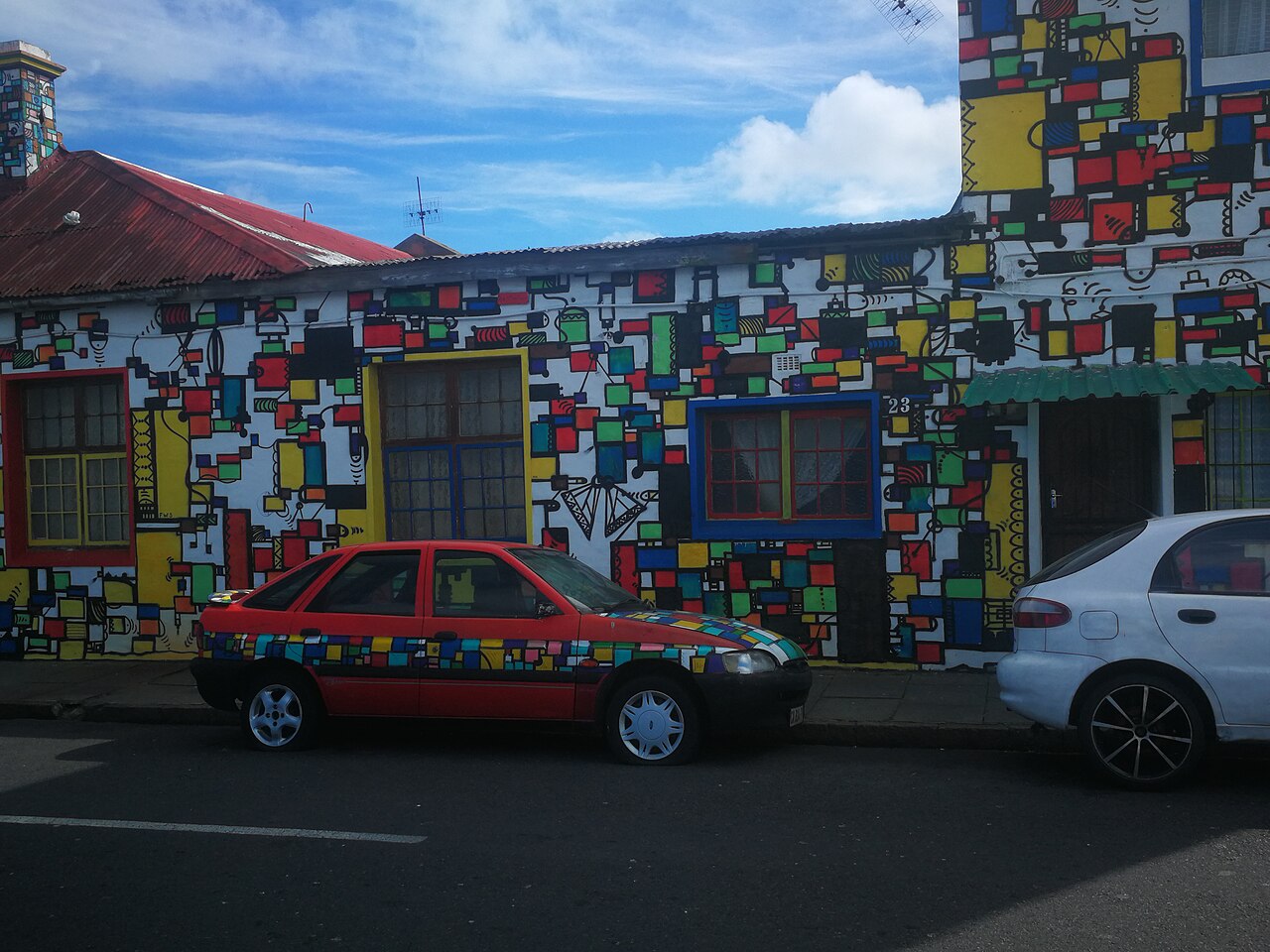
Color-block houses in Salt River
Leave the postcard streets behind and Cape Town murals get louder. On Tennyson Street in Salt River, a low house is covered edge to edge in a patchwork of red, yellow, green, blue and black rectangles, with loose line drawings tucked between them. Windows and doors are outlined in strong colors so they become part of the design. A red car parked in front carries a similar color-block pattern along its side, which looks like a deliberate joke, or at least a happy accident.
This is street art at the scale of a whole building, and it does something a framed painting cannot. It changes how a block of ordinary houses feels. Nothing in the photograph tells us who painted it, so we will not guess, but it shows how an ordinary wall can become a landmark.

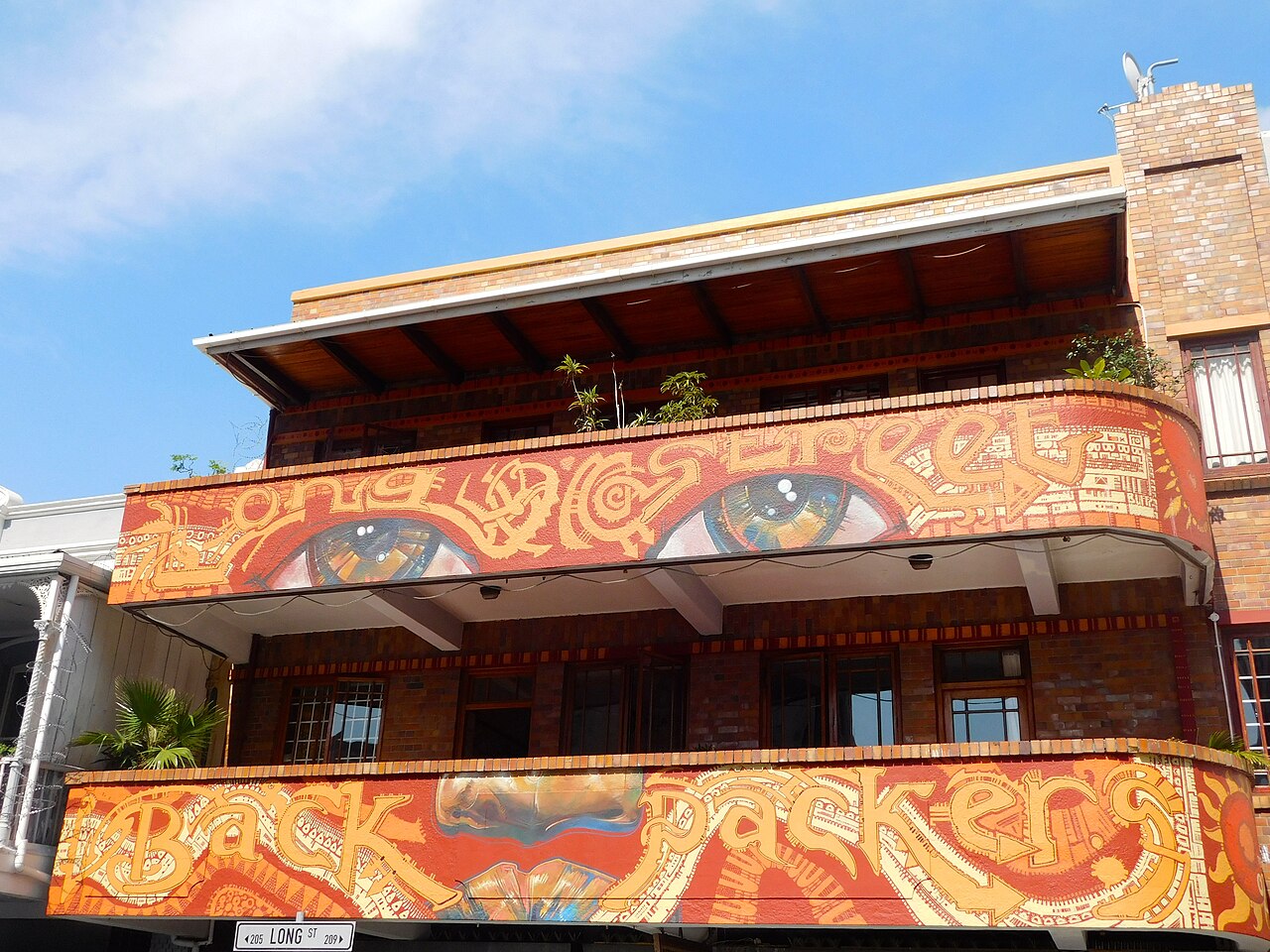
Painted balconies on Long Street
Long Street runs through the heart of the city, and one of its best-known painted facades is on a brick building with two curved balconies. In this 2016 photograph, giant eyes stare out from the upper balcony, and swirling orange lettering reads Long Street and Backpackers across the two fronts.
The painting treats the building like a sign and a mural at once. It is the kind of painting that suits a busy street because you can read it from a moving car. Paint on a street like this can change often, so treat the photograph as a record of one moment rather than a promise of what you will find today.

A café wall under Table Mountain
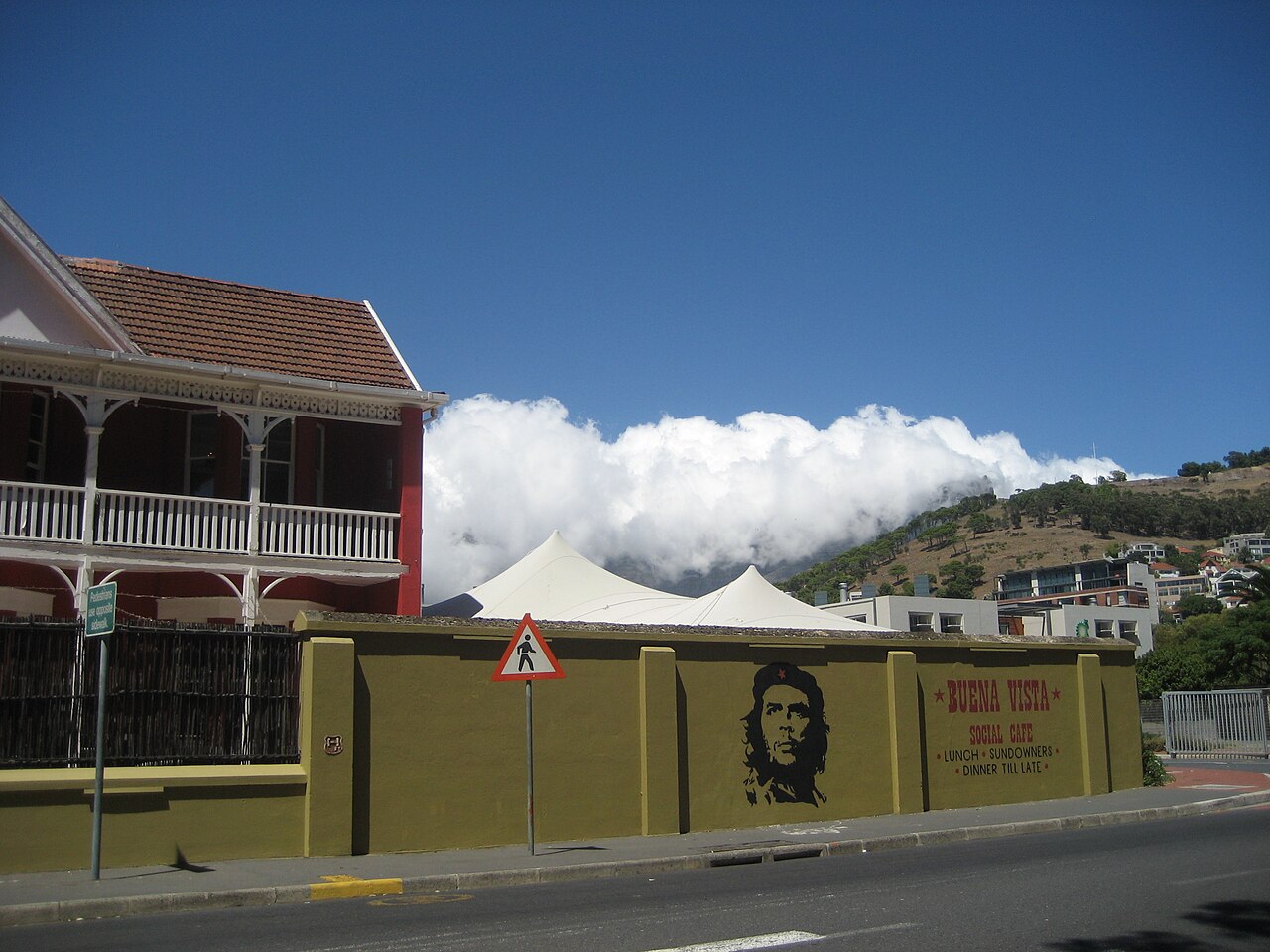
Not every wall needs to be huge. At the Buena Vista Social Cafe, a black and white painted portrait sits on an olive-green boundary wall next to the cafe's name and opening hours. The photographer identifies the portrait as Che Guevara. Behind the wall, a layer of cloud spills over Table Mountain, which gives the whole scene a backdrop no designer could order.
The wall is a reminder that in Cape Town, the mountain is always part of the composition. A mural here competes with one of the most recognizable skylines in the world, and the smartest ones leave room for it.

Words on the wall
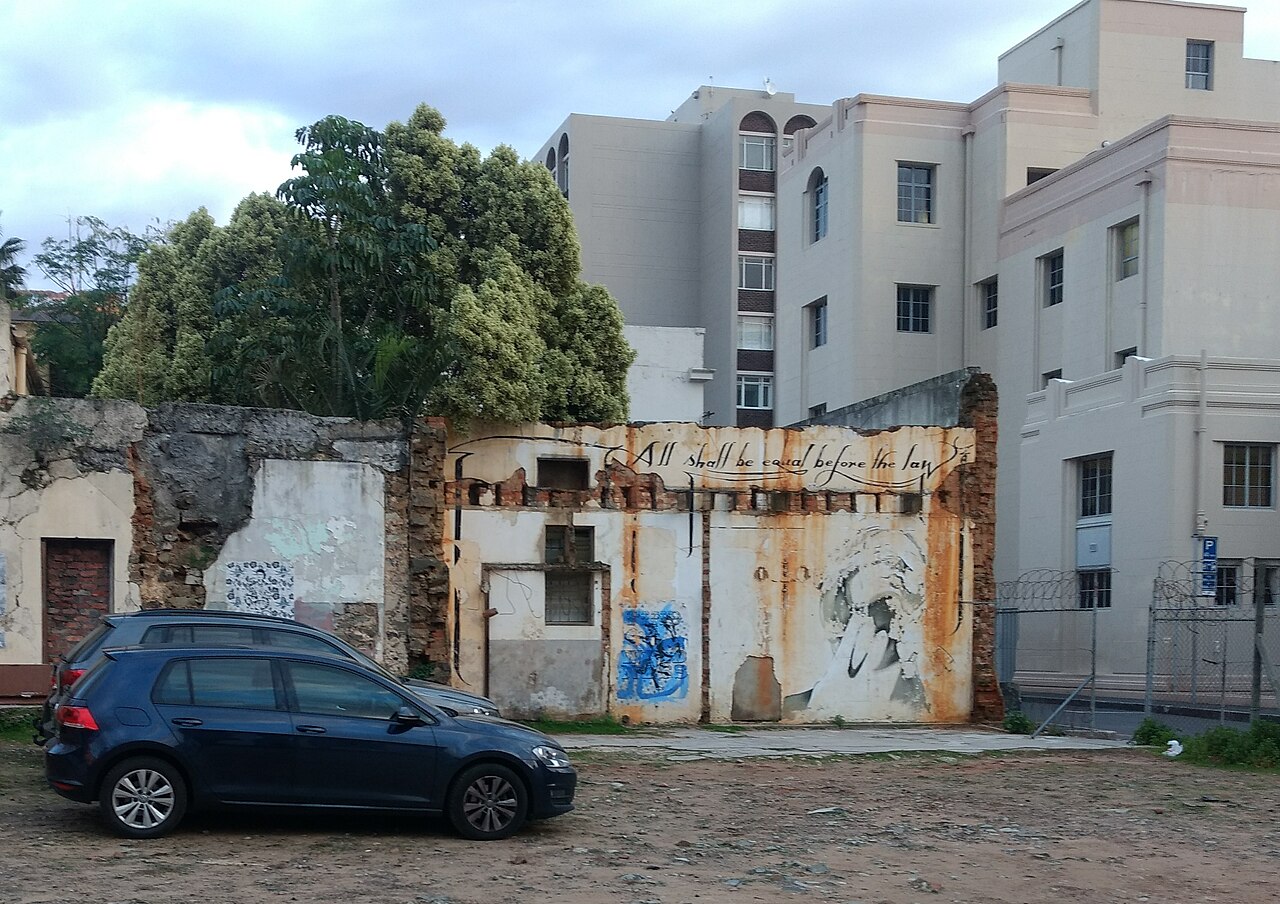
Some of the most direct Cape Town street art has no picture at all. On a ruined, rust-streaked wall on an empty lot, flowing black lettering reads All shall be equal before the law, with a faded painted face beneath it. The line matches a heading of the Freedom Charter of 1955. Next to it, the crumbling brick and peeling plaster do half the work, and the cars and offices behind give it a very ordinary city setting.
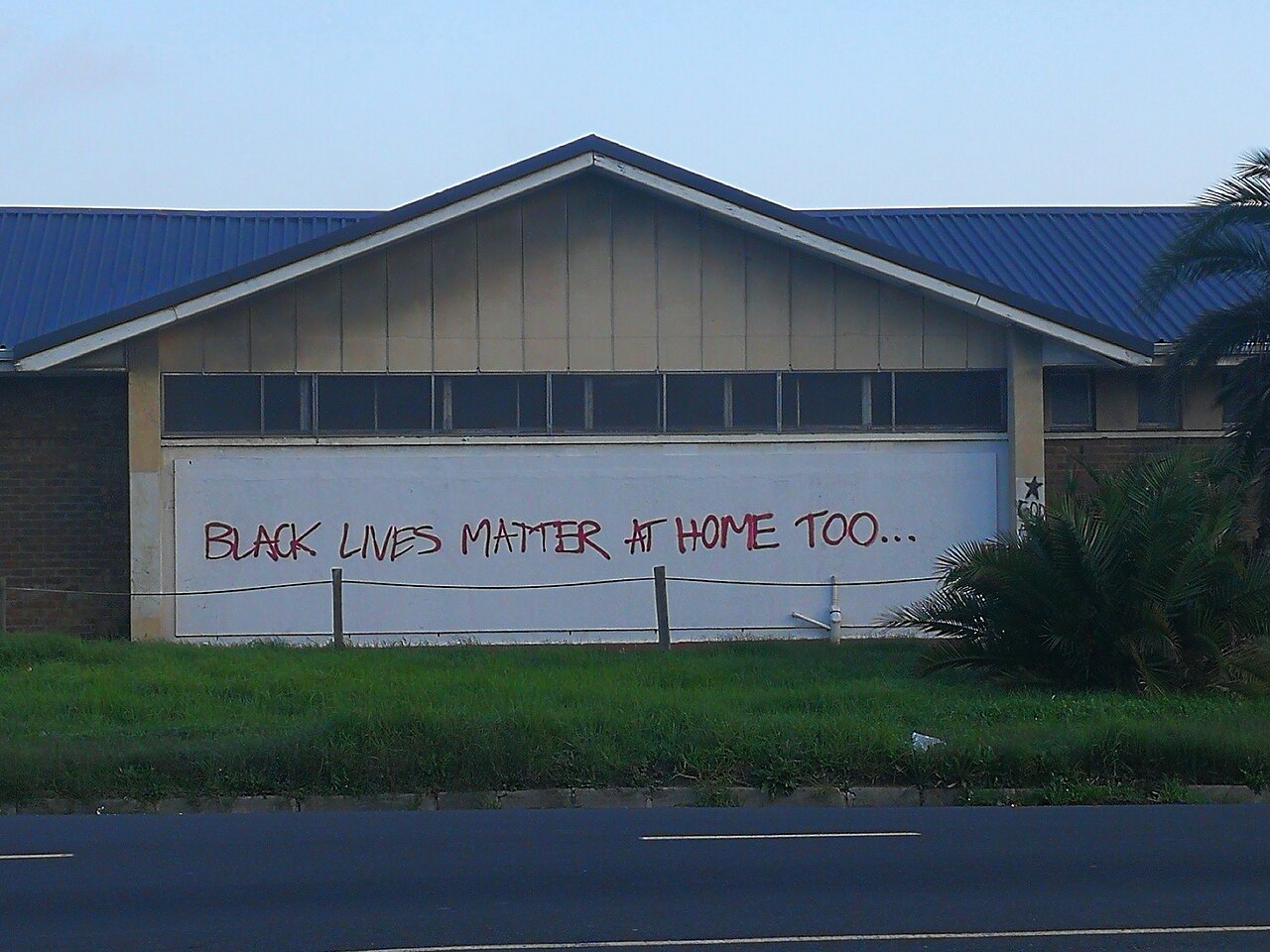
A different wall, photographed in June 2020 in Observatory, is plain white under a blue roof, with hand-lettered red words reading Black Lives Matter at home too. We are only describing what is written, because the words speak for themselves. Walls like these are a good reminder that a mural can be a sentence, and that lettering is its own craft.


A message at the Waterfront
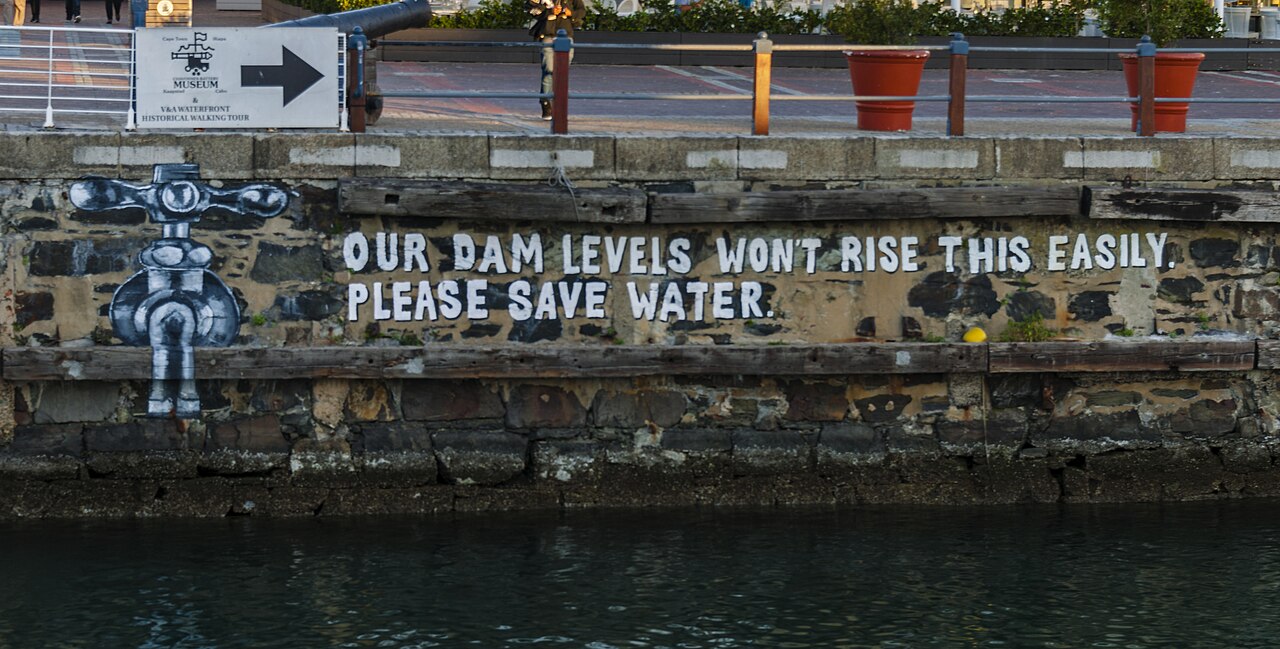
On the harbor edge at the V&A Waterfront, a dark stone retaining wall carries a message in big white letters: Our dam levels won't rise this easily, please save water. A painted tap sits at the left end of the wall, and a sign for a historical walking tour points past it. The photograph is from July 2018, during the city's water crisis, when conserving water was a daily topic across Cape Town.
It is a useful example of what a mural can do that a billboard cannot. The words are painted straight onto the old stone, right at the water line, and the wall itself becomes part of the joke. People walking past could not miss it.

Mosaic and found-material art
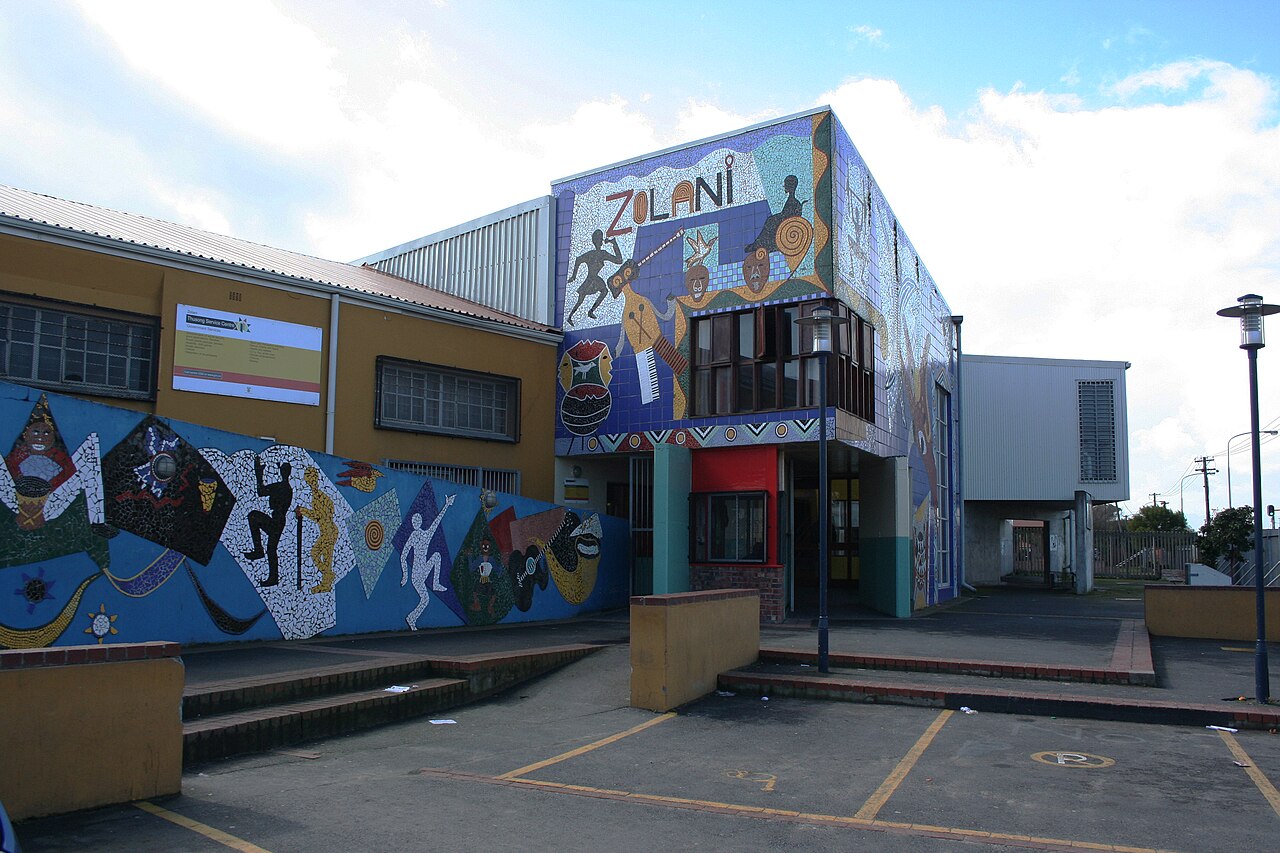
Cape Town art does not stop at paint. In Nyanga, the front of the Zolani community center is covered in mosaic artwork, with the name Zolani in big letters and tile figures of musicians, a drum and dancers. A long mosaic wall runs along the front of the building, so the art greets you before you walk in. It is a good example of public art made for the people who use the place every day.
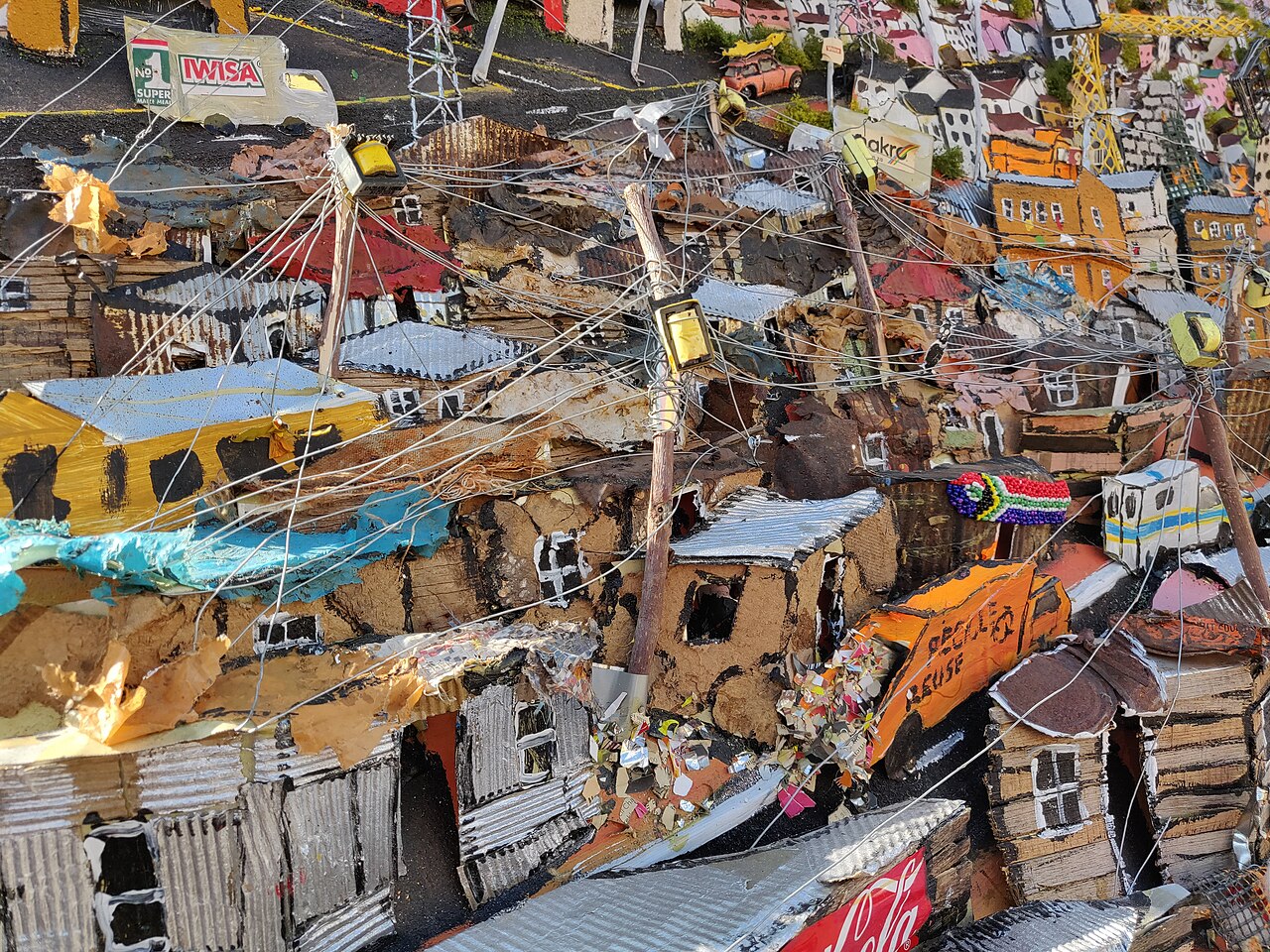
Another photograph, filed by the photographer as street art in Bo-Kaap, shows something even more unusual: a crowded scene built from cardboard, corrugated sheet and wire, with tiny houses, power poles, a minibus and a small striped flag. It is not a mural in the usual sense, but it shows how wide street art can stretch. We cannot tell from the photograph who made it or whether it is still on display.


Giraffes at the airport
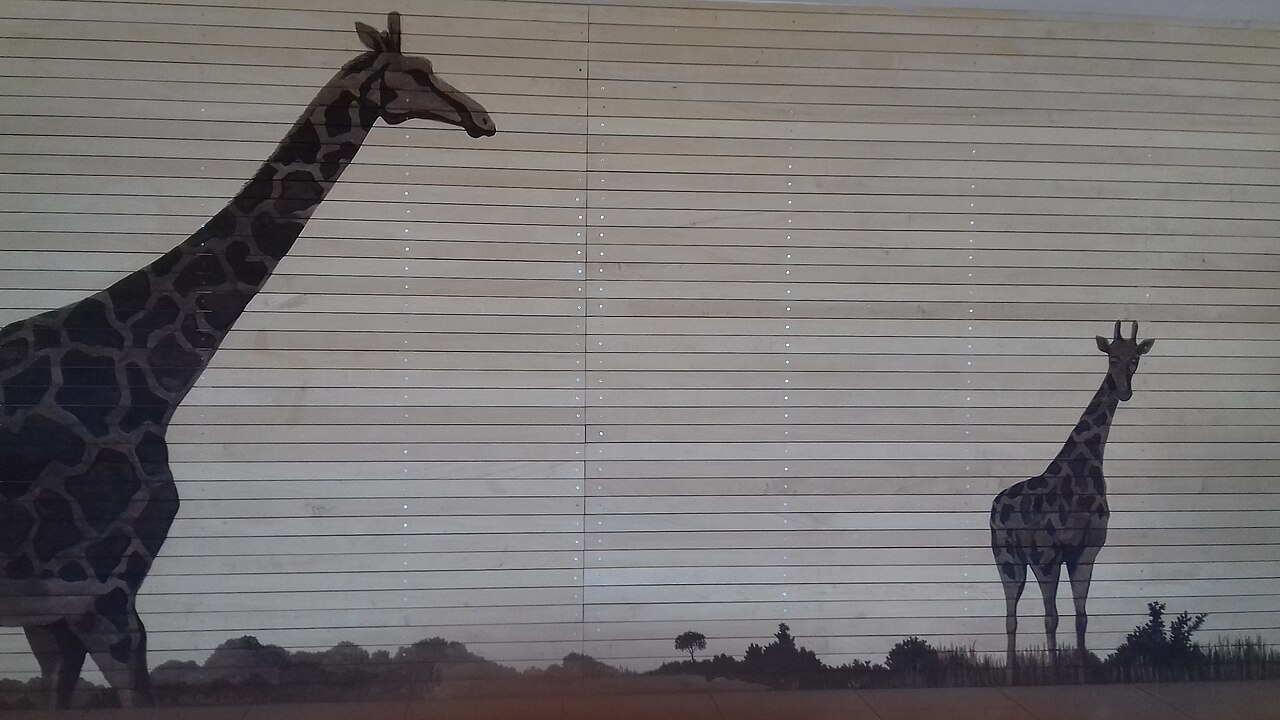
Many visitors see Cape Town murals before they even leave the airport. At Cape Town International Airport, a large and a small giraffe stand on a pale slatted wall above a strip of dark painted grassland, with a single tree in the distance. The photograph is from July 2018.
It is a simple scene, and it works because it is calm. After a long flight, a mural does not have to shout. It only has to make the building feel like somewhere in particular.

How to see Cape Town murals on foot
Cape Town is spread out, so plan by neighborhood rather than trying to see everything in a day. Bo-Kaap, Long Street and the center of the city can be combined on foot, while Salt River, the Waterfront and Nyanga are each worth a separate trip. Go in daylight, look up as well as ahead, and expect some walls to have changed since the photographs here were taken, because painted walls fade, get covered and get replaced.
In residential areas, remember that you are walking past people's homes. Ask before photographing anyone, and never lean on or touch a painted wall. For more cities with painted walls, see our world field guide.
If you have a wall in mind
Every wall in this story began as a blank surface and someone's decision to do something with it. If you manage a building in Cape Town and keep looking at a wall, or you are an artist who wants to paint in a city like this one, we would be glad to hear from you. Tell us about your wall and we will take it from there.
Frequently asked questions
- Where can I see murals in Cape Town?
- Bo-Kaap has a heritage mural in an arched courtyard on Wale Street, Salt River has color-covered houses on Tennyson Street, and Long Street has painted balcony fronts. You will also find painted walls at the V&A Waterfront and mosaic artwork in Nyanga.
- Is Bo-Kaap good for street art?
- Bo-Kaap is best known for its colorful houses and its Cape Malay heritage, and it also has painted work such as the heritage mural on Wale Street. It is a residential neighborhood, so visit quietly and respect the people who live there.
- What are the Cape Town murals about?
- The range is wide. You will find scenes of local history, color-block patterns, portraits, hand-lettered messages, environmental reminders and mosaics. There is no single theme, which is part of the fun of walking the city.
- Are the murals still there?
- Some walls stay for years and others fade, are painted over or replaced. If there is a wall you want to see, check recent photos before you go.
All photos are free-licensed and credited under each image; license links go to the original file pages.