City story · Cartagena · 7 min read
Cartagena Murals: Street Art in Getsemaní and Beyond
Cartagena is known for its colonial walls, and in Getsemaní those walls have become a canvas. Faces, animals, lettering and whole painted houses fill the streets. A slow tour of the Cartagena murals worth the detour.
Start in Getsemaní
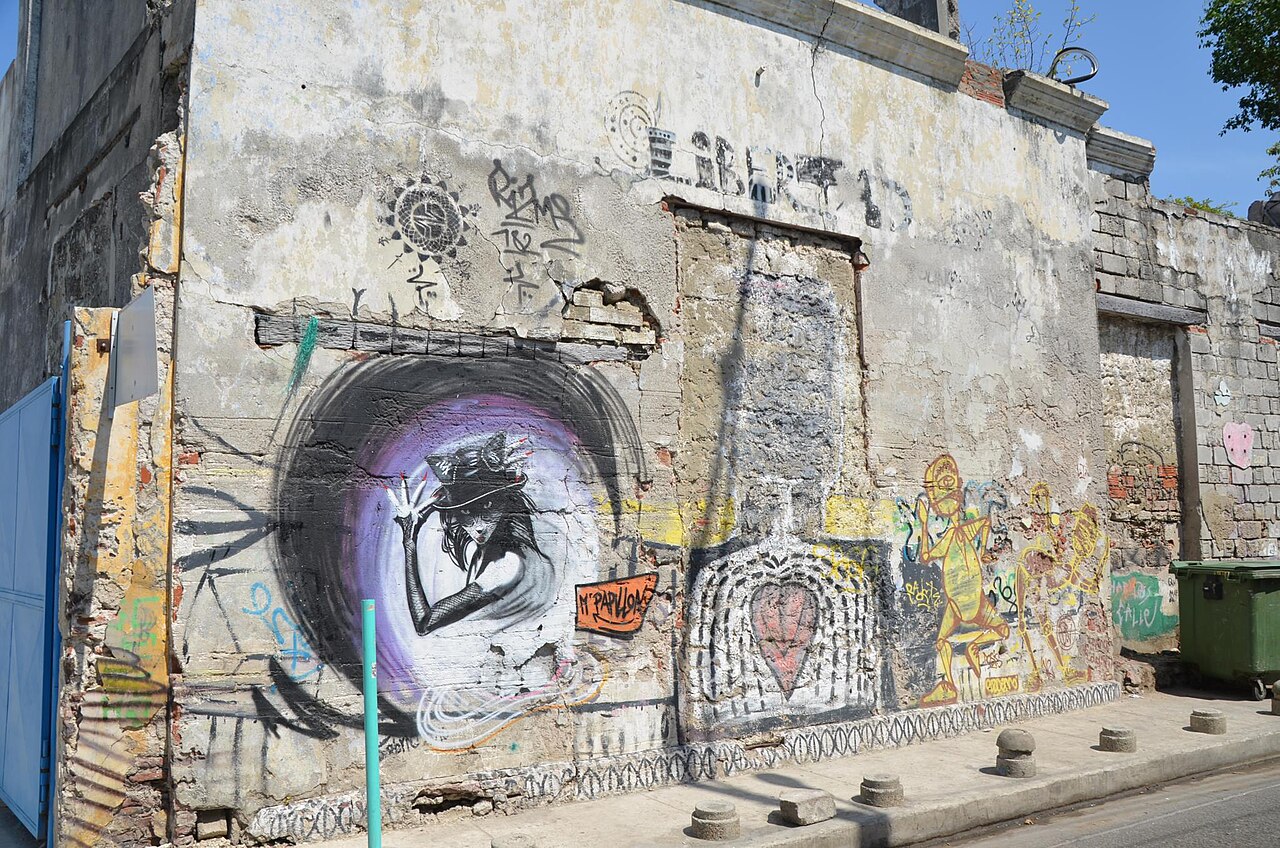
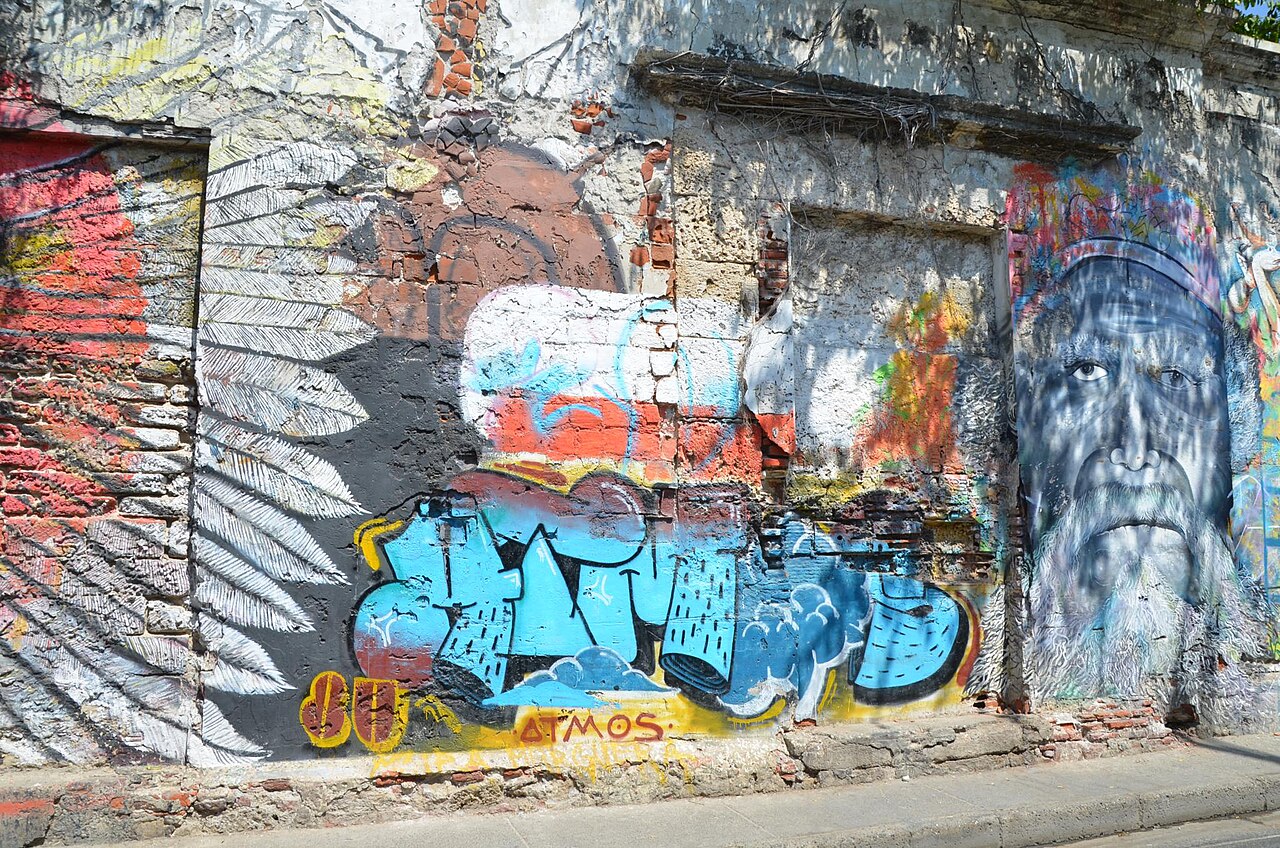
The best first stop for Cartagena murals is Getsemaní, the neighborhood just outside the walled Old City. The photographer who took the first two pictures below describes it as a former poor area that is becoming more trendy, still a destination for backpackers but increasingly drawing a more upscale crowd, partly thanks to events like its street art festival. That mix is easy to feel on the street. Old buildings with peeling plaster and exposed brick sit next to freshly painted walls, and the two seem to need each other.
On one weathered wall, a woman in a hat reaches out of a purple circle, with a painted heart and a yellow figure beside her. A few steps away, a wall carries bold blue lettering, white painted wings and the weathered face of a bearded man. Nothing here is polished, and that is exactly why it works. The rough surface gives every color a texture you could not get on a smooth wall.


Faces and animals on old brick
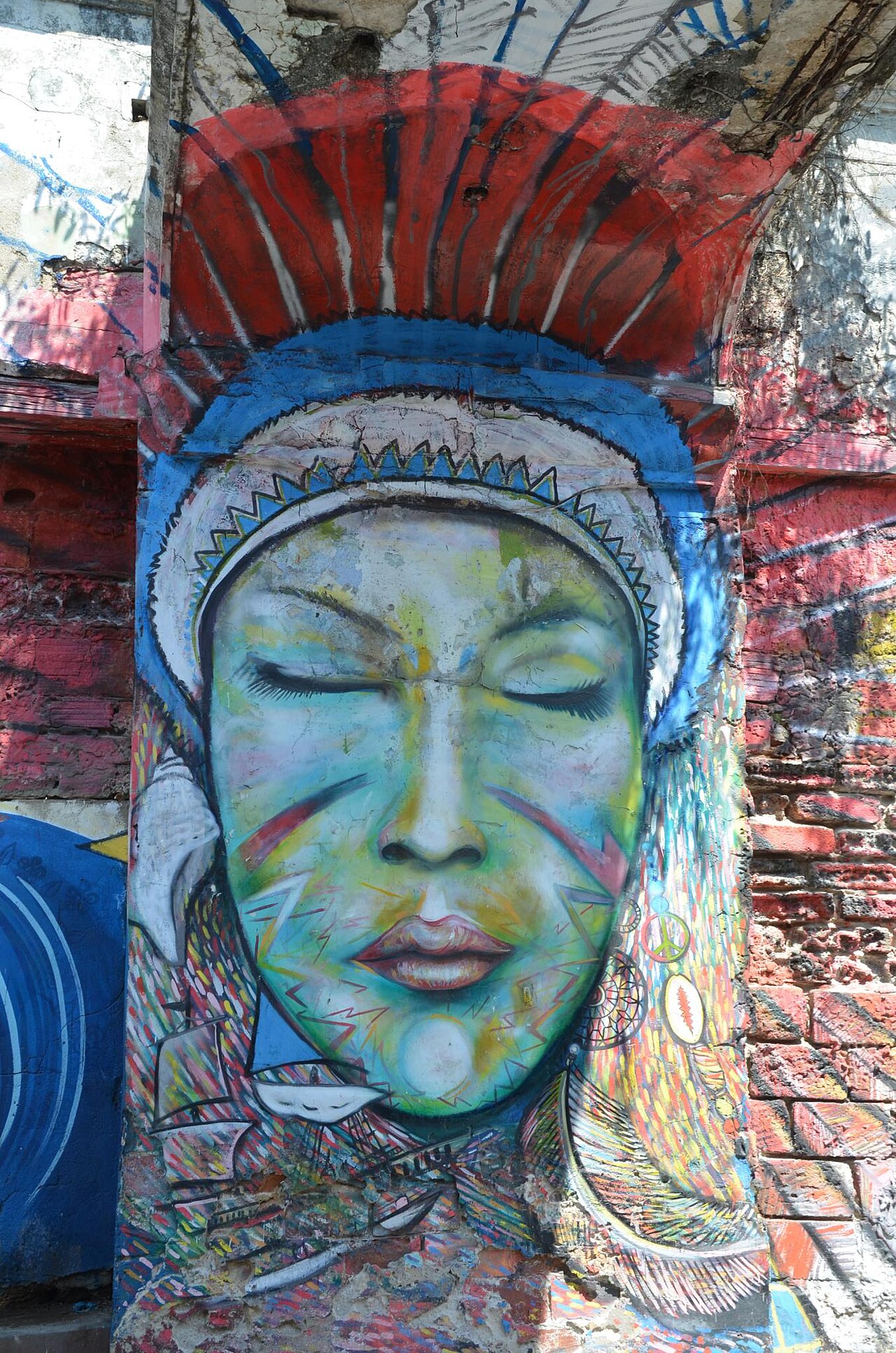
Faces are everywhere in Cartagena street art, and some are enormous. On one column beside exposed red brick, a painted face with closed eyes wears a red feathered headdress and a collar of tiny patterns in every color. The brick showing through around it is part of the picture. Because the plaster is so worn, the painted figure seems to grow out of the building rather than sit on top of it.
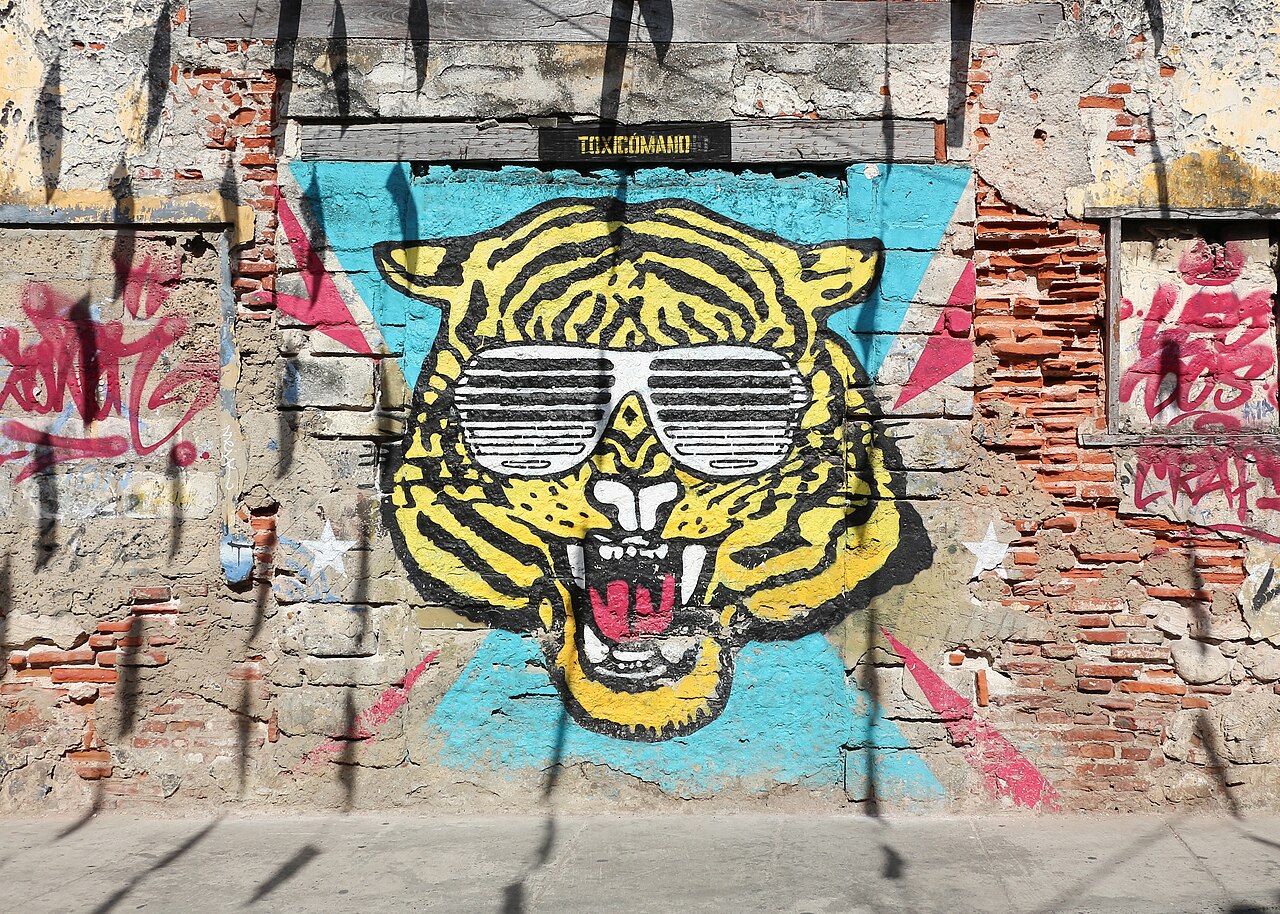
Not every wall is serious. A yellow and black tiger in white shutter-style sunglasses grins out from a turquoise burst on a crumbling brick and plaster wall. It is a good reminder that a mural can be funny, loud and well made at once, and that a city wall can hold a joke next to a portrait.


Portraits on painted houses
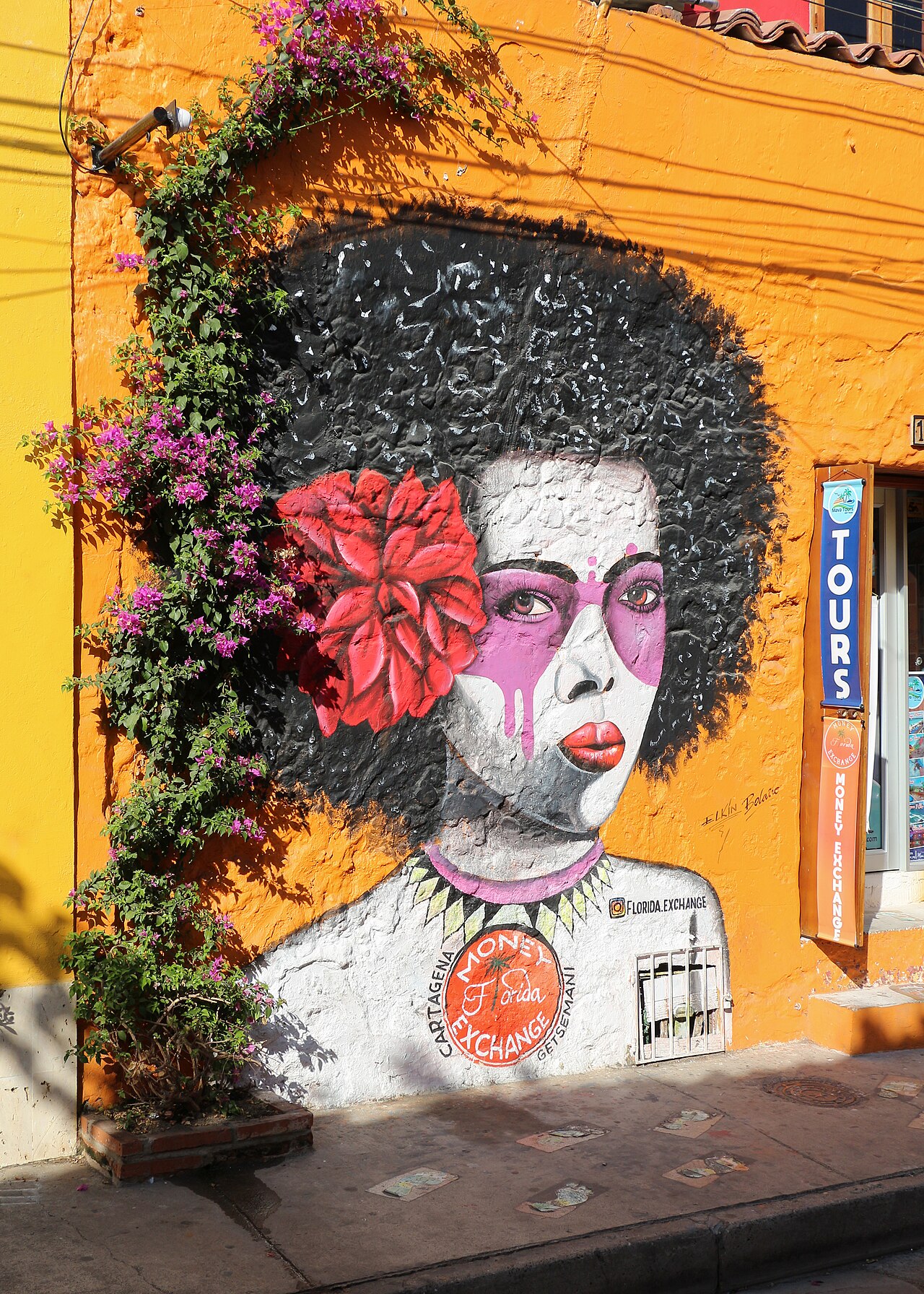
Some of the best Cartagena murals are painted on the fronts of ordinary houses. On one corner, a woman with a large dark afro, a red flower tucked behind her ear and purple paint around her eyes looks out from a bright orange wall, with bougainvillea climbing beside her. The wall color, the flowers and the portrait all work together.
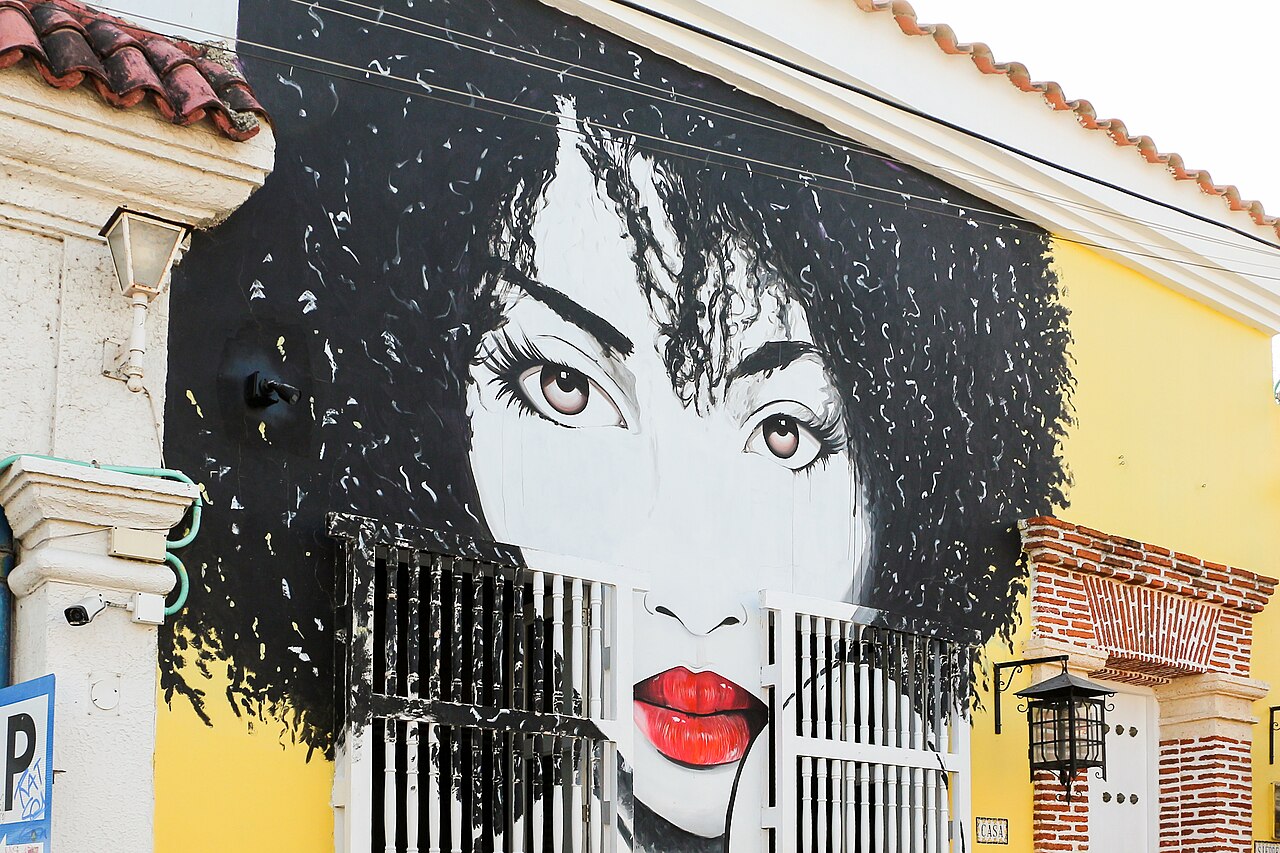
Look back at the picture at the top of this page. There, a woman's face in black and white covers the whole front of a yellow house, and the real door and window grille become part of the painted features. When a mural is planned around the building rather than just placed on it, the result feels like it belongs to the street.

A café wall on Calle San Juan
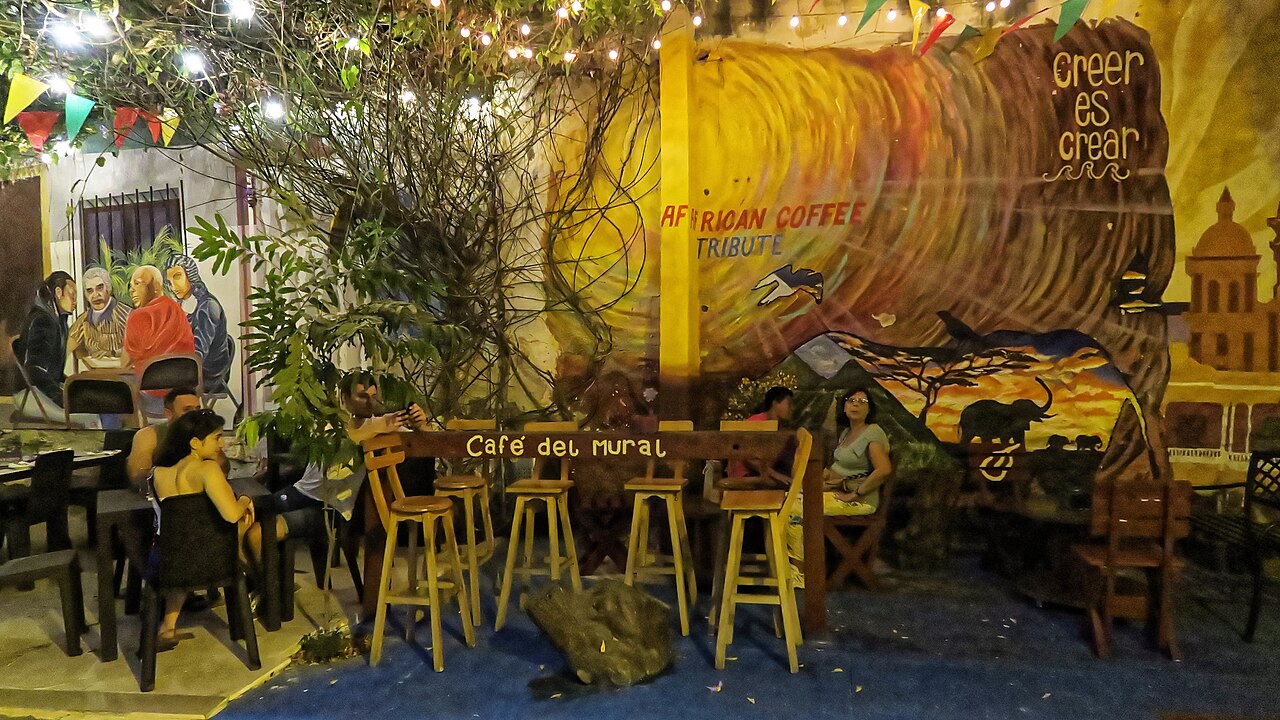
In Getsemaní, a mural does not have to be on the outside of a building. A café on Calle San Juan has painted its outdoor courtyard walls, so diners sit in front of a mountain landscape, animals and a skyline, under the words Creer es crear, which means to believe is to create. At night, with string lights overhead, it feels more like a stage than a restaurant patio.
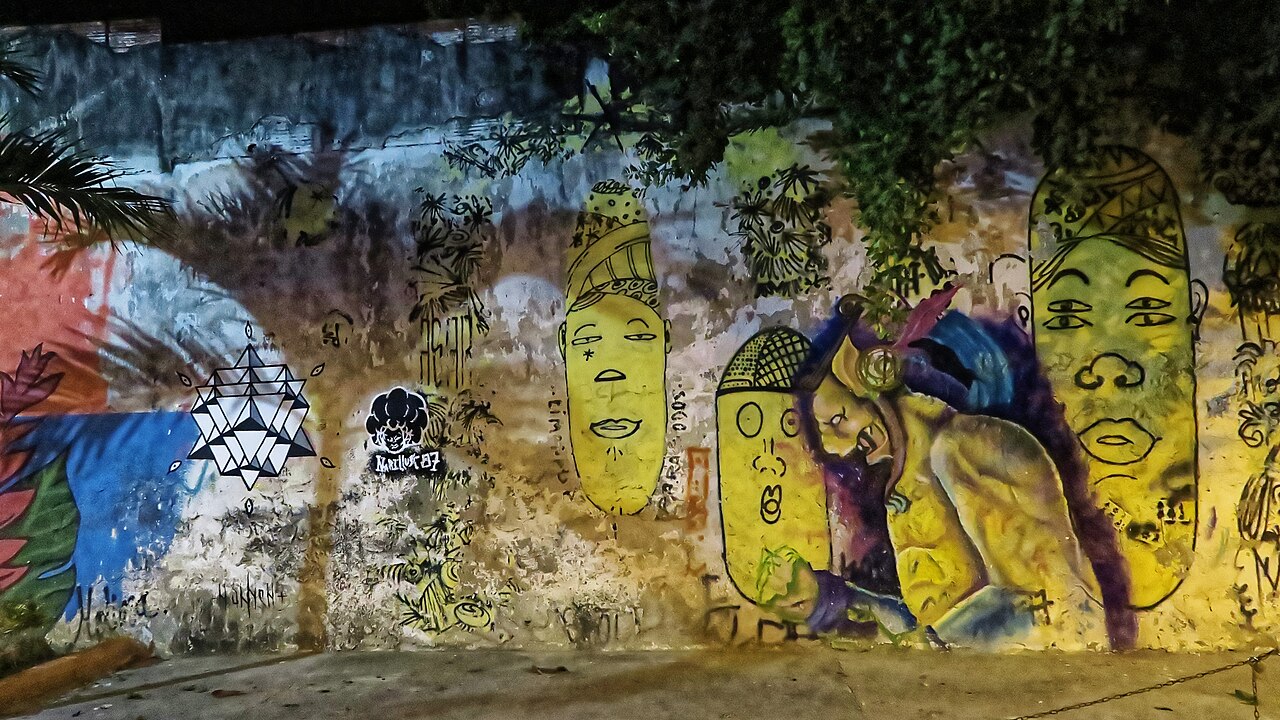
The same set of photographs includes a night view of another painted wall, lit from below, where tall yellow faces and a figure in a purple feathered headdress glow against old plaster. It is a good example of how painted walls change with the light. A wall you pass at noon can look like a different place after dark.


An open-air gallery on Carrera 9
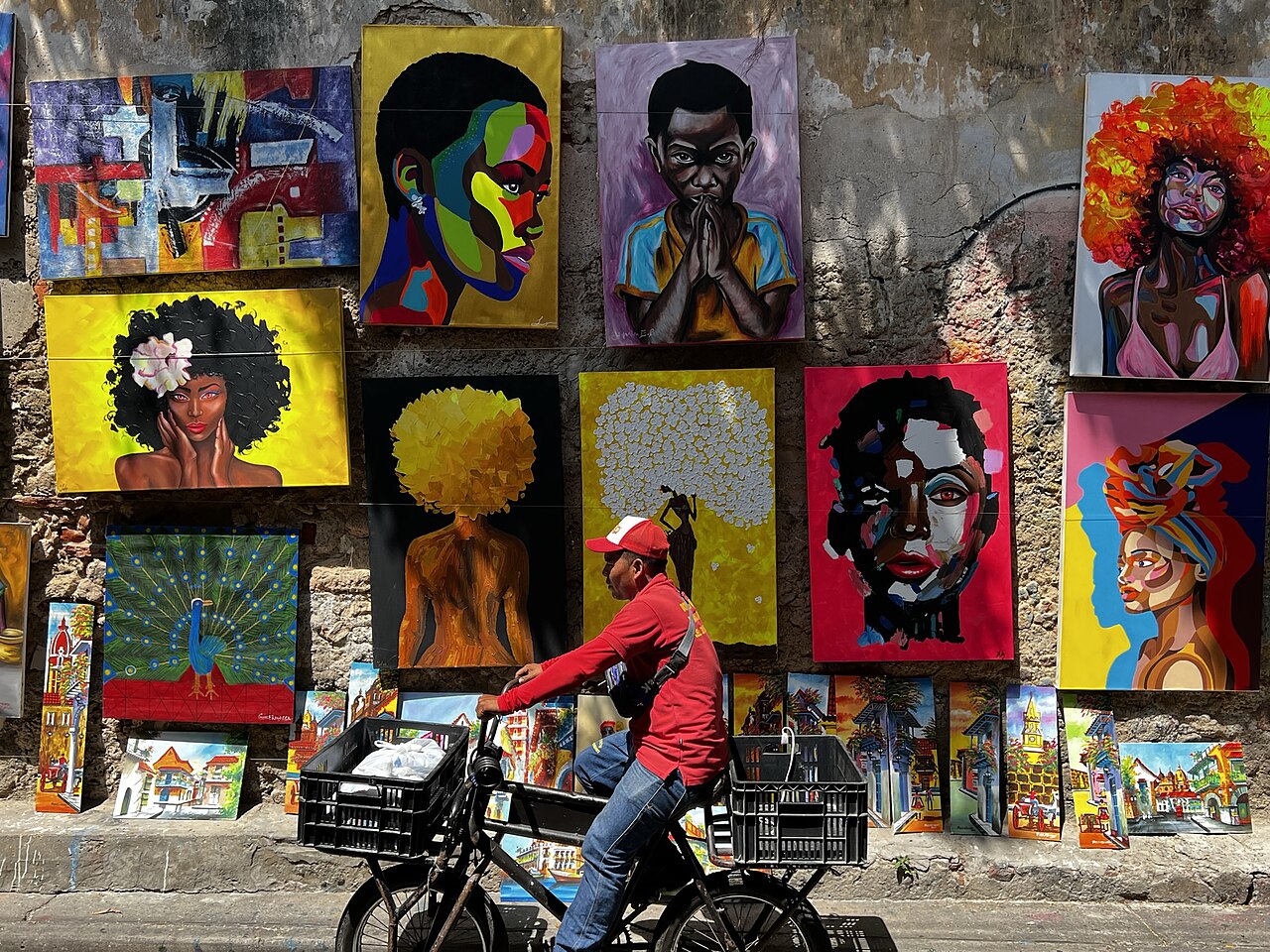
On Carrera 9 in Getsemaní, the wall itself becomes a gallery. According to the photographer's description, the display runs for more than 100 meters and shows work by local artists. Paintings of faces, a peacock and colorful street scenes hang edge to edge along the old wall, and a delivery rider cycles past in front of them.
These are canvases hung on a wall rather than paint applied to it, but they belong in any walk through Cartagena street art. They show how much of the city's visual life happens outdoors, and how much local artists rely on the street to be seen.

A long wall in the historic center
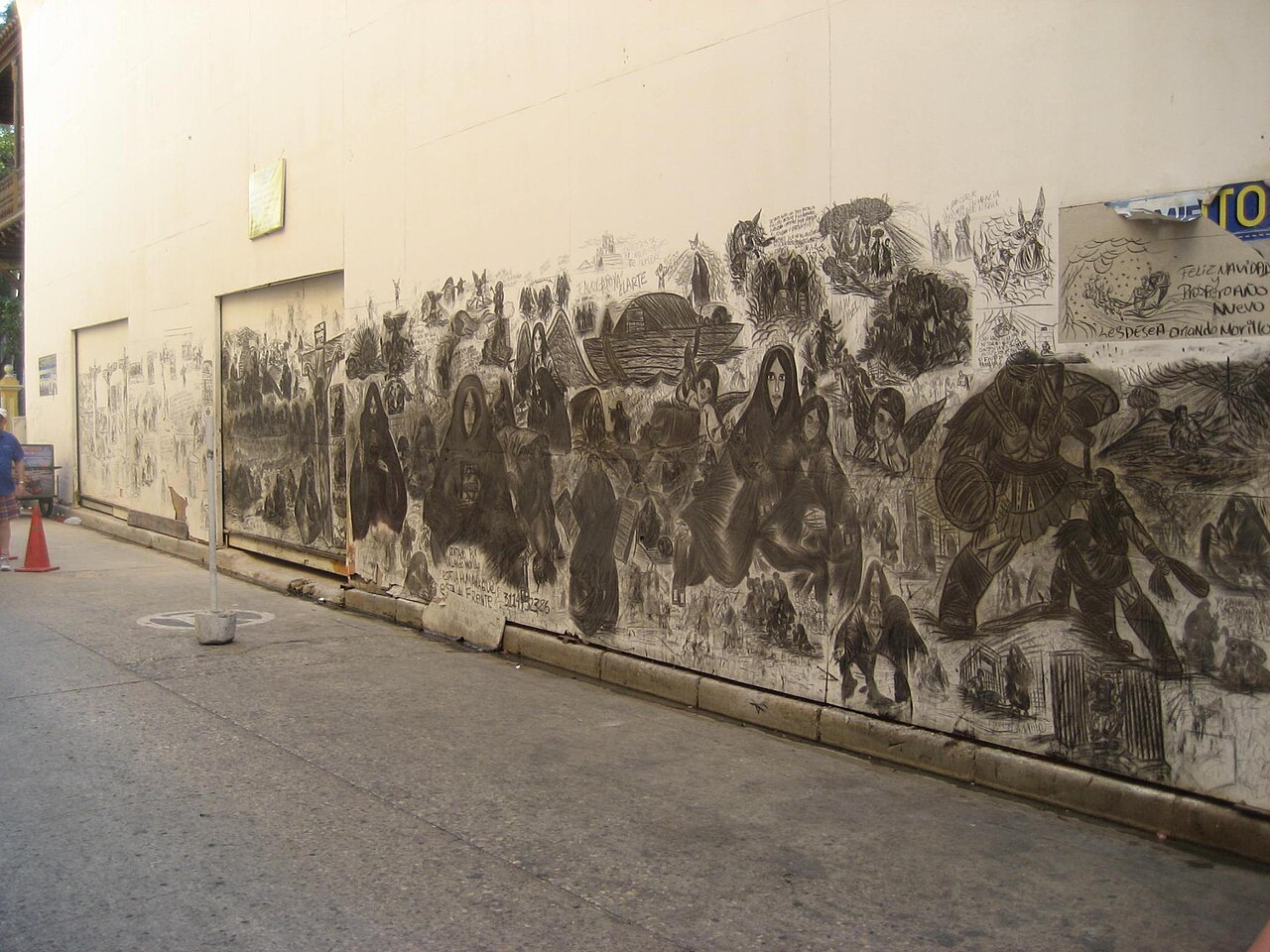
Inside the historic center, Cartagena murals are rarer and quieter. Next to Plaza Simón Bolívar, a long cream-colored wall carries a dark, drawing-like mural of robed figures, boats and warriors, rendered in shades of black and gray that look like charcoal. Its restraint is striking in a city so known for color.
The difference between this wall and the bright houses of Getsemaní is a lesson in itself. A mural can match the mood of its street, and in a historic quarter that often means painting something that feels like part of the architecture rather than a splash of color against it.

Lettering outside the tourist core
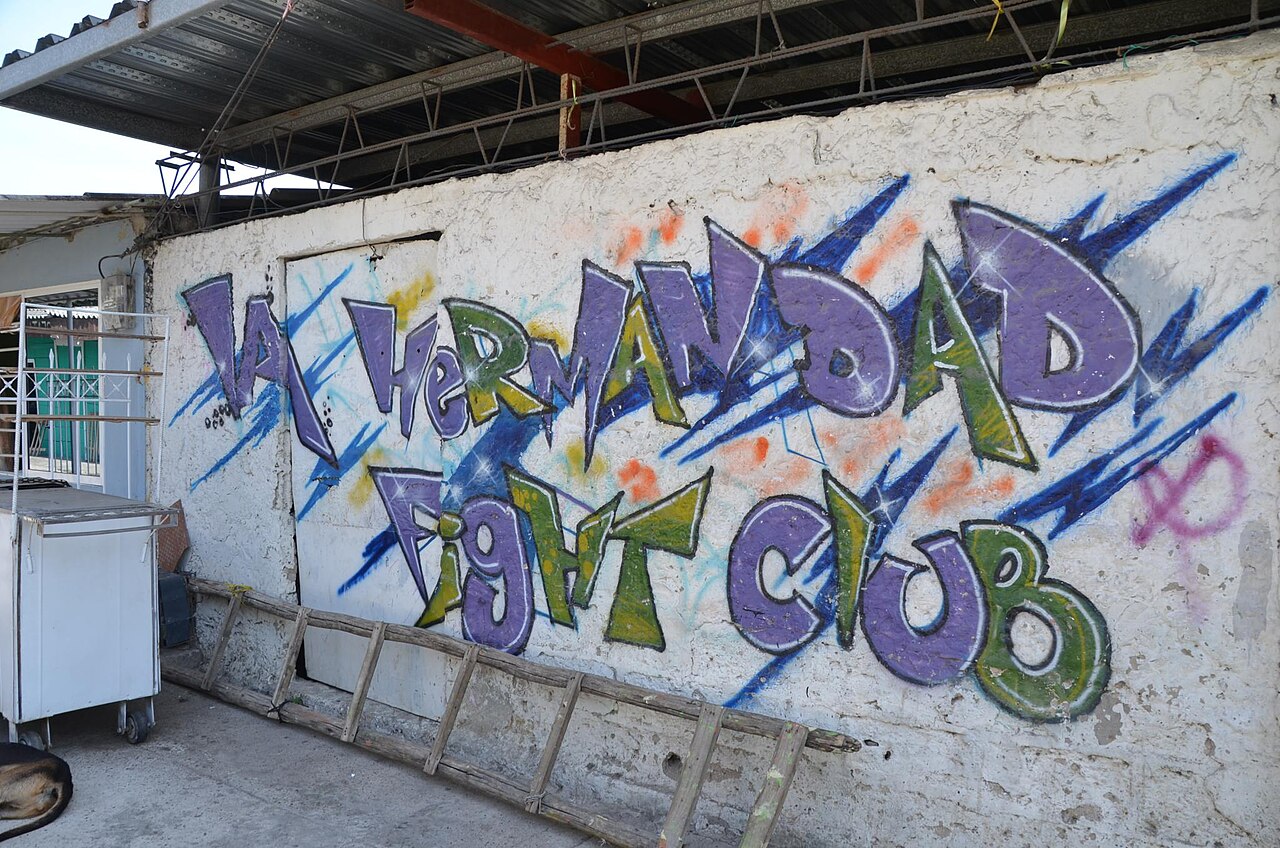
Not every wall in the city faces a tourist street. Walking between the Castillo de San Felipe and the Mall Plaza, the photographer passed a white wall painted with purple and green lettering that reads La Hermandad Fight Club, with blue lightning shapes behind the letters. It marks a boxing gym, and it is a reminder that a mural can be a sign, a neighborhood landmark and a piece of art all at once.
Walls like this one tell you who a place is for. A bright lettered sign on a gym wall says something about the people who use the building that no brochure can.

How to see Cartagena murals on foot
Cartagena is hot, so go early or late and keep a bottle of water with you. Getsemaní is easy to cover on foot in a morning or an evening. Start around Plaza de la Trinidad, follow the streets that run off it, and let the walls pull you along. Look up as well as ahead, and expect some of what you see to have changed by your next visit, because painted walls weather, get covered and get replaced.
Add the historic center and the streets near the Castillo de San Felipe if you want a wider view. Our Cartagena field guide page lists more of the city's walls with locations and credits, for anyone who wants a longer route.
If you have a wall in mind
Every wall in this story began as a blank surface and someone's decision to leave it less blank. If you manage a building in Colombia and keep looking at a wall, or you are an artist who wants to paint in a city like this one, we would be glad to hear from you. Tell us about your wall and we will take it from there.
Frequently asked questions
- Where can I see murals in Cartagena?
- Getsemaní is the best place to start, especially the streets around Plaza de la Trinidad and Calle San Juan. You can also find murals in the historic center, such as the long wall beside Plaza Simón Bolívar, and in neighborhoods further out.
- Is Getsemaní good for street art?
- Yes. Getsemaní is known for its painted walls, from large portraits on house fronts to lettering, animals and murals inside café courtyards. The neighborhood also has a street art festival.
- What are the Cartagena murals about?
- The range is wide. You will find portraits, animals, lettering, jokes, signs for local businesses and quieter drawing-style murals in the historic center. There is no single theme, which is part of the fun of walking the city.
- Are the murals still there?
- Some walls stay for years and others fade, are painted over or replaced. If there is a wall you want to see, check recent photos before you go.
All photos are free-licensed and credited under each image; license links go to the original file pages.
Historia de la ciudad · Cartagena · 7 min de lectura
Murales en Cartagena: arte urbano en Getsemaní y más allá
Cartagena es famosa por sus murallas coloniales, y en Getsemaní las paredes se volvieron lienzo. Rostros, animales, letras y casas enteras pintadas llenan las calles. Un recorrido sin afán por los murales de Cartagena que valen el desvío.
Empiece por Getsemaní
La mejor primera parada para ver murales en Cartagena es Getsemaní, el barrio que queda justo afuera de la Ciudad Amurallada. El fotógrafo que tomó las dos primeras imágenes lo describe como una antigua zona pobre que se está volviendo más de moda: sigue siendo destino de mochileros, pero atrae cada vez más a un público de mayor poder adquisitivo, en parte gracias a eventos como su festival de arte urbano. Esa mezcla se siente en la calle. Edificios viejos de repello descascarado y ladrillo a la vista conviven con muros recién pintados, y parecen necesitarse unos a otros.
En una pared desgastada, una mujer con sombrero se asoma desde un círculo morado, con un corazón pintado y una figura amarilla a su lado. A pocos pasos, otro muro lleva letras azules, alas blancas y el rostro curtido de un hombre barbado. Nada aquí está pulido, y por eso mismo funciona. La superficie áspera le da a cada color una textura que no se consigue en un muro liso.
Rostros y animales sobre ladrillo viejo
Los rostros están por todas partes en el arte urbano de Cartagena, y algunos son enormes. En una columna junto a un muro de ladrillo rojo a la vista, un rostro pintado de ojos cerrados lleva un tocado de plumas rojas y un collar de diminutos patrones de todos los colores. El ladrillo que asoma alrededor es parte de la imagen. Como el repello está tan gastado, la figura pintada parece nacer del edificio en lugar de estar puesta encima.
No todos los muros son serios. Un tigre amarillo y negro con gafas de sol blancas de rejilla sonríe desde una explosión turquesa en una pared de ladrillo y repello a punto de caerse. Es un buen recordatorio de que un mural puede ser divertido, estruendoso y bien hecho al mismo tiempo, y de que en el muro de una ciudad caben un chiste y un retrato uno al lado del otro.
Retratos en casas pintadas
Algunos de los mejores murales de Cartagena están pintados en los frentes de casas comunes y corrientes. En una esquina, una mujer de abundante afro oscuro, con una flor roja detrás de la oreja y pintura morada alrededor de los ojos, mira desde una pared naranja brillante, con una bugambilia trepando a su lado. El color de la pared, las flores y el retrato se complementan.
Vuelva a mirar la imagen del comienzo de esta página. Allí, el rostro de una mujer en blanco y negro cubre todo el frente de una casa amarilla, y la puerta y la reja de la ventana reales pasan a ser parte de los rasgos pintados. Cuando un mural se piensa a partir del edificio en lugar de simplemente ponerse encima, el resultado se siente parte de la calle.
Un muro de café en la Calle San Juan
En Getsemaní, un mural no tiene por qué estar por fuera del edificio. Un café de la Calle San Juan pintó las paredes de su patio al aire libre, así que los comensales se sientan frente a un paisaje de montaña, animales y un horizonte de ciudad, bajo las palabras Creer es crear. De noche, con luces de cuerda en lo alto, se parece más a un escenario que al patio de un restaurante.
Esa misma serie de fotografías incluye una vista nocturna de otro muro pintado, iluminado desde abajo, donde unos rostros amarillos altos y una figura con un tocado de plumas moradas resplandecen sobre el repello viejo. Es un buen ejemplo de cómo cambian los muros pintados con la luz. Una pared por la que usted pasa al mediodía puede parecer otro lugar después de oscurecer.
Una galería al aire libre en la Carrera 9
En la Carrera 9, en Getsemaní, el propio muro se vuelve galería. Según la descripción del fotógrafo, la muestra se extiende por más de 100 metros y exhibe obras de artistas locales. Pinturas de rostros, un pavo real y escenas coloridas de la calle cuelgan una junto a otra a lo largo del muro viejo, mientras un repartidor pasa en bicicleta frente a ellas.
Son lienzos colgados en la pared y no pintura aplicada sobre ella, pero tienen lugar en cualquier recorrido por el arte urbano de Cartagena. Muestran cuánto de la vida visual de la ciudad ocurre al aire libre, y cuánto dependen los artistas locales de la calle para darse a conocer.
Un muro largo en el centro histórico
Dentro del centro histórico, los murales de Cartagena son más escasos y más callados. Junto a la Plaza Simón Bolívar, un largo muro color crema lleva un mural oscuro, de trazo como de dibujo, con figuras con túnicas, barcos y guerreros, en tonos de negro y gris que parecen carboncillo. Su sobriedad llama la atención en una ciudad tan conocida por el color.
La diferencia entre este muro y las casas brillantes de Getsemaní es una lección en sí misma. Un mural puede ir con el ánimo de su calle, y en un barrio histórico eso muchas veces significa pintar algo que se sienta parte de la arquitectura y no un manchón de color contra ella.
Letras fuera del circuito turístico
No todos los muros de la ciudad dan a una calle turística. Caminando entre el Castillo de San Felipe y el Mall Plaza, el fotógrafo pasó junto a una pared blanca pintada con letras moradas y verdes que dicen La Hermandad Fight Club, con formas de rayos azules detrás. Marca un gimnasio de boxeo, y recuerda que un mural puede ser a la vez un aviso, un punto de referencia del barrio y una obra de arte.
Muros como este cuentan para quién es un lugar. Un letrero pintado a todo color en la pared de un gimnasio dice algo de la gente que usa el edificio que ningún folleto puede decir.
Cómo recorrer a pie los murales de Cartagena
Cartagena es calurosa, así que salga temprano o al final de la tarde y lleve una botella de agua. Getsemaní se recorre fácil a pie en una mañana o en una noche. Empiece por la Plaza de la Trinidad, siga las calles que salen de ella y deje que los muros lo vayan llevando. Mire hacia arriba y no solo hacia adelante, y espere que parte de lo que vea haya cambiado en su próxima visita, porque los muros pintados se desgastan, se tapan y se reemplazan.
Sume el centro histórico y las calles cercanas al Castillo de San Felipe si quiere una vista más amplia. Nuestra página guía de Cartagena reúne más muros de la ciudad con ubicaciones y créditos, para quien quiera un recorrido más largo.
Si tiene un muro en mente
Cada muro de este recorrido empezó como una superficie en blanco y la decisión de alguien de dejarla menos en blanco. Si administra un edificio en Colombia y no deja de mirar un muro, o si es artista y quiere pintar en una ciudad como esta, con gusto lo escucharemos. Cuéntenos sobre su muro y nosotros nos encargamos del resto.
Preguntas frecuentes
- ¿Dónde puedo ver murales en Cartagena?
- Getsemaní es el mejor lugar para empezar, sobre todo las calles alrededor de la Plaza de la Trinidad y la Calle San Juan. También hay murales en el centro histórico, como el largo muro junto a la Plaza Simón Bolívar, y en barrios más alejados.
- ¿Getsemaní es bueno para ver arte urbano?
- Sí. Getsemaní es conocido por sus muros pintados, desde grandes retratos en frentes de casas hasta letras, animales y murales en patios de cafés. El barrio también tiene un festival de arte urbano.
- ¿De qué tratan los murales de Cartagena?
- El abanico es amplio. Hay retratos, animales, letras, chistes, avisos de negocios locales y murales más callados, de trazo como de dibujo, en el centro histórico. No hay un solo tema, y eso es parte del gusto de caminar la ciudad.
- ¿Los murales siguen ahí?
- Algunos muros duran años y otros se desvanecen, se tapan con pintura o se reemplazan. Si hay un muro que quiere ver, revise fotos recientes antes de ir.
Todas las fotos tienen licencia libre y llevan su crédito bajo cada imagen; los enlaces de licencia llevan a las páginas de los archivos originales.