City story · Dublin (Ireland) · 6 min read
Dublin Murals: Street Art on the Walls of the City
Dublin is a city of red brick, slate roofs and long gable walls, and painters have been making good use of them. From a tall wall on Smithfield Square to a sea wall at Sandymount, here is a slow tour of the Dublin murals worth the detour.
Start in Smithfield, then cross the river
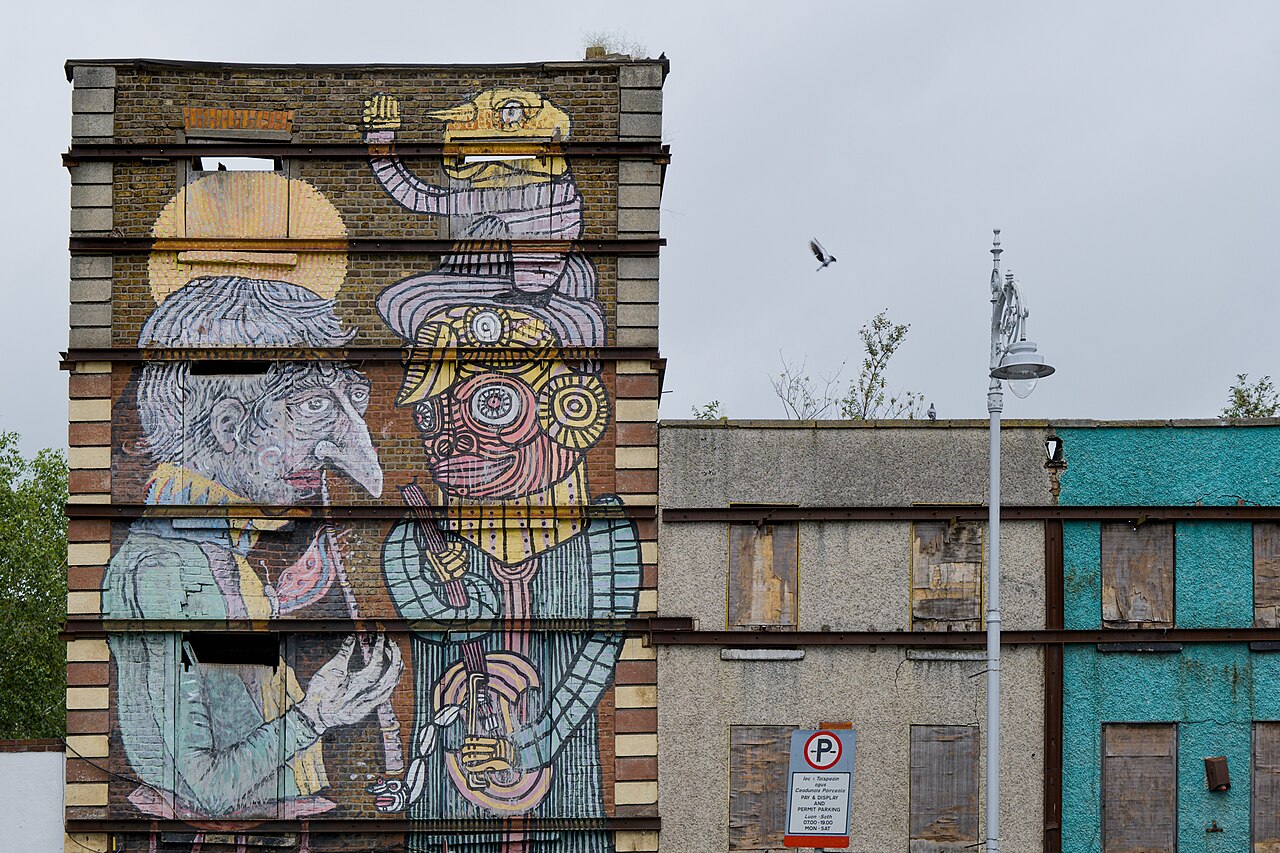
The best first stop for Dublin murals is Smithfield Square, where a tall brick end wall carries two enormous figures. One is gray-haired with a long nose and a thoughtful, sideways look. The other wears a striped hat and a pair of round, target-like eyes, with a sunburst glowing behind. The photographer's note names the artists as Danilo Quo Vadis and Giuseppe Tilf and dates the wall to 2013. Notice how the painters let the building's own horizontal steel bands run straight through the picture. The wall is part of the design, not an obstacle.
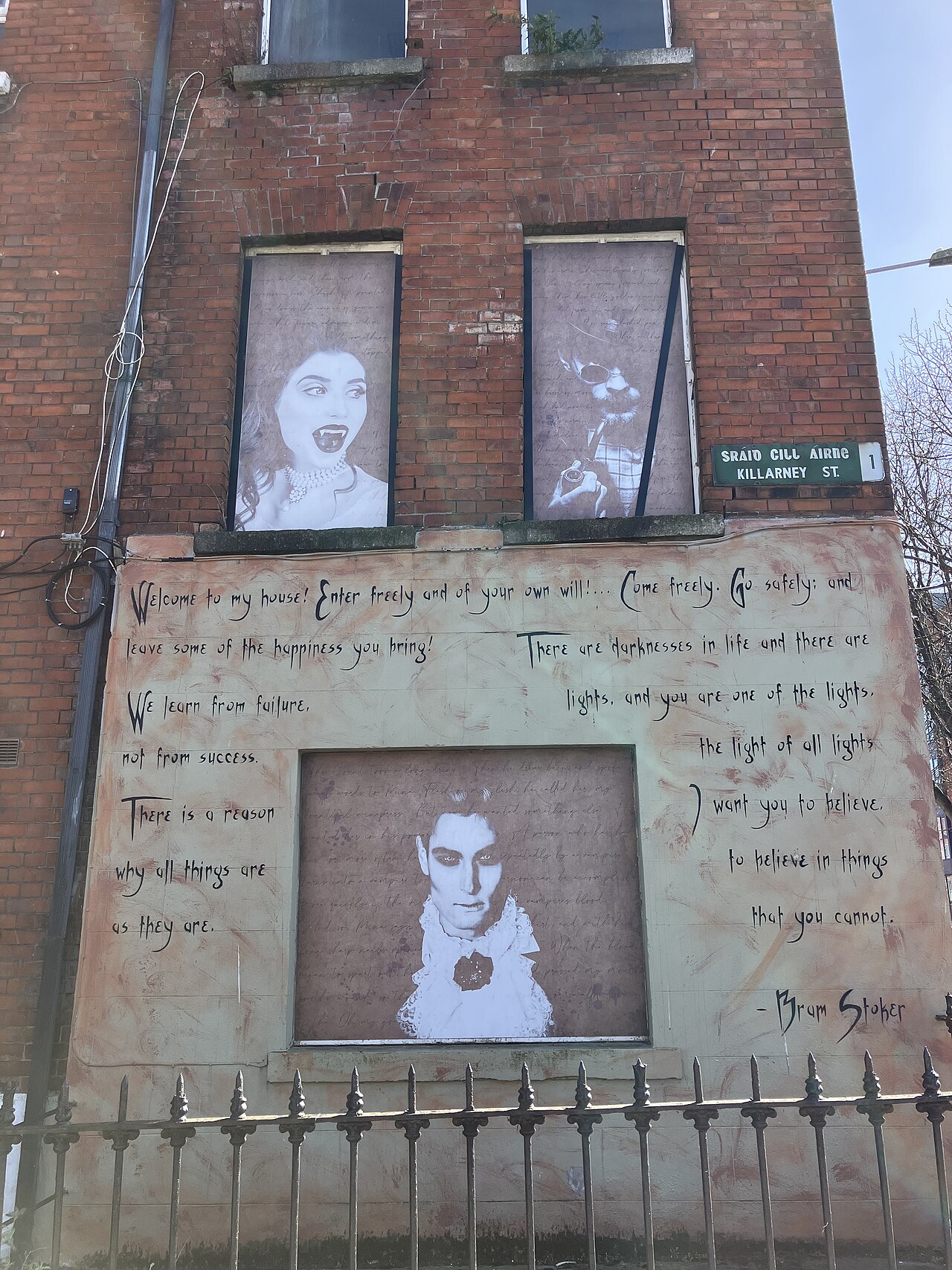
From Smithfield it is a short trip to the north inner city, where a house on Killarney Street was photographed in March 2025 with a very different kind of wall. Below two windows, a pale painted panel is lettered in black with lines signed Bram Stoker, and each boarded-up window holds a black-and-white portrait with a vampire's gaze. It is part mural, part theater set, and it turns an ordinary brick gable into a story. Dublin is, after all, where Stoker was born, and the street seems to know it.

Old and new on the walls of the city center
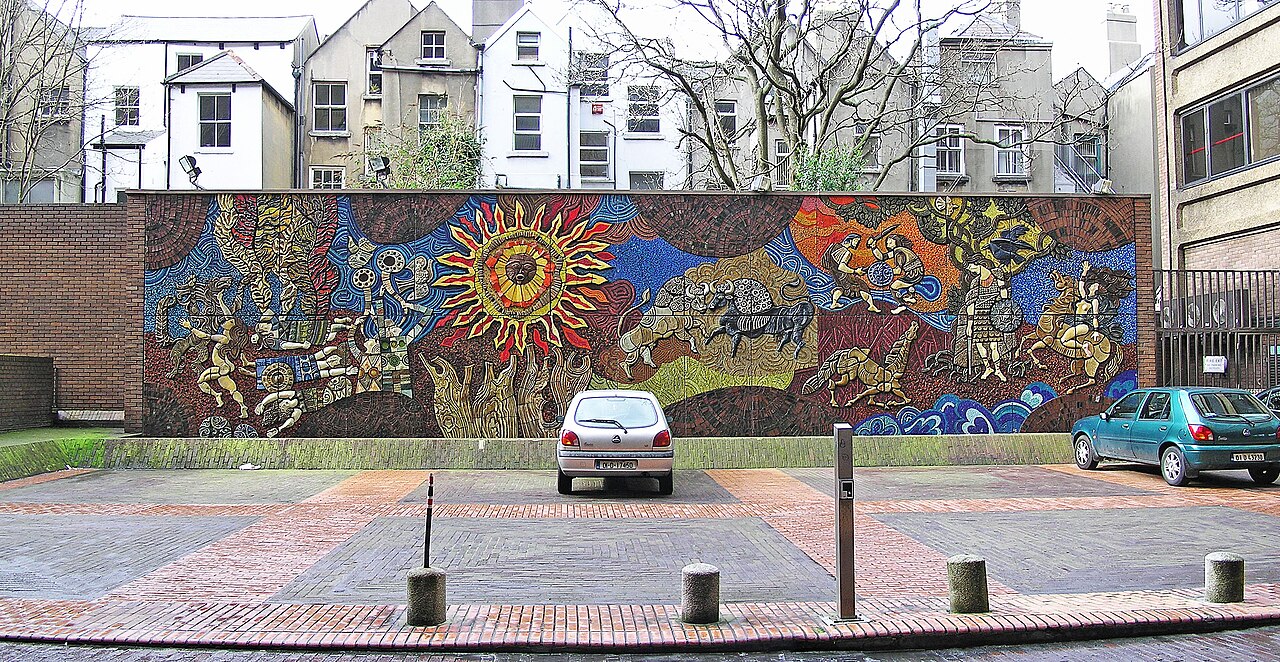
Not every Dublin mural is spray paint. In the city center a long brick wall above a paved car park is covered in a wide mosaic of a sun, bulls, horsemen and warriors, set in blues, oranges and golds. The photographer's categories identify it as the Táin Bó Cúailnge mosaic by Desmond Kinney, which other photos on Wikimedia Commons describe as a 1974 work. It is a good reminder that murals in Dublin have a long history, and that a big wall has always been a place to tell a big story.
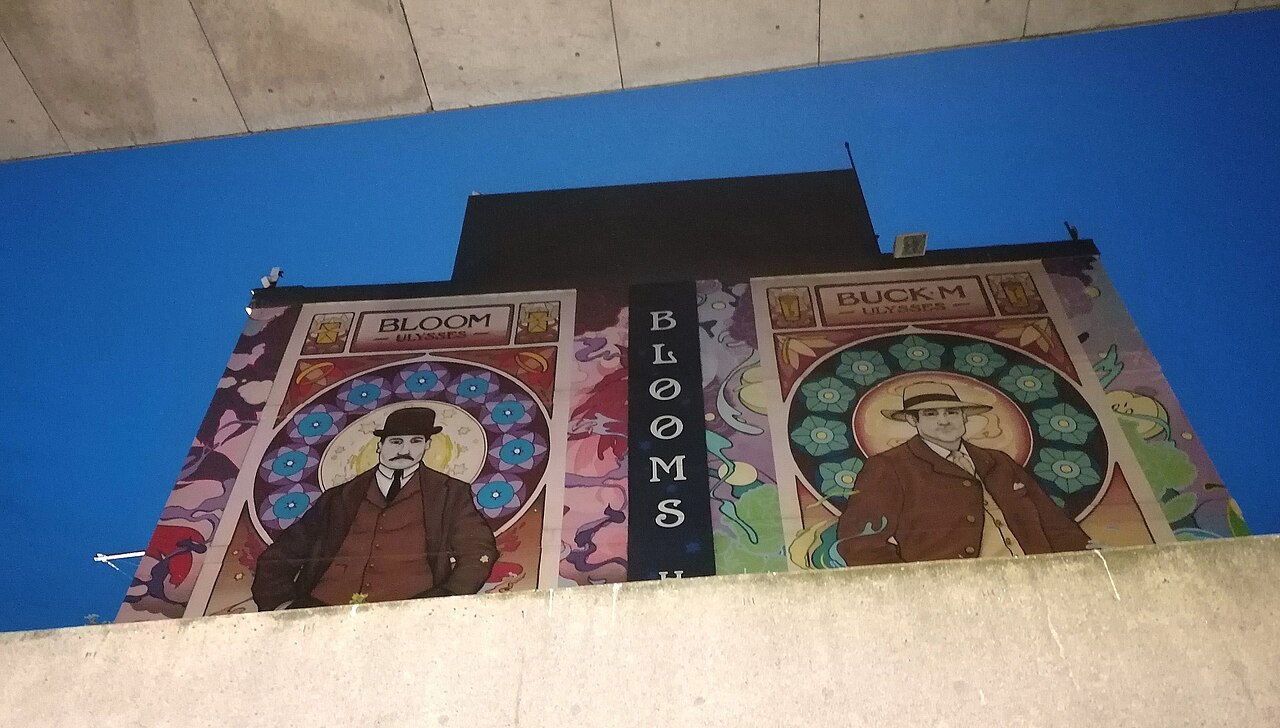
Near Temple Bar, a hotel wall carries a newer story. Photographed from below in August 2025, two Art Nouveau style panels sit either side of a tall vertical sign reading BLOOMS. Each panel holds a portrait in a ring of blue flowers, one labeled Bloom and the other Buck-M, with the word Ulysses on both. It is a neat way to put a famous novel on the side of a hotel.
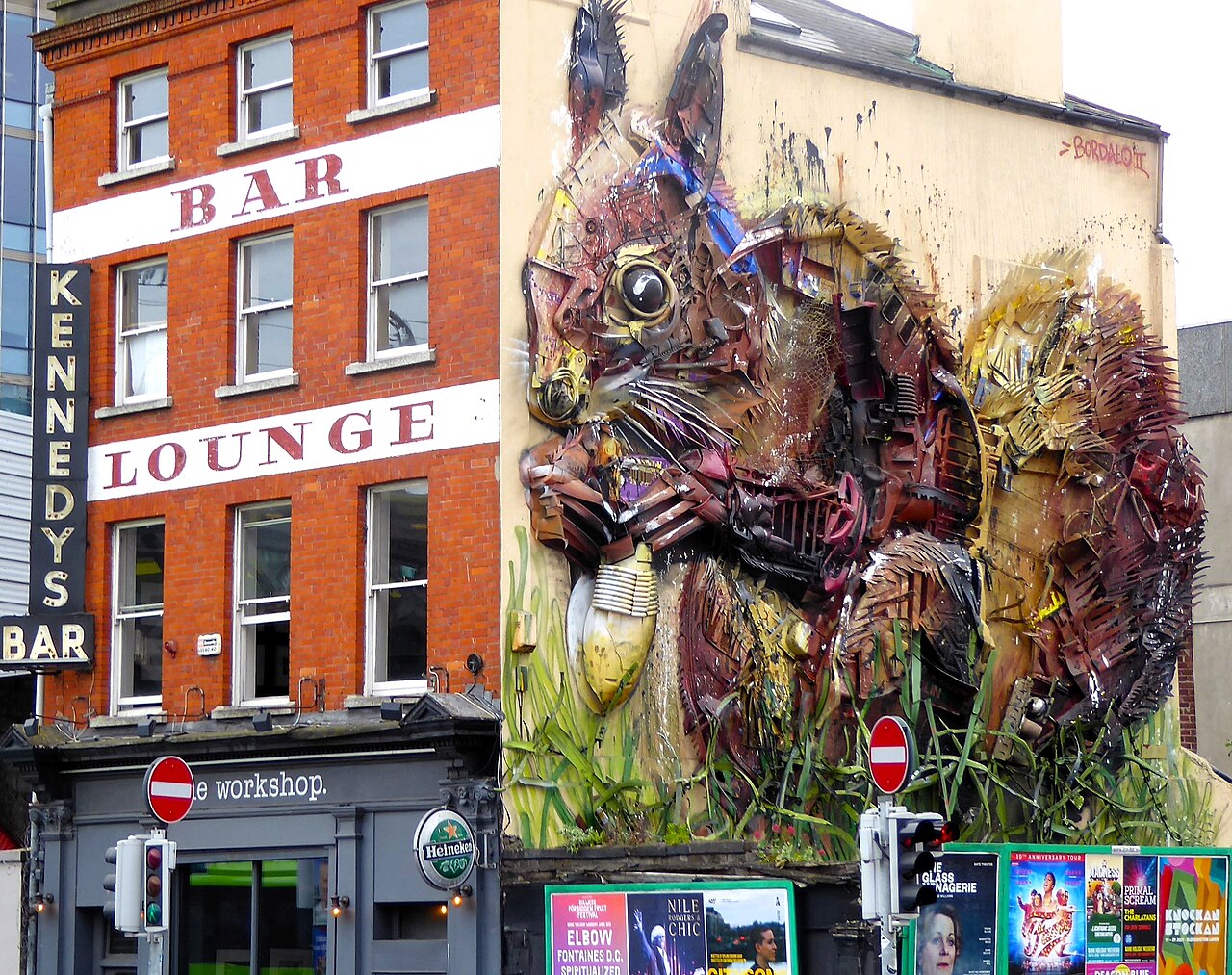
A few streets away, a corner building shows a squirrel-like animal that looks assembled from scrap pieces and painted details. It climbs the side of a red brick bar and fills the whole wall, a giant creature looming over the street. It was photographed in September 2025.



Portobello and the streets around Richmond Street
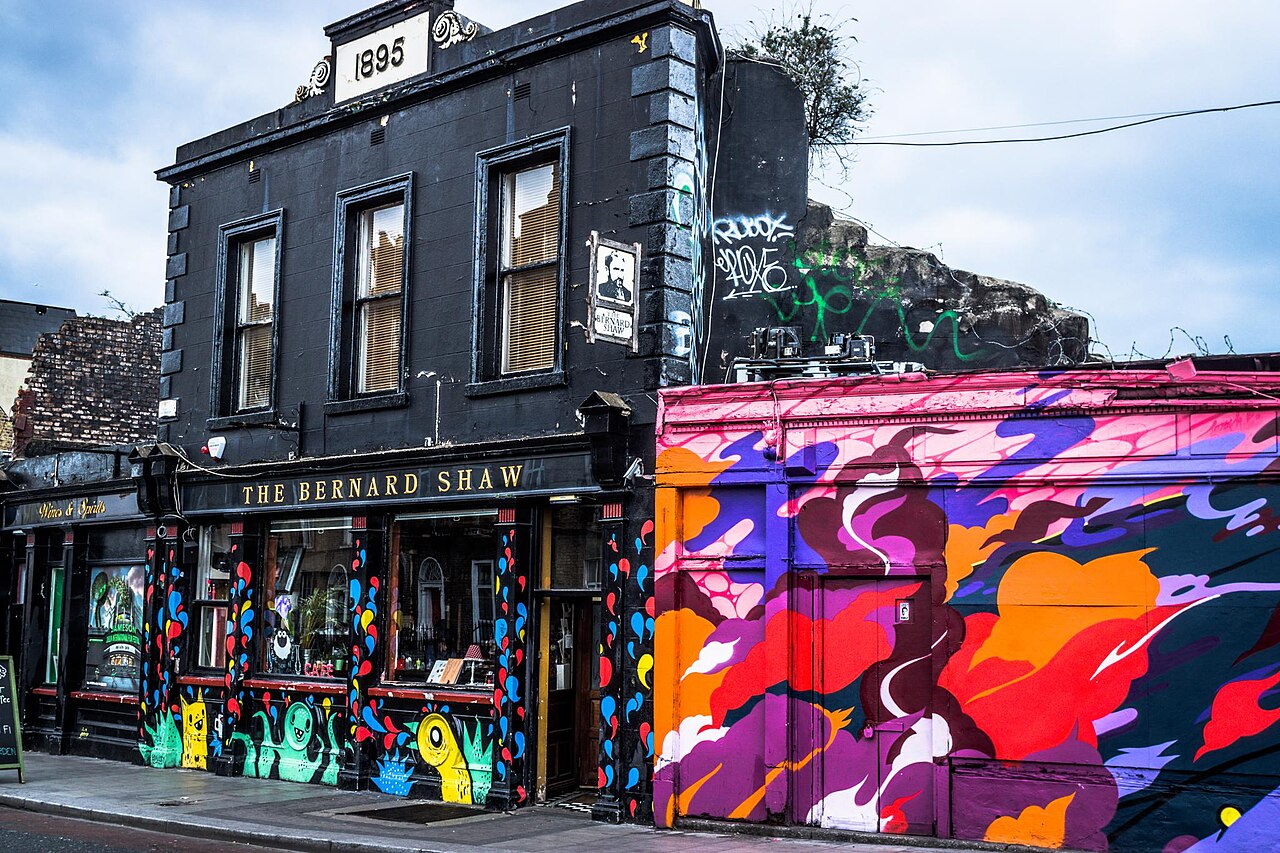
Portobello, south of the city center along the Grand Canal, is where Dublin's painted walls feel the most like a neighborhood. In a photo from April 2012, a black pub front called The Bernard Shaw is trimmed with painted creatures and drips of color, while the long wall beside it is covered in swirling pink, purple, orange and red. It shows how a mural can be a shopfront and a street sign at the same time: you know where you are before you read a word.
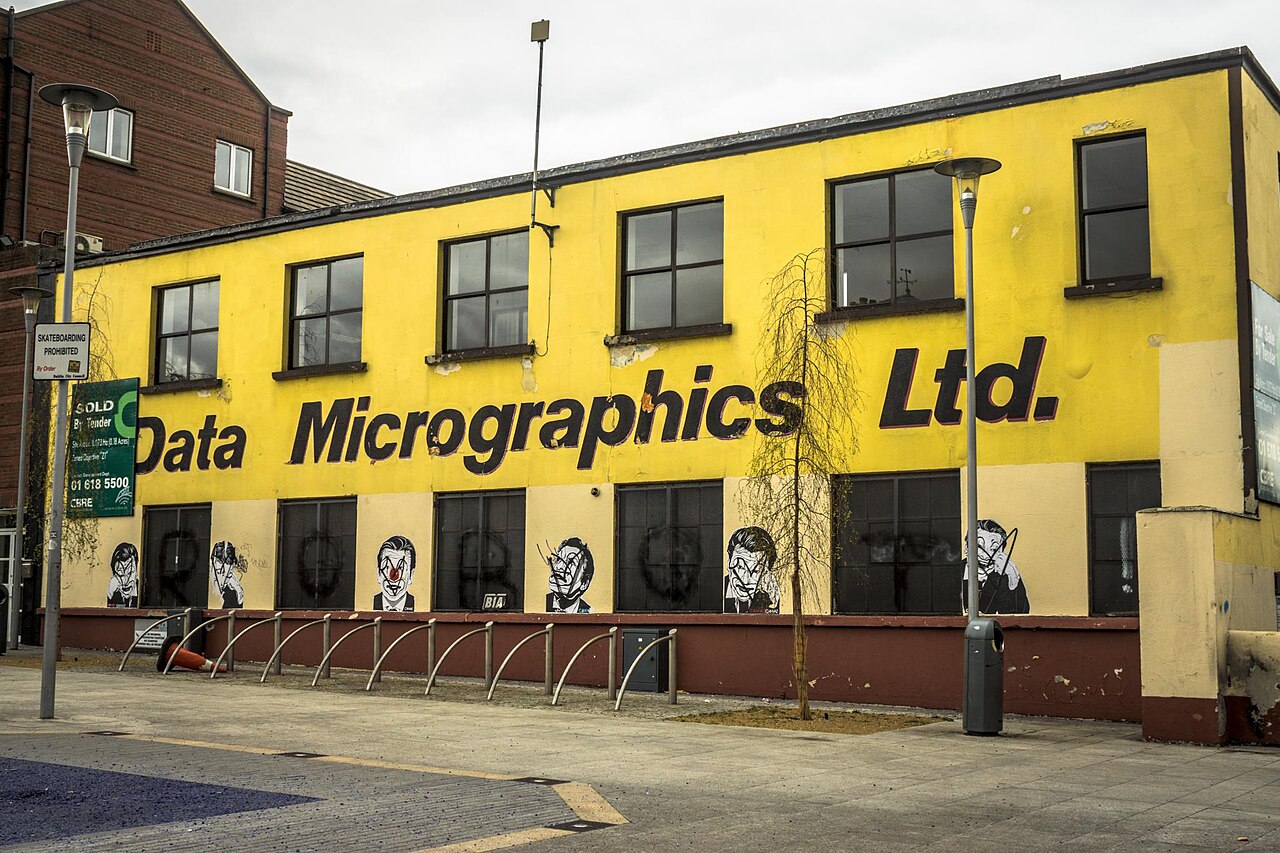
A second photograph from the same area shows a yellow two-story building with black-and-white painted faces lined up along its ground floor, each with a slightly comic expression. The effect is a row of onlookers watching the pavement, a simple idea that works because it repeats.


The Docklands and Barrow Street
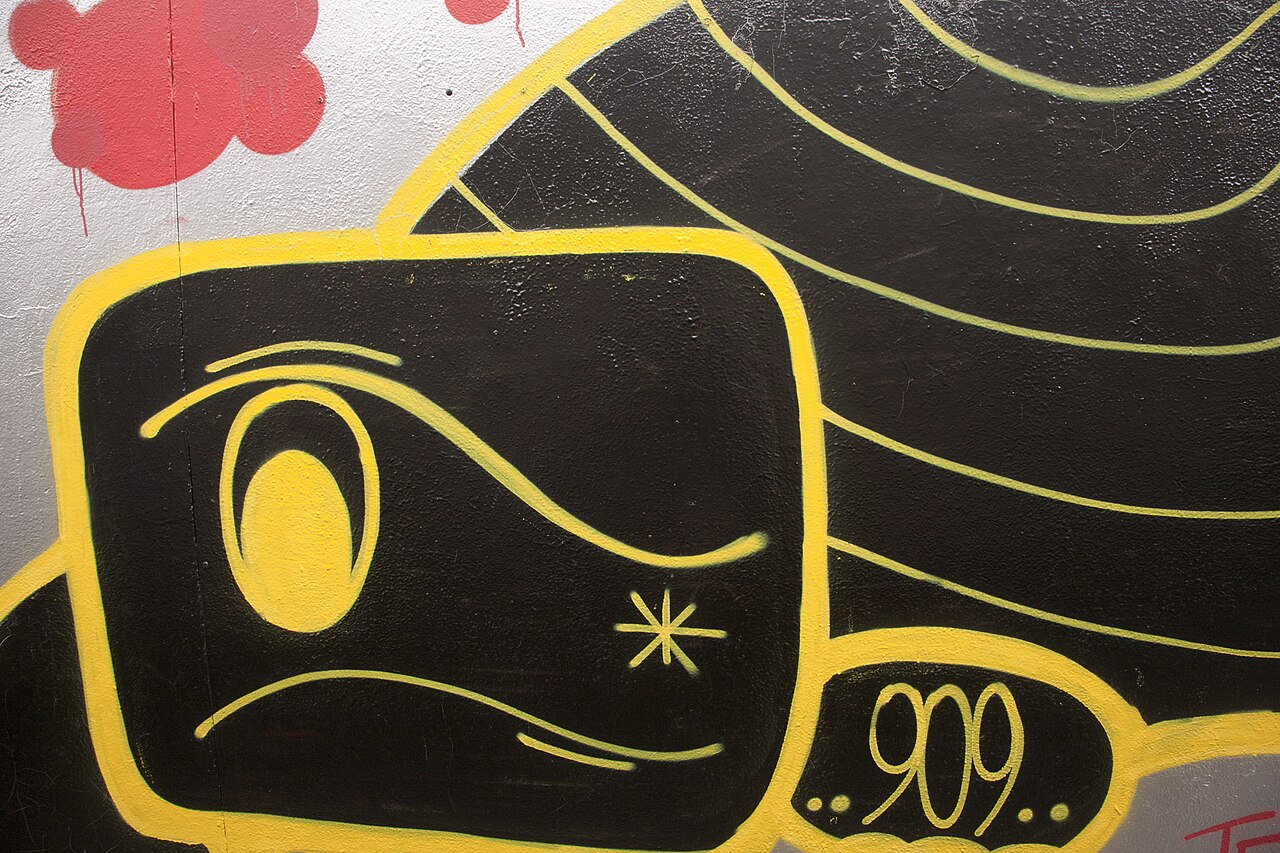
The Docklands are newer, with glass offices and wide pavements, and the walls here come in all sizes. In a photograph from June 2010, a black character with a yellow outline and a big yellow eye is painted on a silver wall, a bold shape that reads from across the street.
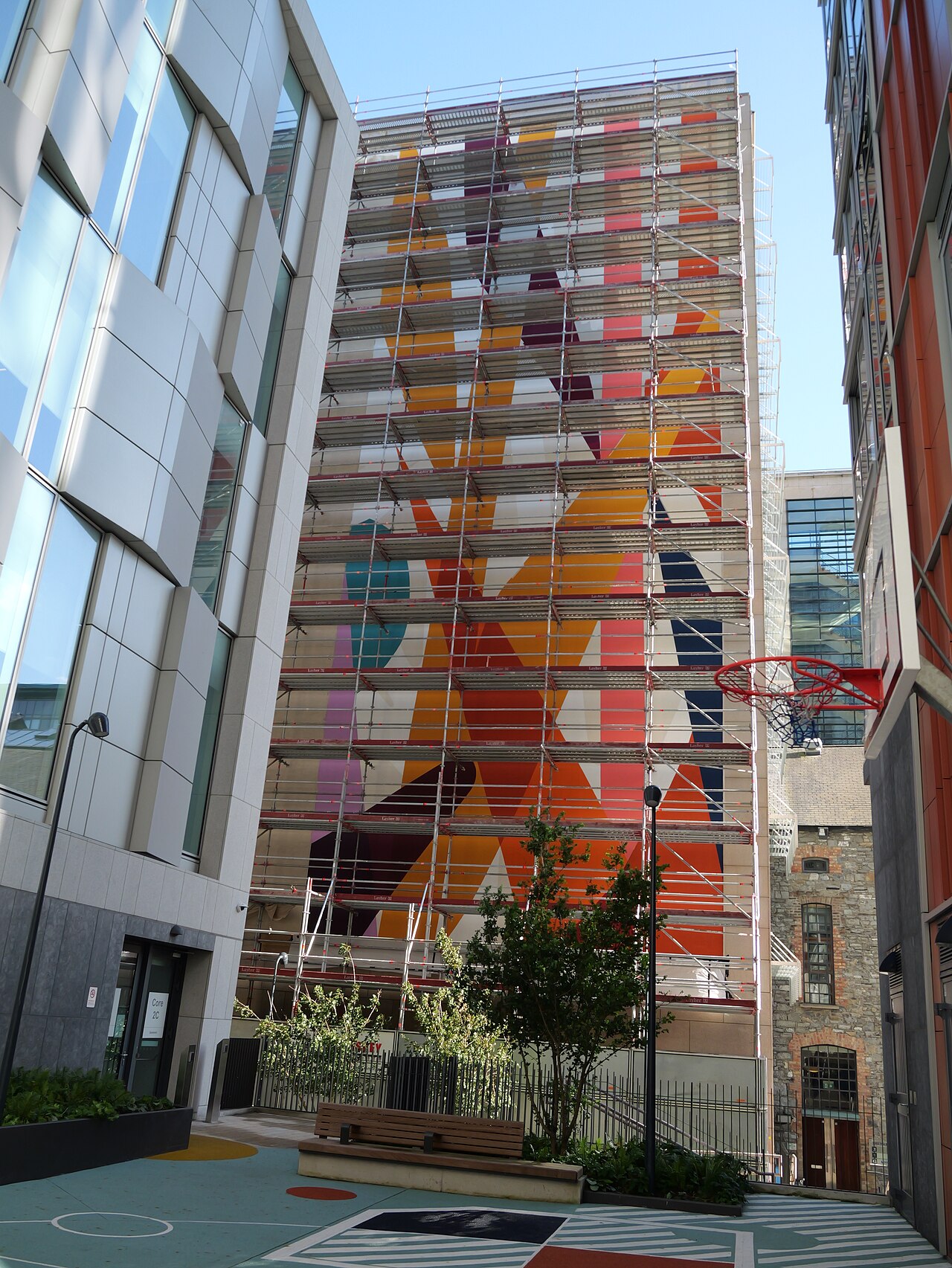
On Barrow Street, a photograph from July 2025 shows a tall wall at South Bank House wrapped in scaffolding, with orange, pink, purple, teal and navy geometric shapes showing between the platforms. The photographer's note says it was one week of painting. A companion photo names the artist as Sean Atmos. It is a rare chance to see the work of a mural in progress, and a reminder that a wall this tall is a real piece of logistics as much as a painting.


Sandymount, by the sea
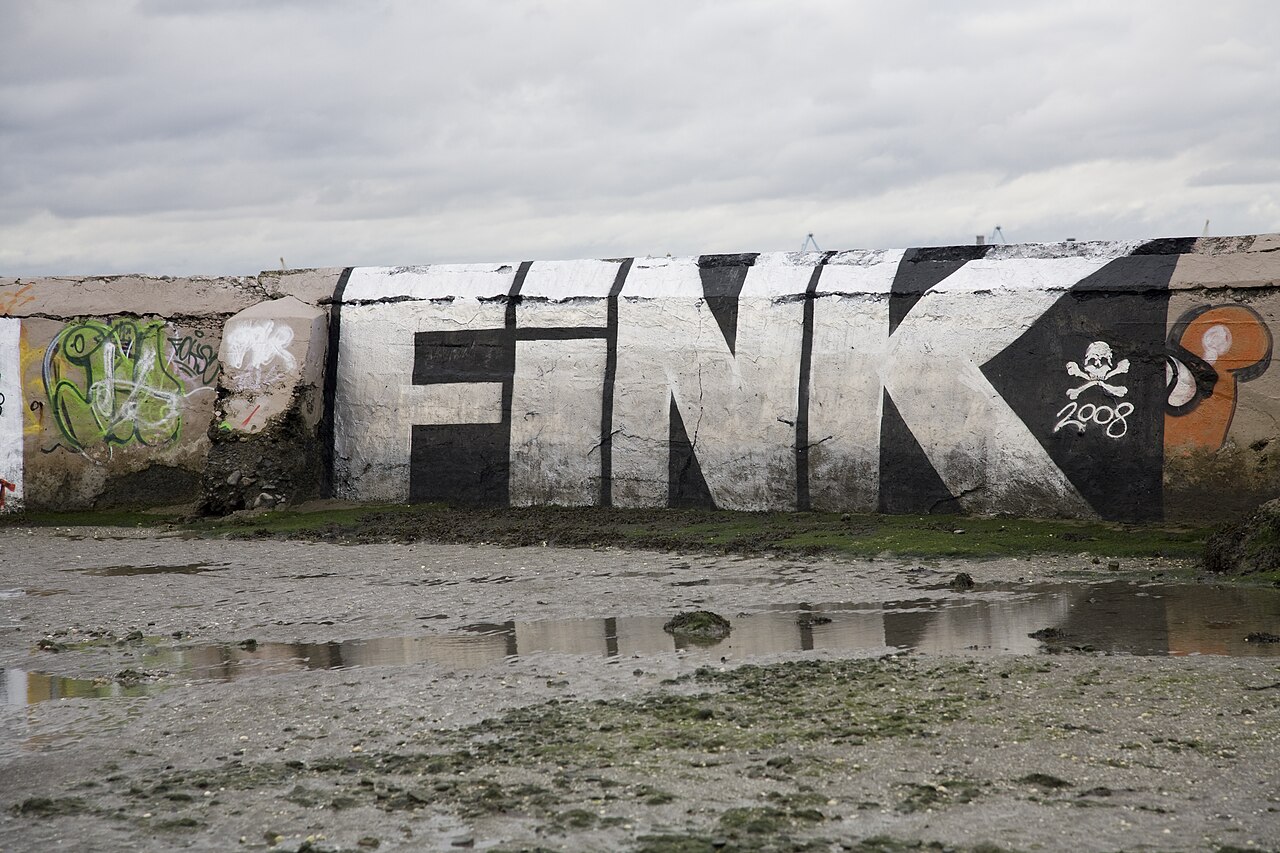
Dublin's walls are not only on streets. On the strand at Sandymount, a long concrete sea wall was photographed in February 2008 with huge black and white block letters painted across it and an orange character at the right, the mud flats stretching out in front. It is a very different setting from the brick lanes of the center. The wall has the sky, the tide and the weather for company, and the letters stand out against all three.

Hoardings, lettering and the temporary wall
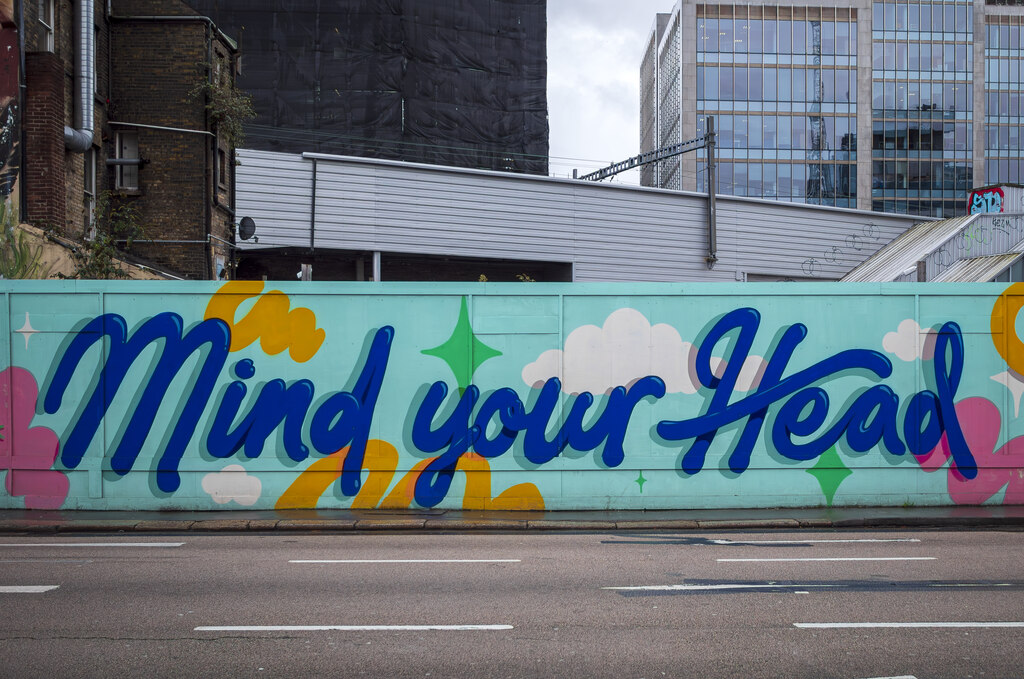
Some of the most cheerful walls in any city are the temporary ones. A long turquoise hoarding in a photograph from October 2023 carries the words Mind your Head in rounded blue script, with clouds, stars and flowers floating around them. A construction fence becomes a friendly sign, and the writing does the job of a warning in a far better mood than the usual sticker.

How to see Dublin murals on foot
Dublin is compact, so pick a route and walk. Smithfield and the north inner city pair well in a morning. The city center, with its mosaic and the Temple Bar walls, suits an afternoon, and Portobello is a short walk south along the canal. Barrow Street and the Docklands sit on the east side, and Sandymount is a tram or bus ride out. Many of the photographs here are several years old, so some of these walls will have been painted over or replaced. Check recent photos before you set out.
Our Dublin field guide page lists more of the city's walls, with locations and credits, for anyone who wants a longer route.
If you have a wall in mind
Every wall in this story began as a blank surface and someone's decision to leave it less blank. If you manage a building and keep looking at a wall, we would be glad to hear about it. Tell us about your wall and we will take it from there.
Frequently asked questions
- Where can I see murals in Dublin?
- Good places to start are Smithfield Square, the city center around Temple Bar, Portobello along the Grand Canal, the Docklands and Barrow Street, and the sea wall at Sandymount.
- Who painted the Smithfield Square mural?
- The photographer's note on Wikimedia Commons names the artists as Danilo Quo Vadis and Giuseppe Tilf and dates the mural to 2013.
- What is the Táin mosaic in Dublin?
- It is a large mosaic mural by Desmond Kinney of the Irish epic Táin Bó Cúailnge, the tale of the cattle raid of Cooley. Photographs on Wikimedia Commons describe it as a 1974 work.
- Are the murals still there?
- Some walls stay for years and others are painted over or replaced. Several of the photographs here date from 2008 to 2012, so check recent photos before you go to see a particular wall.
All photos are free-licensed and credited under each image; license links go to the original file pages.