City story · London · 7 min read
London Murals: Street Art on the Walls of the City
London is a city of brick, and brick makes a very good canvas. Painted tunnels, side streets and end walls turn a walk across town into a gallery visit. A slow tour of the London murals worth the detour.

Start under Waterloo
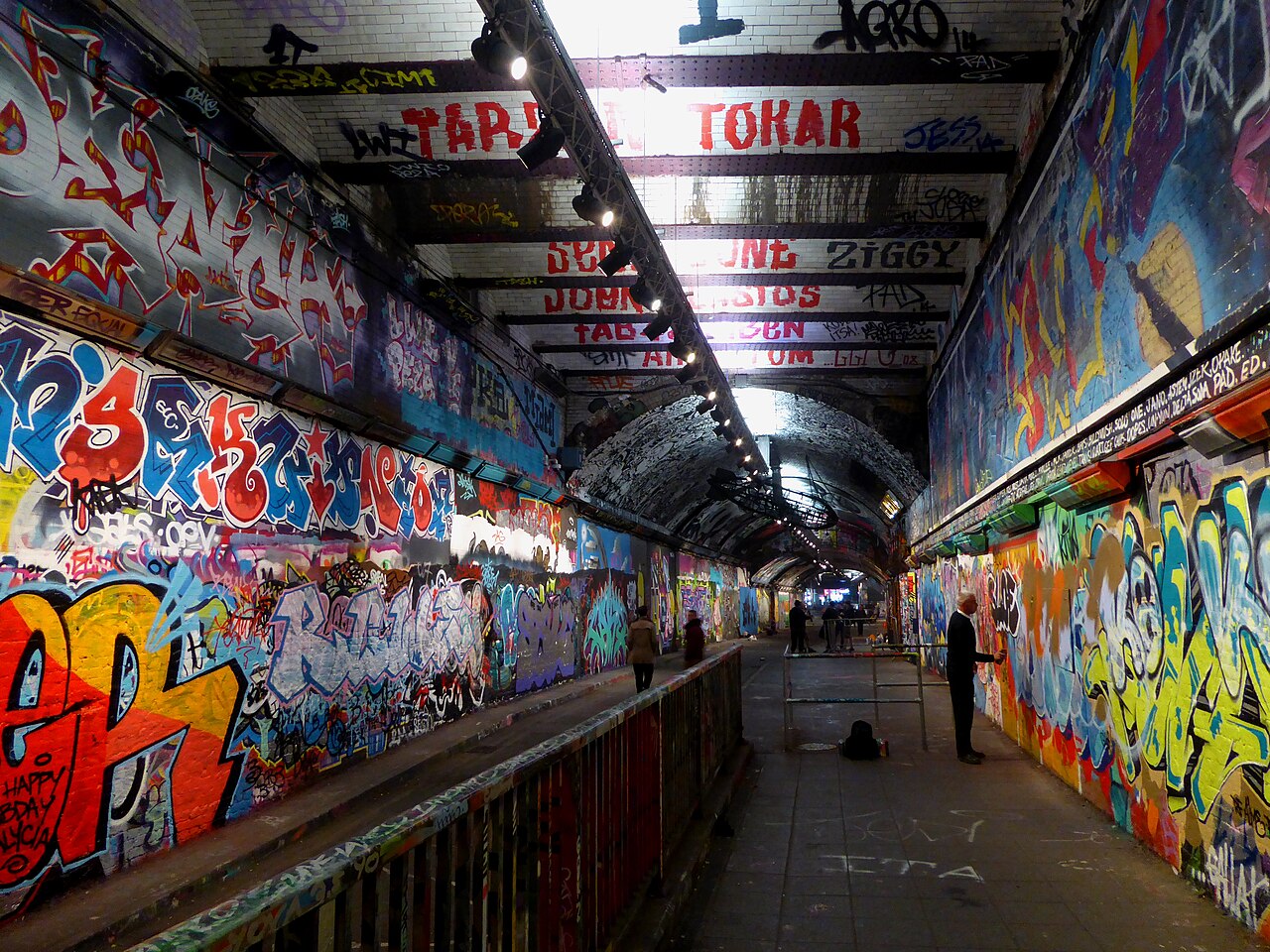
The best first stop for London murals is a tunnel. Leake Street runs beneath the railway lines at Waterloo, and every surface of it, from the brick walls to the vaulted ceiling, is covered in paint. Nothing stays the same for long. Come back in a month and whole stretches will have been repainted, which is part of the appeal. In the photograph a painter is standing at the wall, mid-piece, and that is exactly the feeling of the place: it is a working wall, not a finished one.
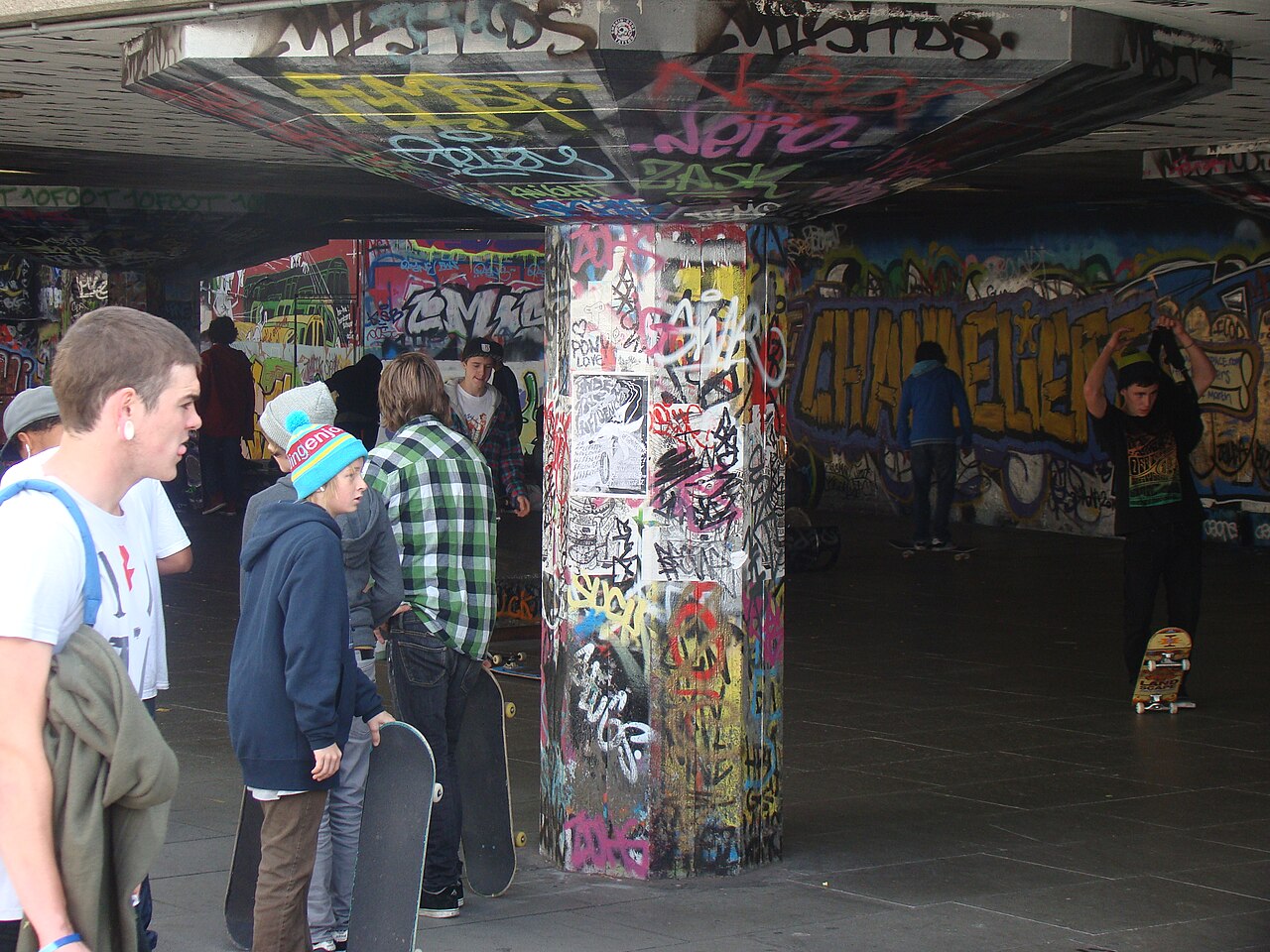
A short walk along the river brings you to the undercroft beside the Southbank Centre, where skaters share a concrete space with decades of lettering. The columns, ceilings and low walls are layered with names and colors, and the whole place hums. It is a good reminder that painted walls in London are not only things to look at. People live, skate, meet and work around them.


Brick Lane and the streets around it
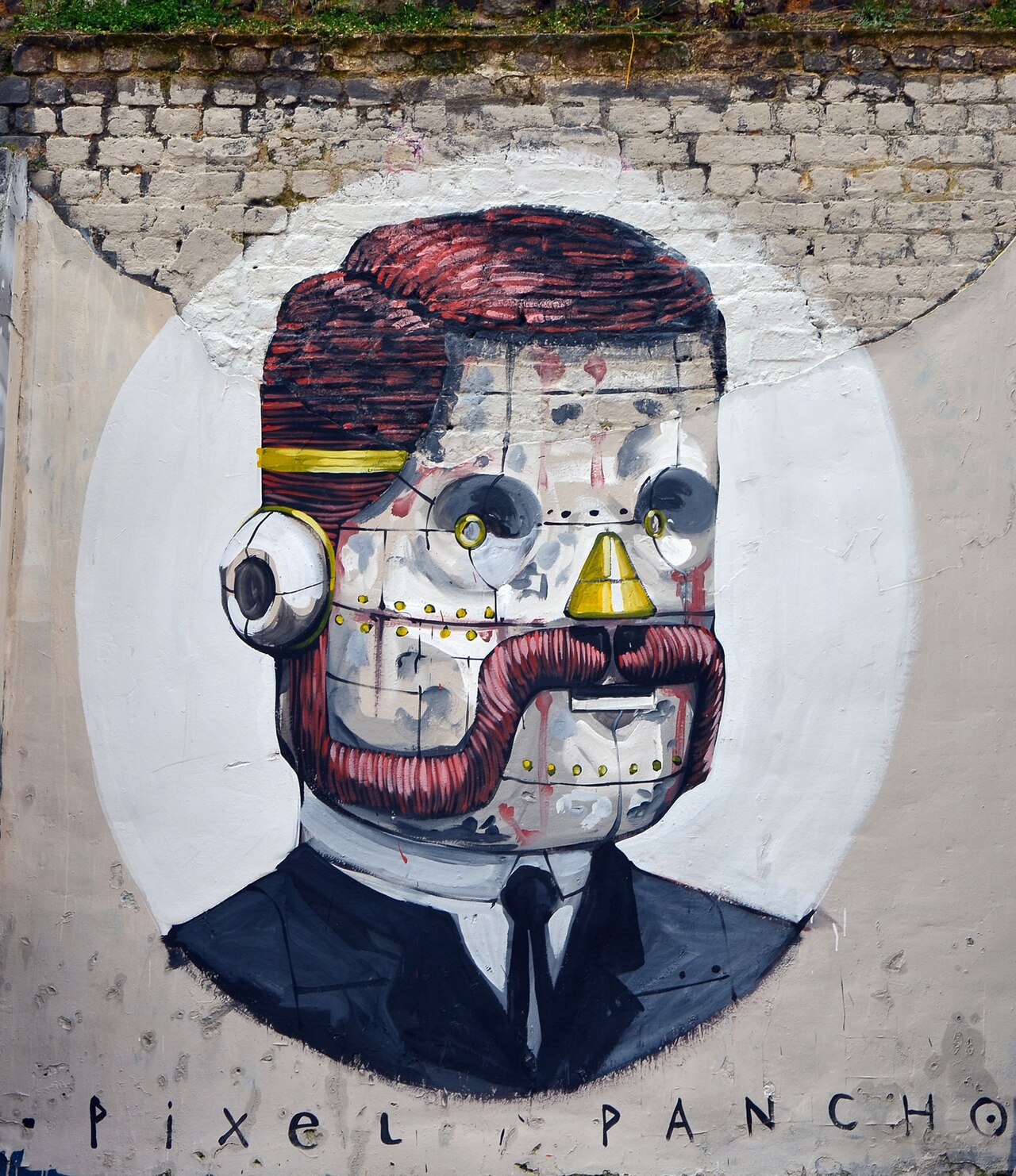
Cross the river and head north-east to Brick Lane, and the scale changes. Here the walls are the sides of old warehouses, yards and passages, and the paintings tuck themselves into them. Just off the lane, a wall carries a large portrait of a man with a robot face, a red mustache and a neat dark suit, set inside a white circle and signed Pixel Pancho. The photographer's caption on Wikimedia Commons notes that the artist is from Turin, which is a nice detail: London's walls have long been a place where painters from other cities come to leave something behind.
What strikes you about the Brick Lane area is how little space a good mural needs. A bare patch of brick, a circle of white paint and one confident face are enough to stop people in the street.

Shoreditch backstreets
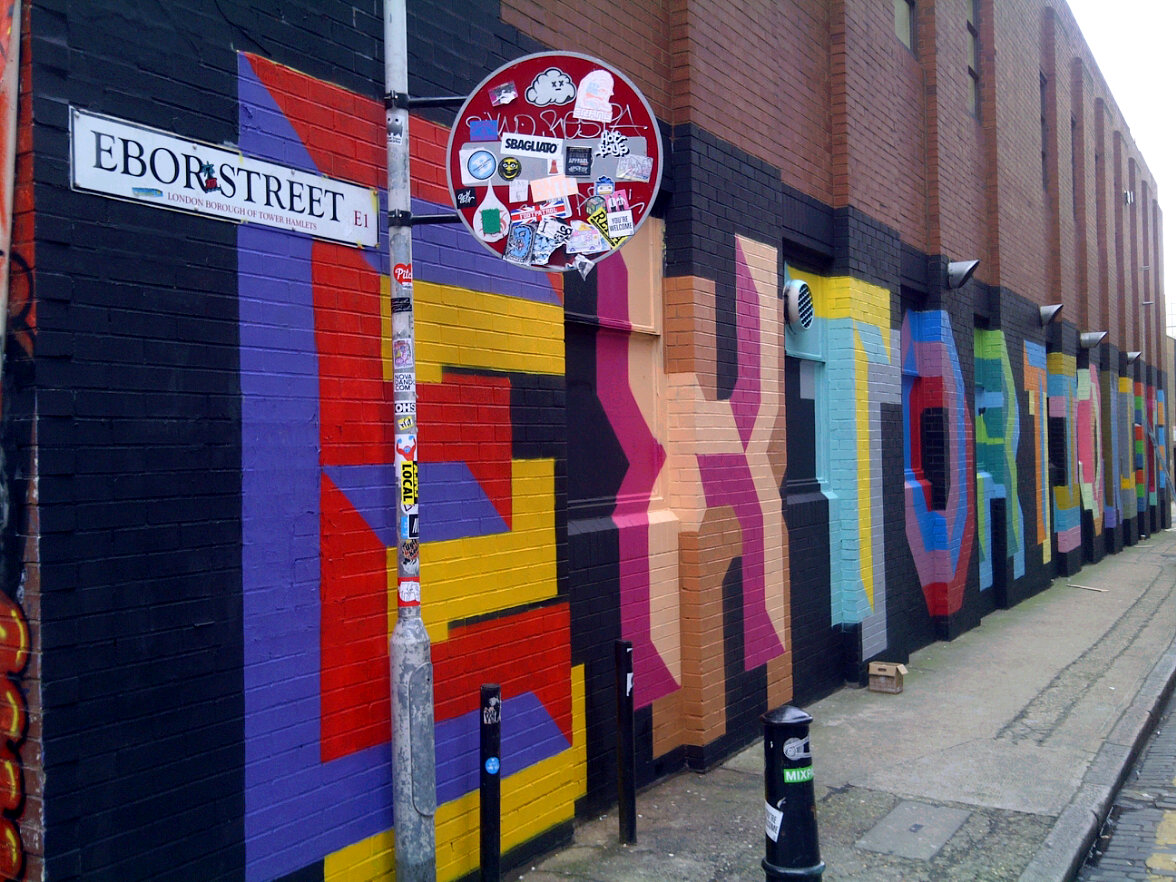
Shoreditch is where London's street art is easiest to find, and the trick is to leave the main streets. On Ebor Street, a whole run of black brick wall has been painted with oversized block letters in red, purple, yellow, pink and turquoise. The photographer's note credits the piece to Ben Eine. It is a lesson in how letters can become pure shape: you read the colors first and the words second.
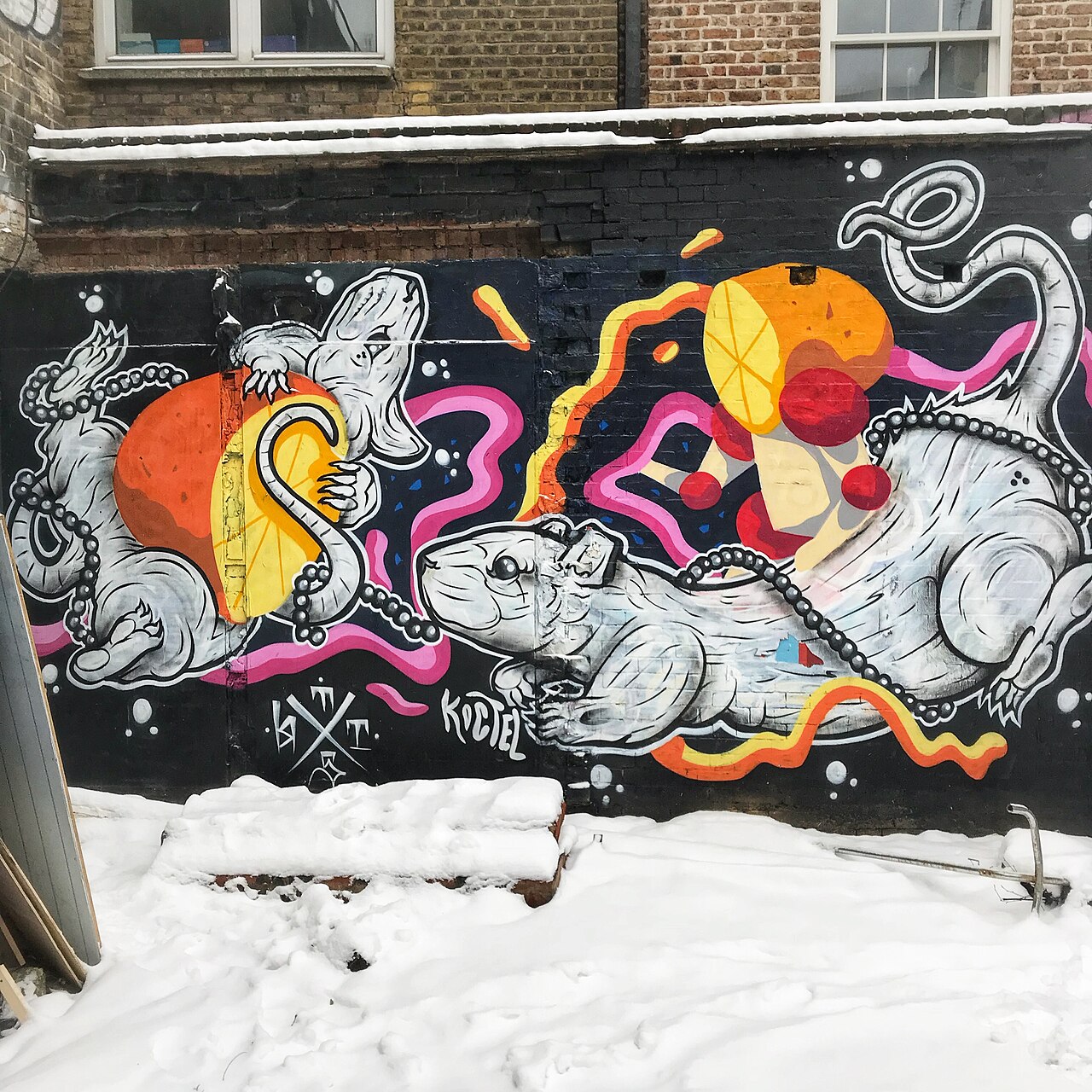
Further in, in the Star Yard car park, a black wall holds a very different picture. Two pale rats lie nose to nose with orange fruit and ribbons of pink and yellow floating around them, a collaboration between the artists Thisone and Koctel, photographed in snow in March 2018. Nearby, on Holywell Lane, a wall nearly as long as the street itself shows riders and a golden carriage in a birch wood, the kind of painting that makes a stretch of pavement feel like a stage set.
Shoreditch walls change quickly, so treat any list as a starting point. The point of the neighborhood is that the next alley might have something you have not seen.


Hackney Wick: a word as a wall
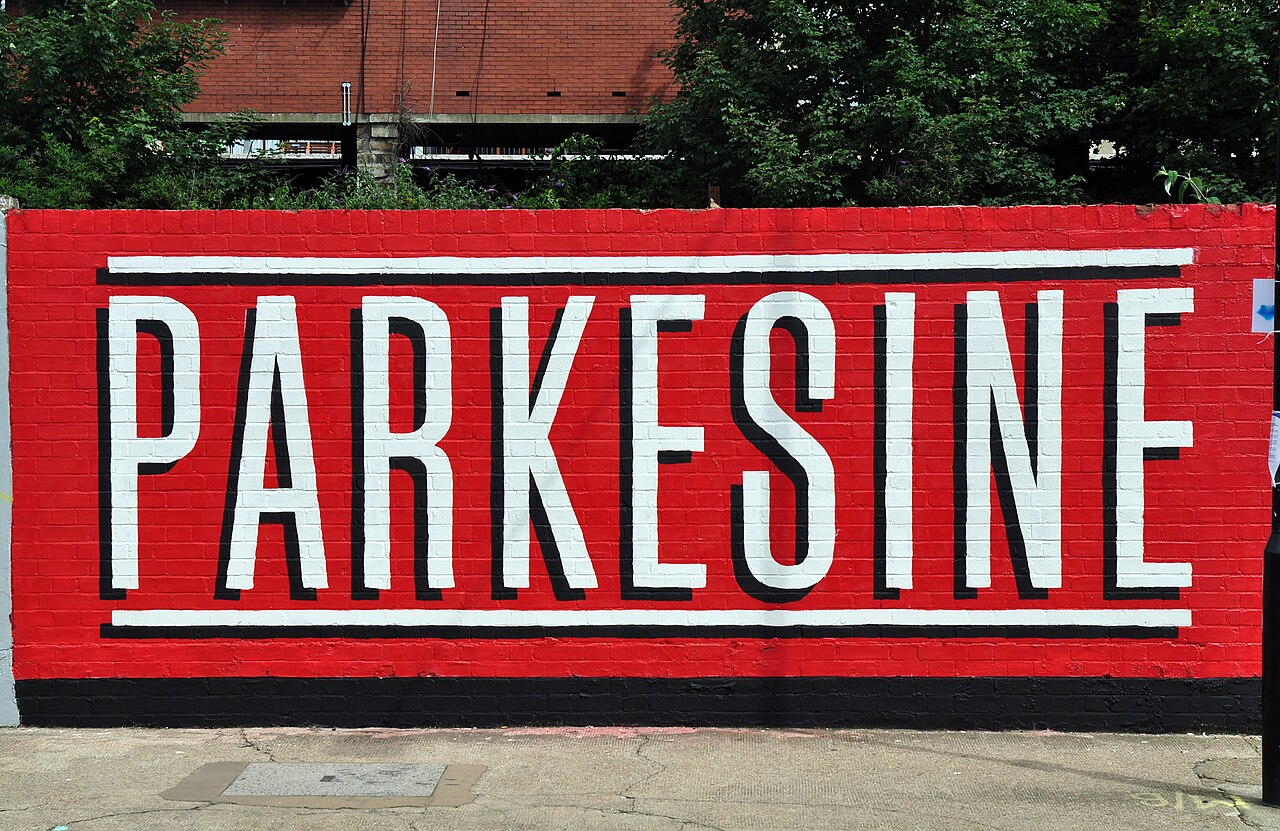
Hackney Wick, by the canals in the east, is a neighborhood of studios, warehouses and murals. One of the simplest is also one of the most memorable: a red brick wall painted with the single word PARKESINE in tall white letters with a black shadow. According to the photographer's caption, the first man-made plastic was manufactured in Hackney Wick in 1866, and the mural is by the Bread Collective, painted in July 2012.
It is a lovely example of what a mural can do for a place. A bare wall now carries a piece of local history, and anyone who walks past can read it from across the street.

Dalston shutters and hoardings
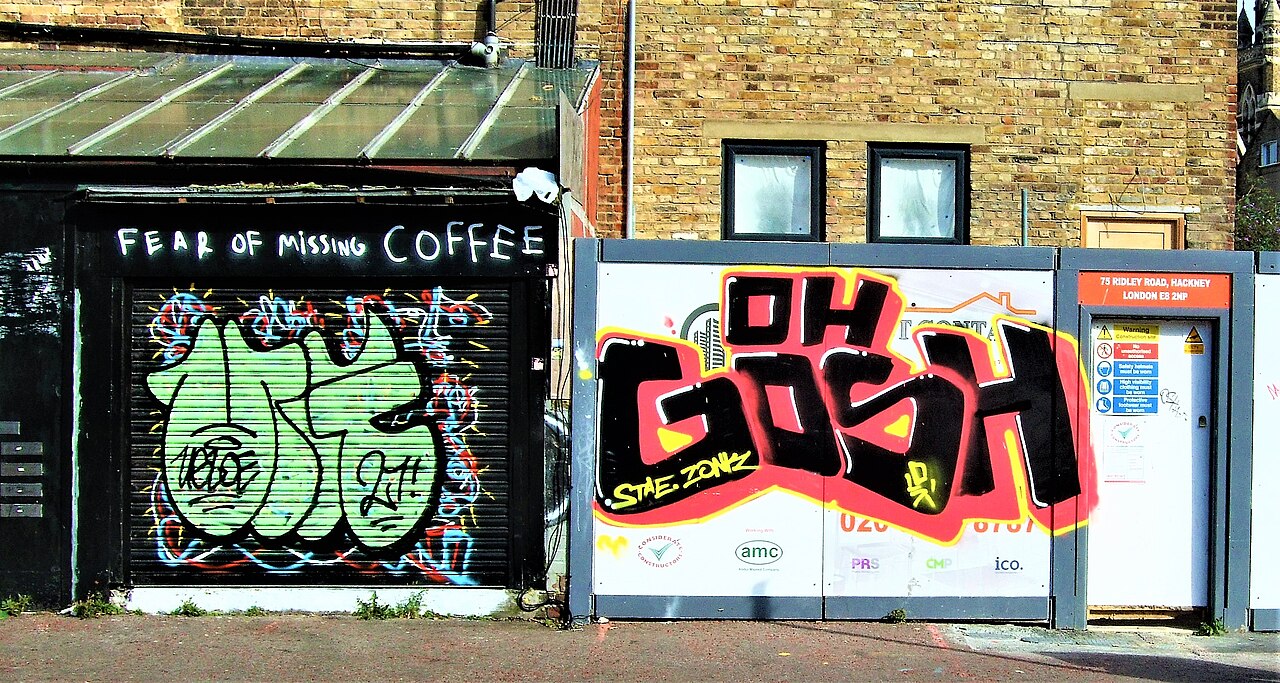
Not every wall in London is a showpiece. In Dalston, on Ridley Road, the painted surfaces are everyday ones: a shop shutter with a green piece outlined in red and blue, and a construction hoarding beside it carrying a bold black and red graffiti piece that reads, as far as the lettering allows, Oh Gosh. Above the shutter, a line of hand-painted text jokes about missing coffee.
This is street art at its most ordinary and, in a way, its most honest. Shutters and hoardings exist to be covered, and in a busy market neighborhood they become part of the street's character. Look closely and you will see how much care goes into the lettering.

Camden's painted corners
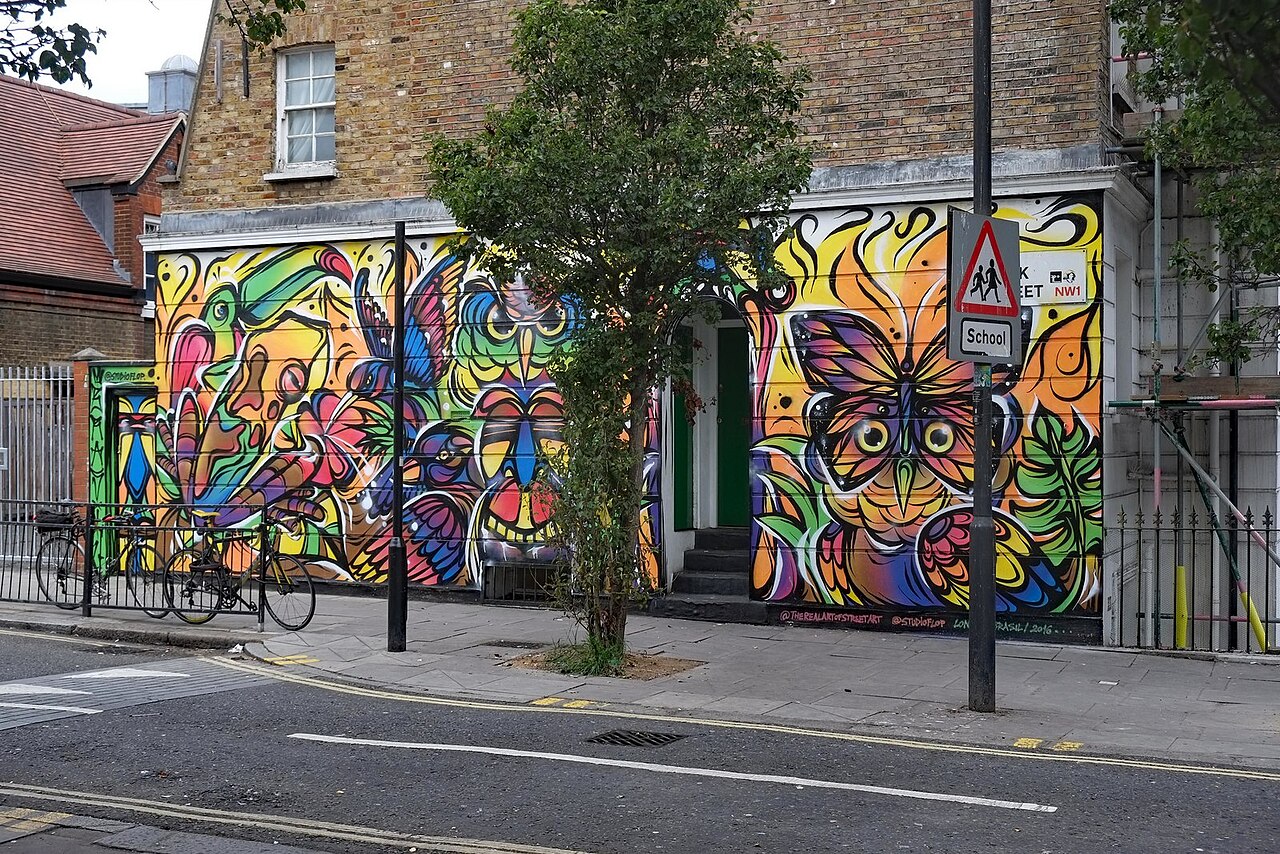
North of the center, Camden Town has long been the part of London most comfortable with color. On Buck Street, the front of a small corner building has been covered with owls, a butterfly and flowers in orange, yellow, green and blue, with the door set neatly in the middle of the design. It makes an ordinary street corner into a destination.
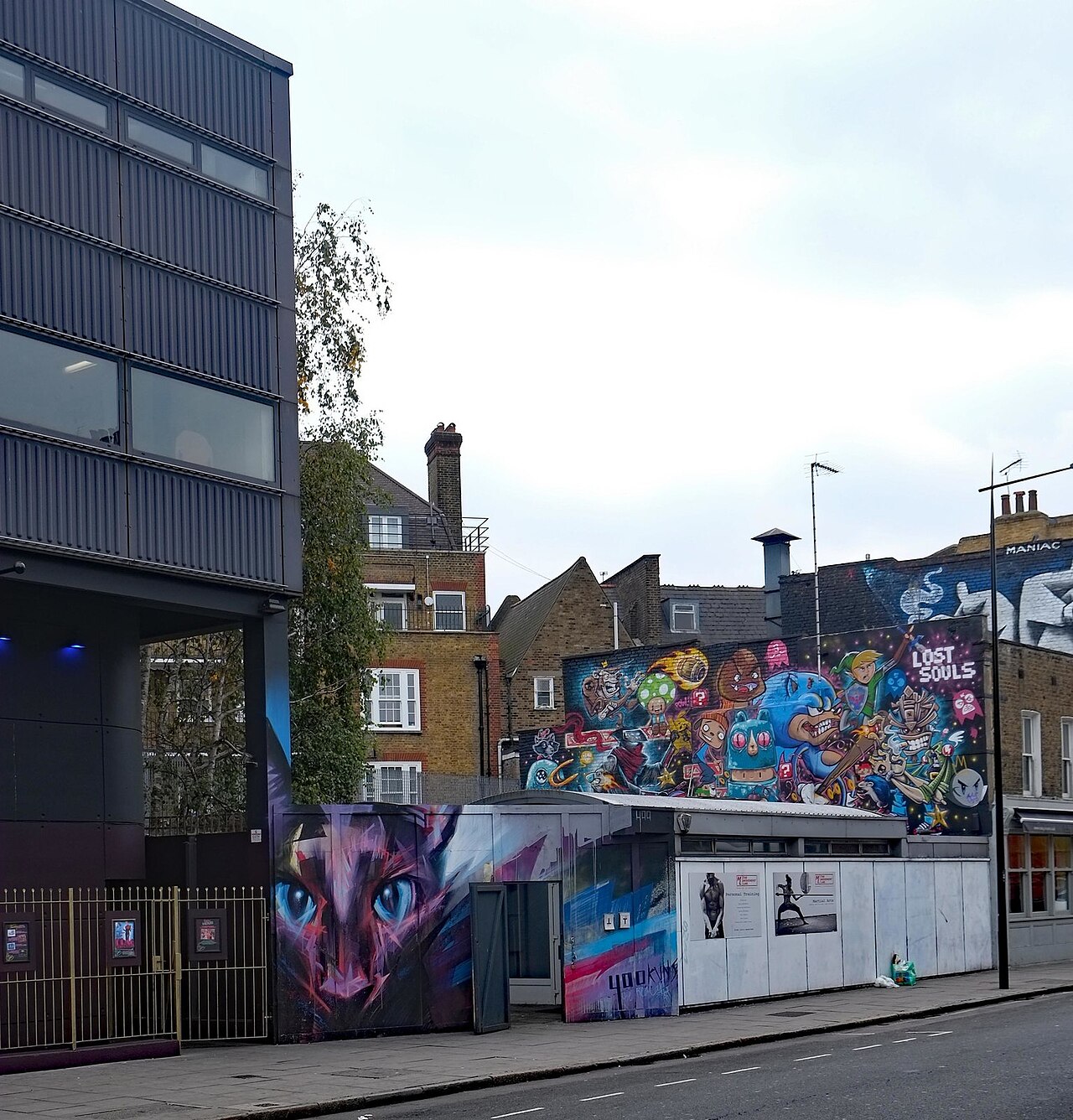
Close by, a run of hoardings and low walls is crowded with painted characters, including cartoon video-game figures under the words Lost Souls, and a huge blue-eyed cat face in purples and blues. The two walls could hardly be more different, and both fit comfortably into one short stroll.


Nuclear Dawn in Brixton
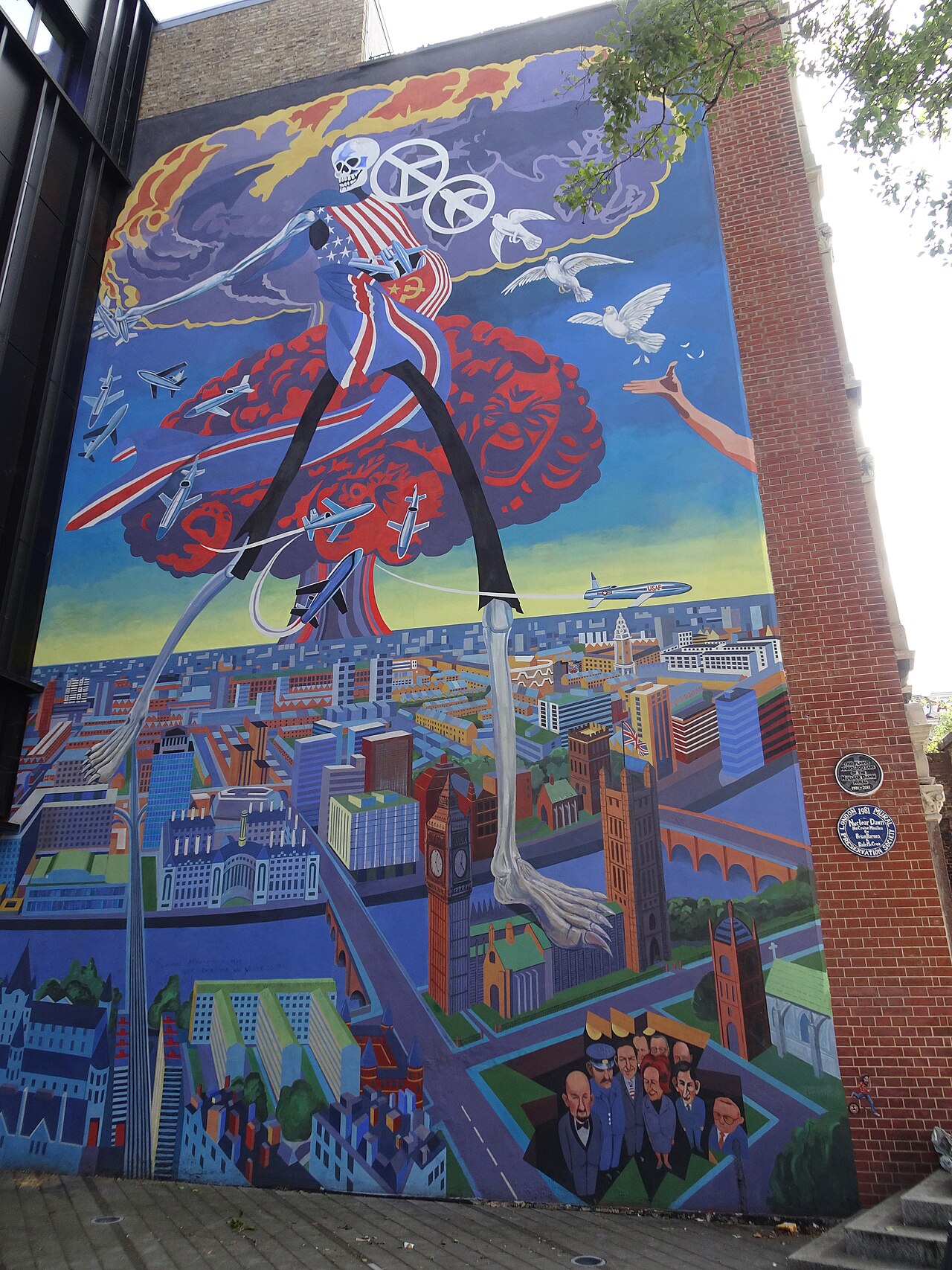
South of the river, Brixton has one of the best-loved murals in London. Nuclear Dawn covers the tall end wall of Carlton Mansions on Coldharbour Lane. It was painted in the early 1980s by Brian Barnes, with Dale McCrea and neighbors, as a protest during the Cold War, and the image is unforgettable: a skeleton wrapped in flags strides across a bird's-eye view of London, with Big Ben and the Thames at its feet, while white doves fly from a cloud above.
The mural was repainted and unveiled again in 2021, and it is still one of the first things people mention when they talk about murals in Brixton. It shows how long a painted wall can last when a neighborhood cares about it.

How to see London murals on foot
London is too large to see in a day, so pick two neighborhoods and walk. Waterloo and the Southbank pair well with Shoreditch and Brick Lane across the river. Hackney Wick and Dalston sit side by side in the east. Camden suits an afternoon of its own, and Brixton is worth a trip for Nuclear Dawn alone. Go in good light, look up as well as ahead, and expect some of what you see to be gone by next season.
Our London field guide page lists more of the city's walls, with locations and credits, for anyone who wants a longer route.
If you have a wall in mind
Every wall in this story began as a blank surface and someone's decision to leave it less blank. If you manage a building and keep looking at a wall, we would be glad to hear about it. Tell us about your wall and we will take it from there.
Frequently asked questions
- Where can I see murals in London?
- Good places to start are Shoreditch and Brick Lane in the east, the Leake Street tunnel at Waterloo, Hackney Wick and Dalston, Camden Town, and Brixton, which has the Nuclear Dawn mural on Coldharbour Lane.
- What is the Leake Street tunnel?
- Leake Street is a tunnel that runs beneath the railway lines at Waterloo in Lambeth. Its walls are covered with graffiti and street art that is repainted often, so the tunnel looks different from one visit to the next.
- What is the Nuclear Dawn mural in Brixton?
- Nuclear Dawn is a large mural on the end wall of Carlton Mansions on Coldharbour Lane. It was painted in the early 1980s by Brian Barnes with Dale McCrea and neighbors, and it was repainted and unveiled again in 2021.
- Are the murals still there?
- Some walls stay for years and others are painted over or replaced, especially in places like Shoreditch and the Leake Street tunnel. If there is a wall you want to see, check recent photos before you go.
All photos are free-licensed and credited under each image; license links go to the original file pages.