For developers · Chicago · 10 min read
Chicago Murals for Real Estate Developers: Brick, Winters and Block-by-Block Identity
A practical guide for Chicago developers and property managers on what a mural does for a building, how it holds up through a Chicago winter, and how to hire a muralist in Chicago.
Chicago murals for real estate developers start with a simple fact: this is a city of blocks, and every block has its own character. A mural helps your building say which block it belongs to. It gives a plain wall a point of view. Below are twelve practical ideas, from freeze-thaw prep to trail frontage to lobbies, plus the steps to commission one. We also introduce three of our Chicago mural artists along the way, and you can meet more of our Chicago mural artists on their own pages. Looking at Atlanta? See our Atlanta guide.
1. Built for Chicago Winters: Freeze-Thaw, Prep and Coatings for a Mural That Lasts
Chicago weather is hard on any exterior surface. Wet walls freeze, expand, thaw and do it again. A mural on a wall like that needs a plan, not just a pretty picture.
Good work starts before the first color goes up. The artist looks at the surface, fixes or flags weak spots, cleans it and primes it for the material underneath. Then the paint and the protective coating are chosen to suit that wall, not borrowed from a different job.
Ask three plain questions up front. How will the wall be prepared? What coating goes over the finished art? What does a touch-up look like in a few years? An artist who answers easily is an artist who has done this before.
A mural built for a Chicago winter is a prepped wall, a matched coating and a maintenance plan agreed before painting begins.
2. Chicago Brick Murals: Painting Old Masonry and Mortar Lines Well
Brick is the city’s native wall. Greystone, common brick, warehouse brick: much of Chicago is built from it, and a lot of those walls are begging for something better than a faded sign.
Brick is also thirsty and uneven. It soaks up water and carries texture. A skilled muralist cleans the surface, deals with loose areas, primes it properly and then decides how to use the grain. Sometimes the mortar lines are hidden. Sometimes they become part of the picture.
Tell us early if you see crumbling joints or flaking patches. That lets the plan fit the real wall rather than the wall in the photo.
Ruby Bean Art: Teal Brick, Ladders and a Sense of Humor
Ruby Bean Art is a Chicago muralist, illustrator and creative director who paints directly on textured brick and lets the mortar lines stay part of the picture. Her teal walls include a mustached strongman hoisting a giant lime over a pile of fruit, and a big smiling sun. Both are the kind of image that makes people grin and look twice.
On old brick, the best murals work with the masonry instead of fighting it.
3. Alley Walls and Side Elevations: Turning the Overlooked Wall Into the Feature
Most buildings have a side nobody planned. It faces an alley, a gangway or a neighbor’s lot. It is plain, a little grubby and mostly ignored.
That wall is often your best canvas. It is large, it is usually visible from somewhere useful, and it costs you nothing in street-front retail space. People who walk the alley, wait for a ride or look out from an upper floor all see it every day.
A mural here can change how the whole building reads. The forgotten elevation becomes the thing people mention. It can also give the block a safer, more cared-for feel, which is a fair thing for a neighbor to notice.
When you ask for help, send a photo from the angle people actually see it from. That tells the artist how to compose the image.
The wall you ignore today may be the one that gives the building its name tomorrow.
4. Neighborhood Identity: Matching a Mural to Pilsen, Wicker Park or Little Village
Chicago neighborhoods do not look alike, and they do not want to. A mural that suits Wicker Park may feel off in Pilsen or Little Village. Local history, local color and local pride all matter.
So start with the block, not the brand. Who walks past? What do they love about the place? What is already painted nearby? A mural that answers those questions feels like part of the community. One that ignores them feels like an ad.
This is where choosing an artist who knows the city pays off. The artist can suggest imagery, palette and tone that belong, then show you a mockup before you commit.
Hailey Losselyong: Brick and Tall-Wall Portraits in Pilsen and Evanston
Hailey Losselyong is a self-taught muralist based in Pilsen. Hailey paints bold portraits of women with sweeping hair and saturated color on restaurant and salon walls in Chicago and Evanston. The faces read from across the street, and they give a block a personality fast.
The right mural sounds like the neighborhood it is standing in.
5. Chicago Murals Along the 606 and Other Trail Frontage
The 606 changed how people move through parts of the city. A trail like that puts walkers and riders at a different speed, and at a different height, than a street does. Buildings that face it have a rare chance.
A mural on trail frontage is seen slowly and often by the same people. That calls for images that reward a second look, with clear shapes that read from a distance and a little detail up close. It also calls for thought about sightlines, so the art meets people where they actually are.
If your site backs onto a trail, a path or a greenway, say so when you ask. The viewing angle shapes the whole design.
Ramiro Huizar: Night Cruise on the 606 and Bold Walls Built for Passers-By
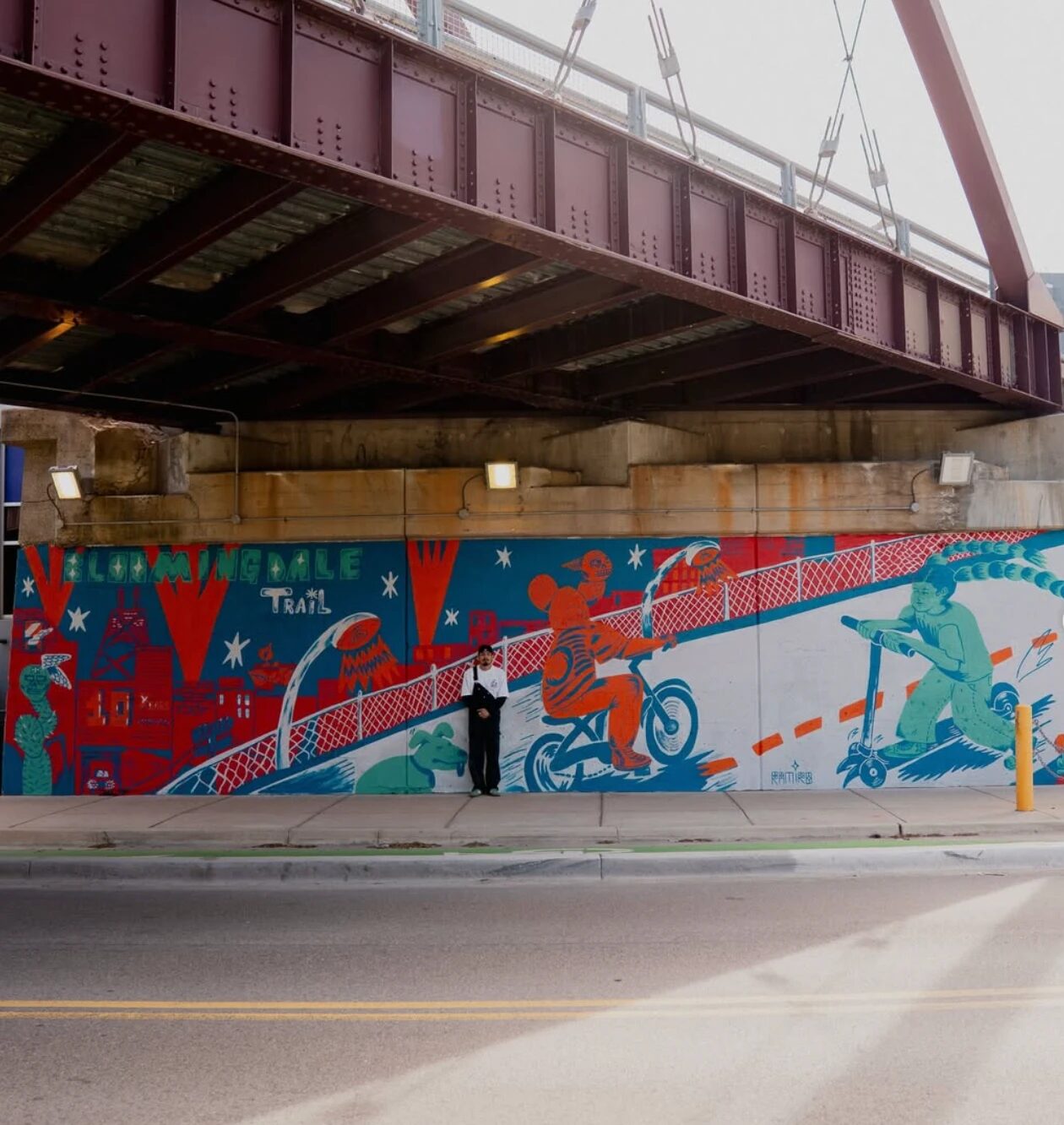
Ramiro Huizar painted Night Cruise at the Milwaukee Avenue entrance of the Bloomingdale Trail in Wicker Park, a wall that greets riders before the trail does. His designs start as illustrations, so you see them before a can is opened, and his flat, saturated color reads from far away. To learn more, read our feature on Ramiro Huizar.
Trail frontage rewards a mural designed for people who are moving past it.
6. Adaptive Reuse: Giving an Industrial-to-Loft Conversion a Face
Chicago is full of old factories, warehouses and industrial buildings turned into homes and offices. They have good bones. What they sometimes lack is a clear identity once the sign painters are gone.
A mural can honor the building’s past without pretending it is still a factory. It can nod to the trades, the neighborhood or the building’s own history, and still tell new residents and tenants that this is a place with a story.
Exposed brick, high walls and loading-dock details make strong backdrops. Talk with the artist about what to keep visible. Often the best move is to leave some of the building’s old character showing and let the paint sit alongside it.
An adaptive reuse project already has a past, and a mural can introduce its future.
7. Rooftop and Amenity-Deck Murals Chicago Tenants Will Photograph
Chicago residents love a good roof. Amenity decks, terraces and rooftop lounges are some of the best places in a building to spend an evening, and the walls around them are often blank.
Parapets, stair enclosures and deck walls can all carry art. A painted backdrop gives people a place to pose, a shot to share and a reason to point visitors upstairs. It also helps the space feel designed rather than leftover.
Work at height needs planning. Share the surface, how high it is and how crews will reach it. That lets the artist choose materials and safe working conditions before the mockup is approved.
A good amenity-deck mural gives residents a backdrop they want to share.
8. Lobbies and Interiors: Chicago Commercial Murals That Make a Tour Memorable
The lobby is where a prospective tenant decides how they feel about you. A painted wall there says the building has taste and that someone took care.
Interior walls also give you control. No winter, no sun, no wind. That opens the door to finer detail, softer color or a quieter style that would not survive outdoors the same way. Corridors, elevator banks, leasing offices and fitness rooms are all fair game.
Think about the tour. What do you want someone to remember when they walk out? A single strong wall near the entry often does more than several small touches spread around.
For more on how we work with interiors, see our page on commercial murals.
On a tour, one memorable wall can do the work of a long list of features.
9. Retail Strips and Mixed-Use: Giving People a Reason to Linger
A strip of storefronts can feel like a place to pass through or a place to stay. Often the difference is small and visual.
A mural on a blank end wall, a courtyard or a passage between shops invites people to slow down. It gives them something to look at while they wait for a friend, and something to photograph while they are there. Slower foot traffic is good for the shops around it.
Mixed-use projects can use the same idea to tie the residential and retail sides together. One shared piece of art says the two belong to the same place.
Think about where people already pause: crosswalks, patios, pickup spots. Put the art where they stand.
A mural gives a retail strip a reason to stay a few minutes longer.
10. Parking Structures: A Chicago Mural for the Largest Blank Wall You Own
Parking structures are often the biggest, plainest walls on a site. They are also the ones neighbors look at most, and like least.
A mural can turn that mass into a landmark. Large concrete faces suit big, simple shapes and strong color. Stairwells, ramps and ground-level entries can carry art too, which helps drivers find their way and feel better about the place.
Concrete is porous, so surface prep and coatings matter even more in a Chicago winter. Raise that at the start. A well-planned wall will keep looking intentional long after the opening photos.
If the structure faces a street, the stakes are higher and the payoff bigger. Everyone passing sees the result.
Your largest blank wall may be your best chance to be remembered.
11. Community Goodwill: Public Art as a Good-Neighbor Gesture, and Where Approvals Fit
A mural is a visible way to say you intend to be a good neighbor. People notice when a developer puts something generous on a wall everyone can see.
Goodwill comes from listening. Talk with the block before you finalize a design, and let local character guide the imagery. A mural chosen with the neighborhood in mind earns respect that a generic image cannot.
On approvals, start with owner sign-off. Some buildings, districts or leases carry extra review, so confirm requirements with your project team or the city early. We help you plan around them, though we are not a substitute for legal advice.
Public art lands best when the neighborhood is part of the conversation from the start.
12. Telling the Story: Press, Social Sharing and Leasing Materials
A finished mural is also a story you can tell. It gives your leasing team a new photo, your marketing team a reason to post and local writers a reason to call.
Plan for that from the start. Ask for progress photos while the artist works. A wall going up draws more attention than a wall that simply appears. Share the reveal on your property channels, in your tenant newsletter and in your leasing tour.
Credit the artist by name wherever you post. It is the right thing to do, and artists share the work, which carries your building further.
Treat the mural like any other launch: a date, a plan and a few good photos.
A mural is a built-in marketing event if you plan to tell the story.
How to Hire a Muralist in Chicago: Steps for Developers and Property Managers
- Know your wall and your goal. Gather a photo, rough dimensions and a sentence on what you want the art to do: lift a lobby, mark a trail entrance, welcome a neighborhood.
- Send us the details. Get a quote by telling us about the wall. We match it to a vetted Chicago muralist, and we confirm timing when you submit your request.
- Review one fixed, written, all-in quote. Check it against our size tiers to see how scale shapes the project.
- Approve a mockup before you commit. You see the design first, and you can request changes within the included rounds.
- Let the painting begin. We handle the contract and scheduling. Read how it works for the full path from request to finished wall.
If you are ready to hire a muralist in Chicago, the fastest first step is a photo of the wall. For other building types, see our overview of commercial murals.
Chicago Mural Questions Developers Ask (FAQ)
How do I hire a muralist in Chicago?
Tell us about the wall, with a photo or rough dimensions and the goal. We match it to a vetted Chicago muralist and handle the quote, contract and scheduling. You receive one fixed, written, all-in quote and approve a mockup before you commit.
Will a mural survive a Chicago winter?
A well-prepped wall with coatings chosen for the surface can handle freeze-thaw cycles, but outdoor murals still need upkeep. Brick and concrete are porous, so ask your artist about cleaning, sealing and a touch-up plan before anything is painted.
Can you paint a mural on old Chicago brick?
Yes. Brick is a common mural wall in the city. The artist checks the masonry, cleans and primes it, and can let the mortar lines become part of the image. Tell us about loose or crumbling areas so the plan fits the wall.
Do murals add value to a Chicago building?
A mural gives a property character that tenants, visitors and neighbors notice, and it supports your leasing and brand story. The dollar effect is hard to isolate and varies by project, so treat it as an amenity, not a promised return.
Do I need approval to paint a mural in Chicago?
For a wall you own or manage, start with owner sign-off. Some buildings, districts or leases have extra review. Confirm requirements with your project team or the city. We help you plan around them, and we are not a substitute for legal advice.
Can a mural work on a rooftop or amenity deck?
Yes. Rooftop walls, parapets and deck enclosures can all carry art. Share the surface, height and access when you ask, so the artist can plan materials and safe working conditions before the mockup is approved.
Ready to Commission a Mural in Chicago?
Send us a photo of the wall and tell us what you want it to do. We will match you with one of our Chicago mural artists and take it from there.