Artist feature · Chicago · 6 min read
Ramiro Huizar and the Mexican American mural tradition in Chicago
Born in Guadalajara and raised in Chicago, Ramiro Huizar paints on a street-level tradition that is much older than he is, and gives it faces, cars and cactus heads that belong to this city today.
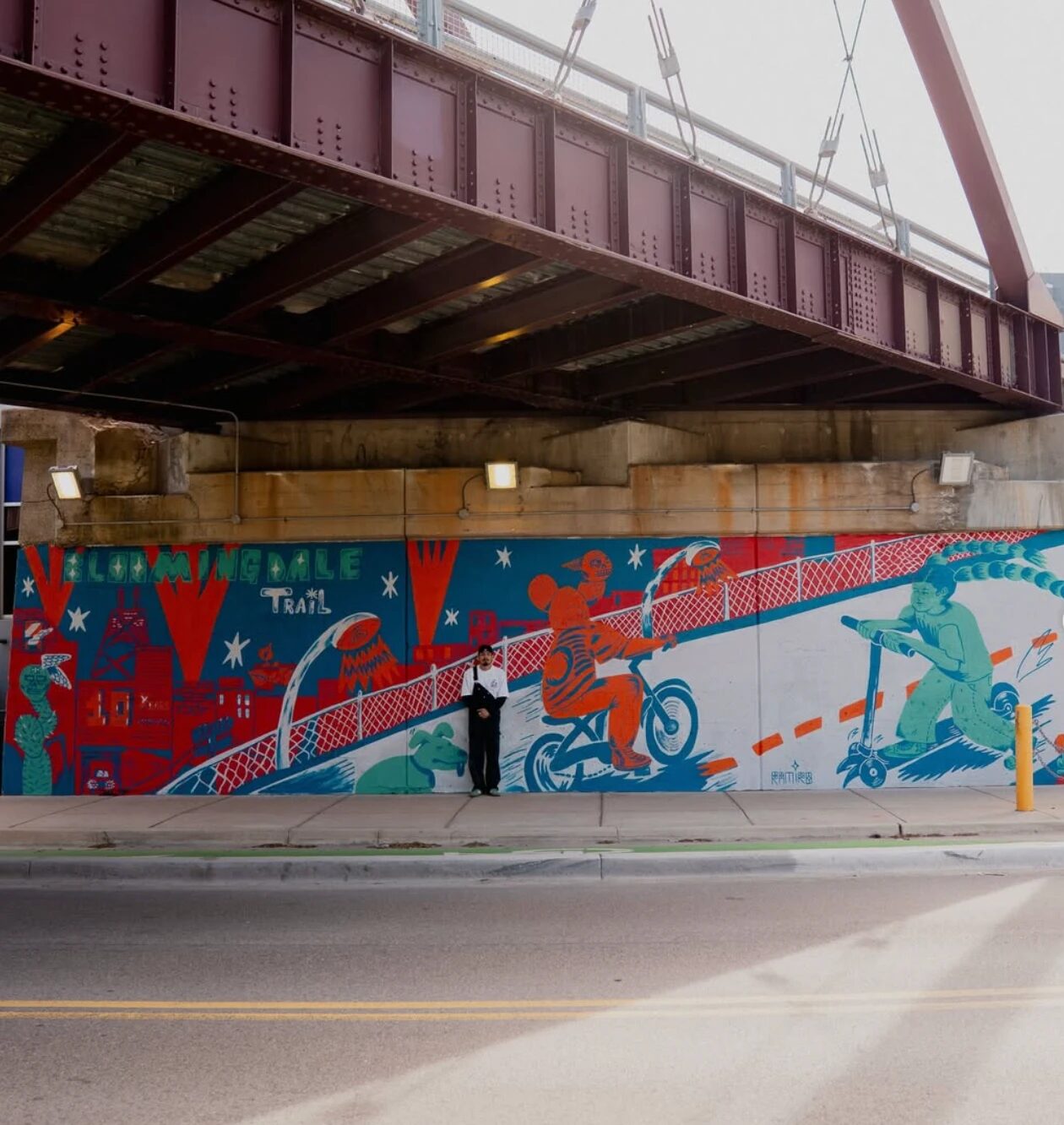
At night the Bloomingdale Trail, the elevated path Chicagoans call the 606, runs above the neighborhood with orange building lights on both sides. At the Milwaukee Avenue entrance in Wicker Park, a rider with a prickly pear cactus for a head pedals through a deep blue wall, and a girl on a scooter glides beside him. The mural is Night Cruise, by Ramiro Huizar. It is a picture of a ride many people in this city know: the trail after dark, the city glowing around you, the feeling that the place is yours.
It is also a piece of a longer story. Mexican and Mexican American artists have been putting big pictures on public walls for a century, and Chicago has been part of that story for a long time. Huizar adds a chapter that looks like now.
A tradition on the wall
Mexican muralism in the 1920s put history and working people on public buildings, so that art did not have to live behind a museum door. The Chicano mural movement, which grew out of the civil rights era of the late 1960s and 1970s, carried that idea into barrios, school walls and underpasses, mostly painted by neighbors for neighbors. Chicago has its own Mexican American and Latino mural history, and Pilsen is the neighborhood most often associated with it.
The point of that tradition is simple. A wall belongs to the street, and the street gets to say who it is. Huizar paints inside that idea, though in his own visual language.
Between Guadalajara and Chicago
Huizar was born in Guadalajara, Jalisco, and raised in Chicago. He has no wish to choose between the two, and his walls do not ask him to. A Mexico soccer jersey and a golden Virgin of Guadalupe share a frame. A Monte Carlo sits in soap suds under a mustached sun in sunglasses, and cactus pads wrap the whole scene. A barber chair opens out of a wide-eyed head, with a crown of yellow pads above it.
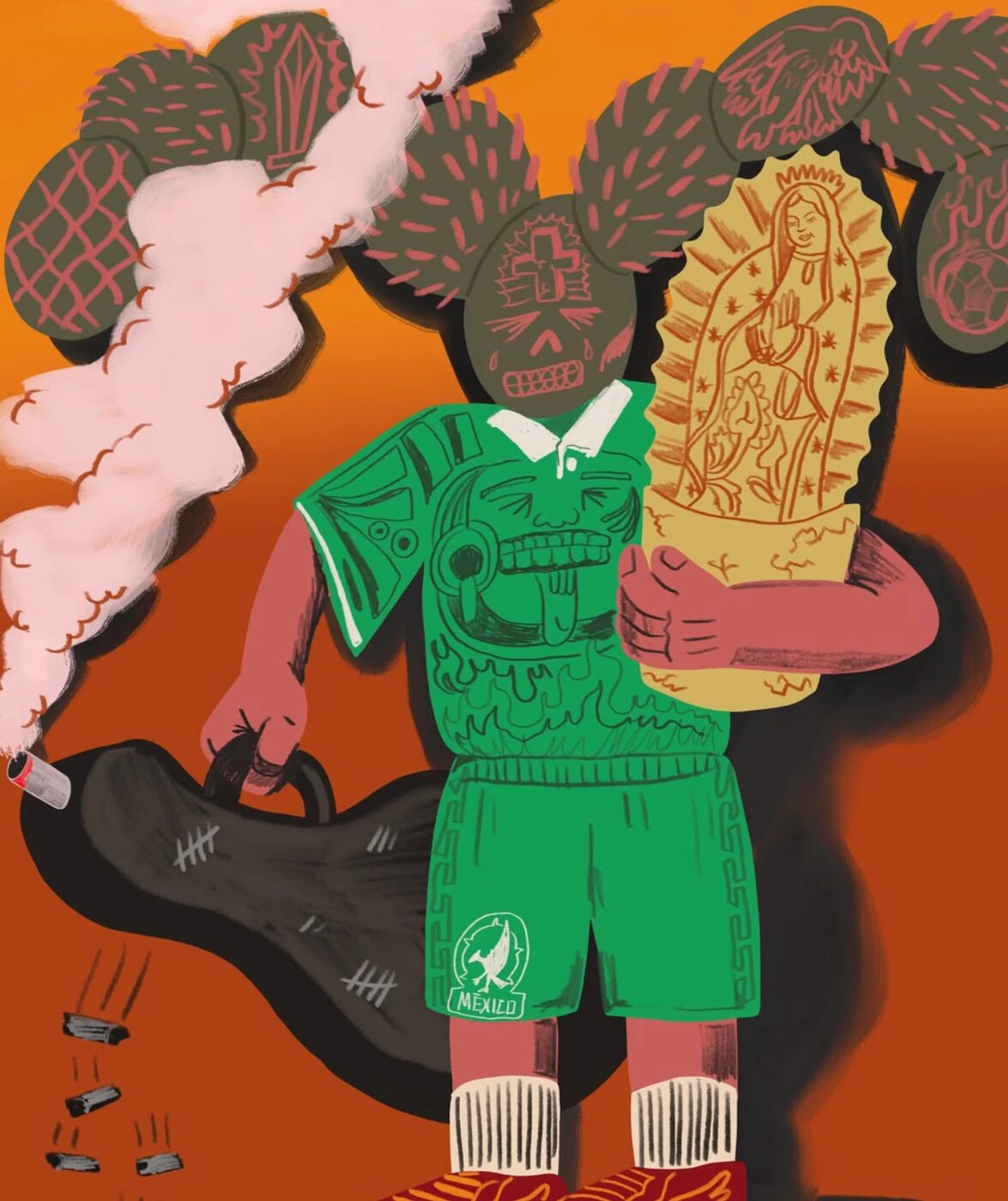
Anyone who has lived with two places in one family knows what that picture is saying. You carry the hyphen every day, in the food, the music, the car on Sunday, the corner shop. Huizar draws a person who lives the hyphen, and he draws that person bigger than life, proud and a little funny.
He hopes his work helps people take pride in their culture and heritage. On a wall in a neighborhood, that is practical as well as sentimental. A kid walking home sees someone who looks like family, crowned with a plant from the family kitchen, and understands that this belongs up in public.

The nopal, and a head that holds a room
The cactus is the center of it. The prickly pear, the nopal, appears on the Mexican flag: an eagle perched on a cactus with a serpent in its beak, drawn from the story of the founding of Tenochtitlan. It is a plant that feeds people and grows in hard ground, and for generations it has stood for the country.
Huizar makes the nopal into a head, and the head into a room. A figure sits on a spinning record inside an open skull. A man sweeps out the inside of his own mind. A painter works at an easel inside another person’s head. Each cactus pad carries a small image of its own, a heart, a cross, a clown face, the Virgin of Guadalupe. You can read the walls as portraits of the inner life, which is crowded and specific, and full of home.

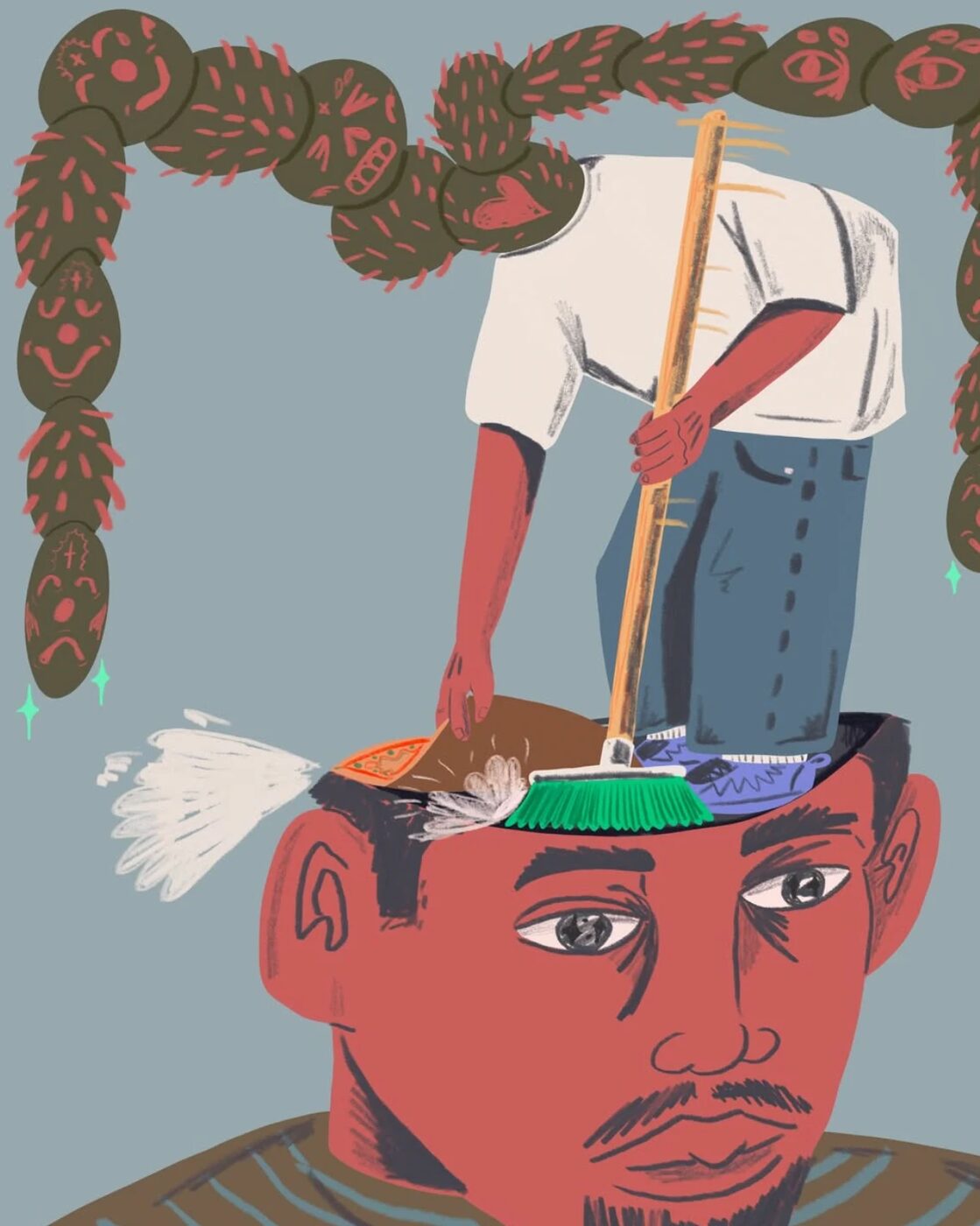
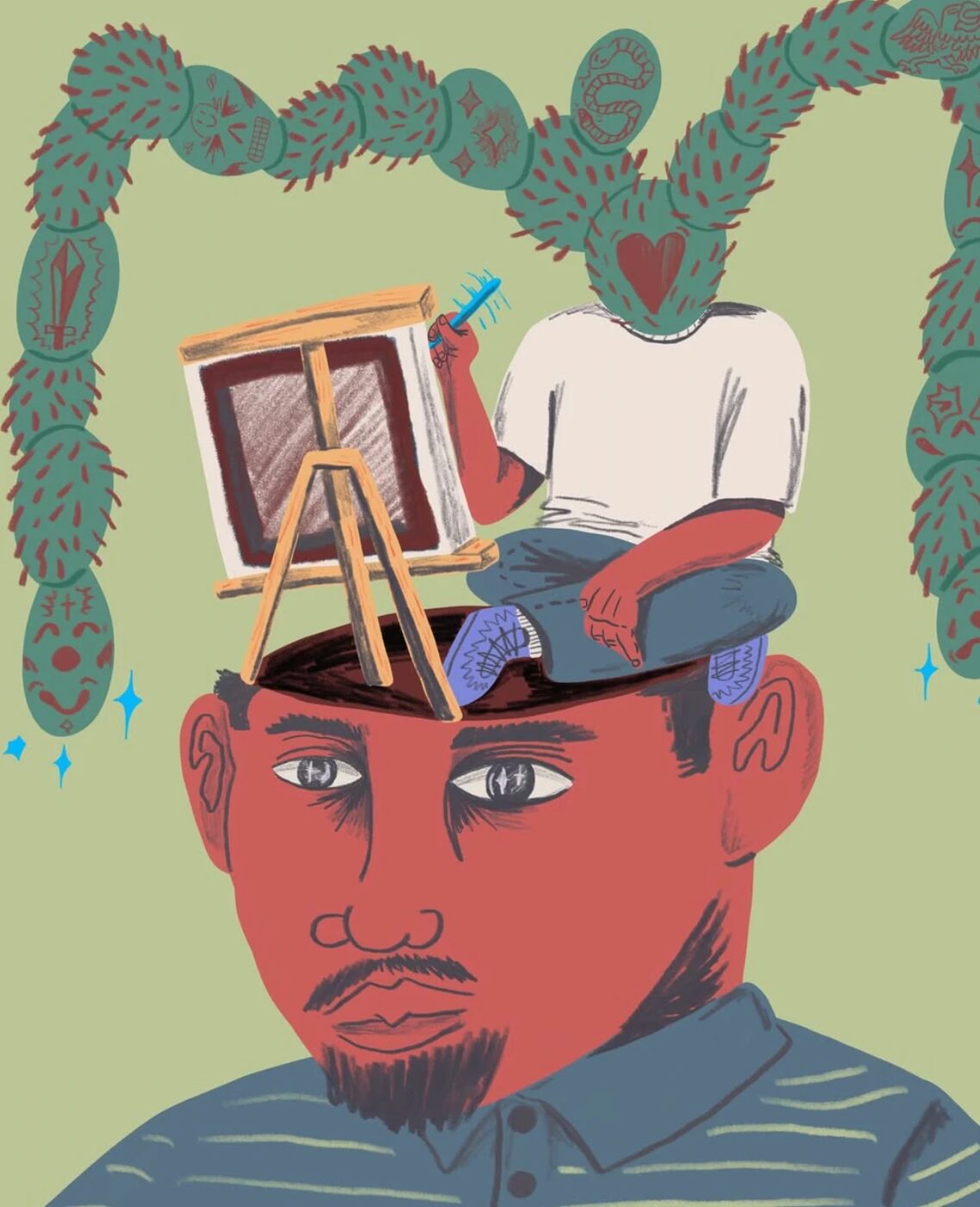
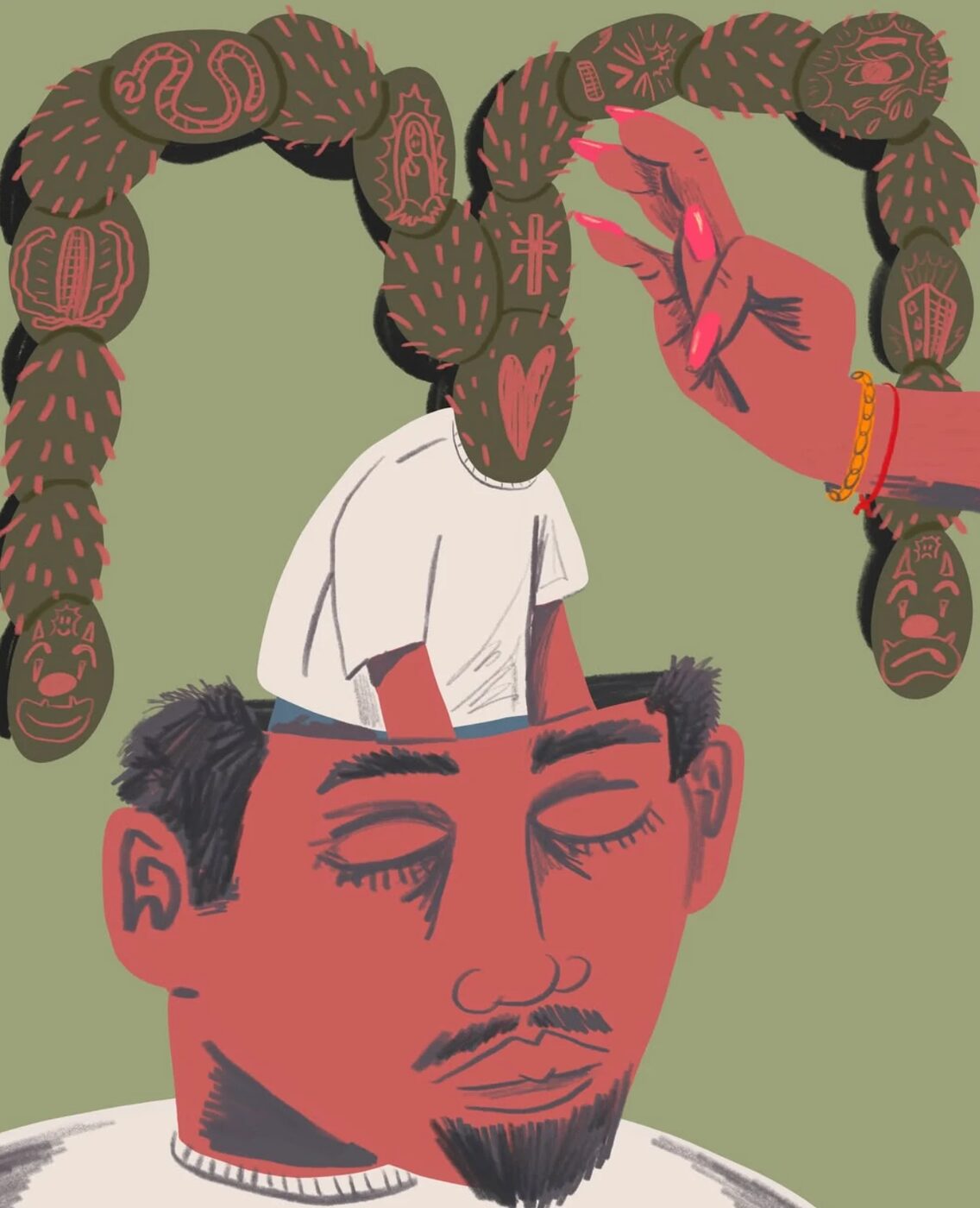
Most of his walls begin as designs on paper or on a screen, in flat, saturated color with clean outlines. That choice suits the tradition he works in. Bold shapes read from across a street and from a moving bike, which is how most people meet a mural in Chicago.
Why it matters in Chicago
Chicago is a city of neighborhoods, and its walls tend to say which one you are in. Pilsen has long been a center of Mexican American life and murals in the city. Humboldt Park is closely tied to Chicago’s Puerto Rican community, and has its own strong tradition of public art. Downtown, the Wabash Arts Corridor shows how much painted work a single stretch of buildings can hold.
Seen against that, Night Cruise has a particular job. It stands at an entrance to the 606, and it puts a cactus-headed rider and a Mexican American sense of humor and pride in front of everyone who passes. It does not argue with the neighborhood. It simply claims a place in it, in four bright colors. For more of the city’s painted history, read our Chicago murals story.
A word for young artists
Chicago has room for new voices on its walls, and the tradition has always depended on them. If you are young and drawing the people, foods, cars and symbols you grew up with, you are already doing what the muralists before you did. Start on paper, work out the design, then take it to a wall. Use your own neighborhood as your subject. It is a good subject, and nobody else has your view of it.
Painting a wall in Chicago
For restaurants, barbershops, corner shops, trail entrances and building sides, a wall tied to a place and a people tends to become part of how that place is described. If that is the kind of wall you have in mind, Ramiro’s work is a good place to start looking. You can see more of it on his artist page, find other Chicago mural artists, or read our first feature on his style.
Questions
Where can I see Ramiro Huizar’s work in Chicago?
Night Cruise is at the Milwaukee Avenue entrance to the Bloomingdale Trail (the 606) in Wicker Park. More of his walls and illustrations are on his artist page.
What does the cactus mean in his work?
The prickly pear, or nopal, is a symbol of Mexico and appears on its flag. Ramiro turns it into heads and crowns, with each pad holding a small image such as a heart, a cross or a clown face.
Can Ramiro paint a mural about a neighborhood, a family business or a story?
Yes. His walls start from people and places, and he works the design up as an illustration first, so you see it before a can is opened.
All artwork © Ramiro Huizar. Shown with the artist’s permission. Please ask before reusing it.
More: Chicago mural artists · Chicago murals story · Ramiro Huizar feature · All guides